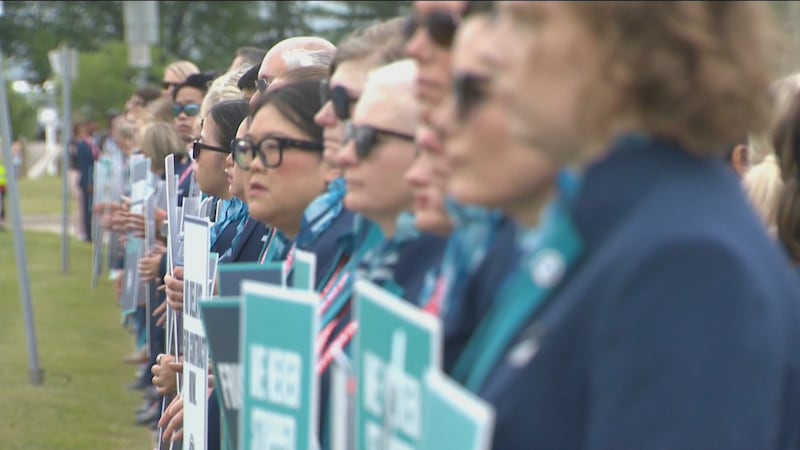
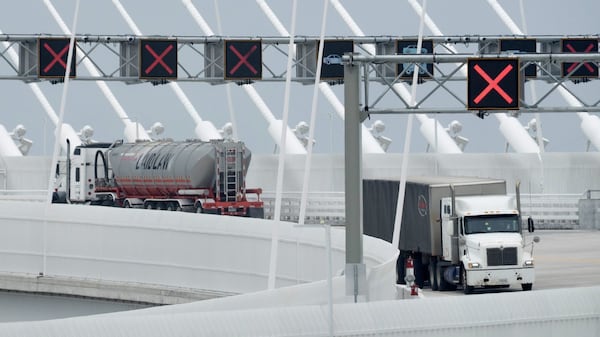
Hours before New Brunswick’s Finance Minister René Legacy tabled the 2026-27 provincial budget, hundreds of students gathered outside the legislature to protest possible cuts to post-secondary education. Camila Baquerizo, vice president of education for St. Thomas University, says the weeks leading up to the budget were stressful with talks one time centring on closing the campus entirely. “Our students felt the pressure to show that their programs were worth it, continuation of their school remaining open, so it was really scary,” she said as protestor chanted “no more cuts” behind her. “Now you can see how our students are here protesting for their future and for basically the best for post-secondary education.” At the end of the day, no major cuts came to the provinces four publicly funded universities. Instead, the province has frozen the institutions’ operating grants for the year ahead, effectively kicking the cut conversation down the line. “It’s great to beat back the threat of closures,” says St. Thomas vice president for the faculty association Dennis Desroches. “But a zero per cent increase in funding for universities is a cut against inflation. Not funding education properly is always a cut in our eyes.” The sentiment of no major increase to combat inflation is also a sticking point for Université de Moncton Student Union president Emma Raphaelle. “What we were told is three per cent today or zero per cent today for 10 per cent tomorrow,” she says. “They want to have those discussions, they want to talk to us about how to cut the budget, and so we just want to make sure we get a seat at the table.” There are a number of reductions: a promise to cut a portion of the civil service by about 1,400 positions, saving up to $100 million over three years, moving away from offering provincial veterinary services and either closing six parks and museums or transitioning them to a community partner. Those museums include the Sheriff Andrews House in Saint Andrews, Bonar Law Common in Rexton, Doak House in Doaktown, MacDonald Farm in Lower Newcastle, Antique Automobile Museum in Edmundston and North Lake Provincial Park near the Canada-United States border. Other parks “will remain open while transition discussions take place,” including Val-Comeau, Anchorage, Oak Bay and Cape Enrage. New Brunswick Historical Society president Greg Marquis jokes historical sites are used to “being last” in public spending. “We already have 80 or 90 small museums and heritage places around the province that are, I think, running on a voluntary basis,” Marquis says. “It could dilute the pool of funding, if you will, by creating even more community-based museums with a finite pool of finite resources that we’re all sort of competing for.” One sector that will see positives from the budget is New Brunswick’s medical field. $4.8 billion is being spent on the sector, an increase of over $700 million from the previous year. New Brunswick Medical Society president Dr. Lise Babin says the investment will have generational impacts. “We’ve been underfunded for many years now, and we had a lot to do to catch up to the rest of Canada,” says Babin. “I think this budget is going to go a long way towards getting us up to par.” She says the health budget increase will put New Brunswick on the list for where new physicians look to start their career, which wasn’t the case before. Toll changes The province also announced it will add a highway toll for out-of-province vehicles at Aulac, estimating it will bring in more than $10 million in revenue a year. The toll is expected to be ready by 2028. Legacy was asked why Aulac was picked and not border crossings with Quebec. “It was picked based on volume. We have to make some capital investments so we need a return. The capital investments we will make at Aulac will allow us to produce about $10.4 million in revenue, in net revenue, every year,” said Legacy. Legacy said other locations didn’t have the volume. “If we look at Saint-Jacques or Edmundston areas, that is a federal/provincial agreement that we have that we’re not supposed to put tolls so we would have to negotiate with the federal government if we were going to change that,” said Legacy. Legacy said it’s not possible to set up the tolls before 2028. “It’s just capital expenditures. We need to build the tolls. I wish we could just drive a truck and slap it beside the highway, but it’s going to take a little more time than that and just find the right location and make sure all the signage is ready and everything that goes with it,” said Legacy. Atlantic Provinces Trucking Association president Chris McKee said the toll is counterproductive to the shared federal and provincial objective of reducing internal trade barriers in Canada. “Applying tolls selectively to non-New Brunswick vehicles will create an unlevel playing field for commercial operators. This will penalize businesses from outside the province that move goods into and throughout New Brunswick as part of our national supply chain,” said McKee. McKee said from a trucking and supply chain perspective, the new toll will have negative consequences. “First and foremost, increased cost for consumers. Any additional toll costs that are imposed on our carrier members and the trucking industry are ultimately going to be passed on through freight rates and that will contribute directly to higher prices at the grocery store and the hardware store,” said McKee. “About 90 per cent of everything we touch in Atlantic Canada is moved by trucks.” With files from CTV’s Laura Brown For more New Brunswick news, visit our dedicated provincial page.