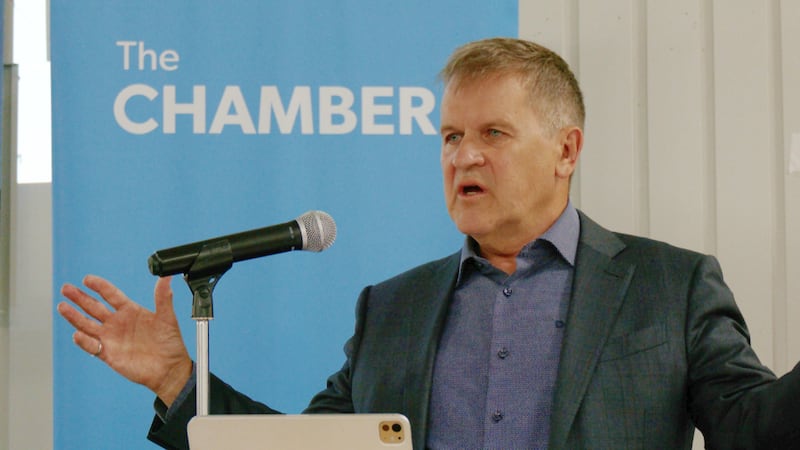
The Manitoba government is taking a closer look at whether freight rail traffic can be shifted away from Winnipeg’s urban core to a route south of the city. Premier Wab Kinew announced Wednesday that Lloyd Axworthy will chair a 90-day feasibility study and proof-of-concept consultation, examining a potential southern rail bypass. The consultation would explore a potential route along Manitoba Hydro’s southern transmission corridor, connecting east to west along the Perimeter Highway. The government says the corridor sits on Crown land that is already cleared and serviced. Axworthy, a former federal cabinet minister, was appointed by the province in October 2024 to lead the Winnipeg Rail Relocation and Renewal Study, part of a broader two-year review of rail systems in and around the city. Kinew called the possibility of moving freight out of the urban core a “historic opportunity... to help secure Winnipeg’s place as a global trading hub” in a news release. During a Wednesday news conference, he said the relocation would take at least 20 years to implement, calling it an investment in the province’s future. The government says the new consultation will look at whether moving more freight traffic out of the urban core could improve the movement of goods, reduce effects on residential neighbourhoods, and open opportunities for housing, green space, transportation and economic development. The province says three key questions will guide the review — how rail operations could be accommodated while protecting Manitoba Hydro infrastructure, what the potential costs of relocation would be, and whether the route is operationally and commercially practical for railways. “This is an opportunity to think ahead about the kind of city we want Winnipeg to become,” Axworthy said in a news release. “We have a chance to plan for growth in a way that brings communities together, protects the land around us and leaves future generations a stronger, more connected city.” The study will work with Canadian National (CN), Canadian Pacific Kansas City (CPKC) and Burlington Northern Santa Fe (BNSF), the province says, with each railway providing a senior technical liaison as the study progresses. ‘Enormously complex matter’: CPKC In a statement, CPKC spokesperson Terry Cunha said the company has told Axworthy and senior Manitoba government officials that evaluating the feasibility of relocating railway infrastructure is “an enormously complex matter.” “The challenges inherent with any proposal to relocate railway infrastructure are vast, complex, and should not be underestimated,” the statement said. “In our experience across North America, these challenges are too often underestimated and eventually they prove insurmountable.” Cunha said such proposals “would invariably require significant public dollars to rebuild infrastructure that already exists,” adding that in other rail relocation cases—including in Winnipeg’s past—the debate has often resurfaced decades later as cities grow. “Given the magnitude of the challenges and costs with any such proposal, we have generally cautioned governments against rail relocation,” the statement said. CPKC said it is prepared to continue engaging with the study, but added that the challenges associated with any relocation proposal should be fully evaluated. Spokespeople for CN and BNSF said they will continue to engage as the study proceeds, with CN noting the bypass concept would be a “sizeable undertaking” requiring a strong business case. As part of the long-term planning, the province said the study will also examine the potential for a greenbelt along the Perimeter Highway, alongside the proposed rail and Hydro corridor. The government says the concept could protect infrastructure from future development while preserving agricultural land and green space, and creating opportunities for trails, recreation and Indigenous stewardship. Municipal and Indigenous governments, CentrePort Canada, the business community, rail customers and shippers are also expected to provide input, the province said. Kinew said the bypass could also strengthen Manitoba’s north-south and east-west trade links, improving connections between Winnipeg, CentrePort Canada, the Port of Churchill and North American markets. Winnipeg has more than 240 kilometres of active rail lines, with an average of 50 trains passing through the city daily, according to the province’s website. It adds major yards and corridors intersect residential, industrial and commercial areas, making Winnipeg “one of the most rail-dense urban centres in Canada.” With files from CTV’s Joseph Bernacki