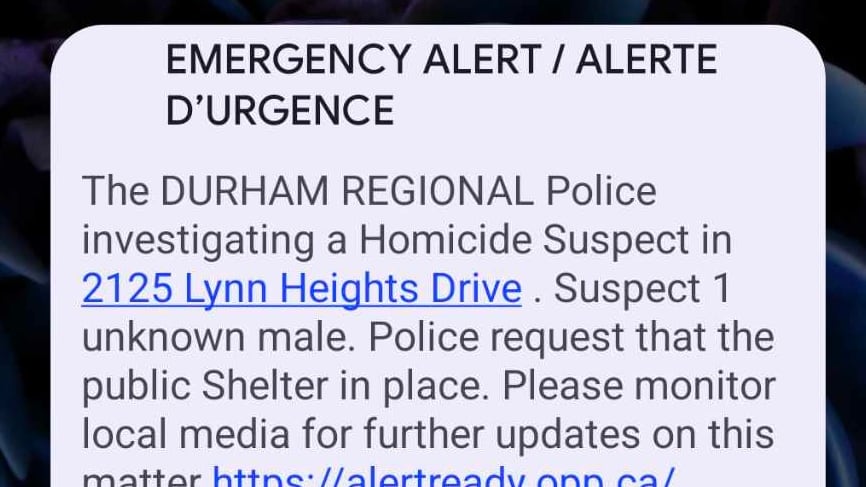
Police lit up cell phones and TV screens with an emergency alert Thursday evening following a deadly stabbing in Pickering, Ont. But why did the notification to shelter in place reach as far as downtown Toronto? The alert issued by Ontario Provincial Police (OPP) on behalf of the Durham Regional Police Service (DRPS) went out at 5:39 p.m. More than two-and-a-half hours earlier, an incident outside of a residence near Lynn Heights Drive and Fairport Road left a senior dead. Investigators say they are still in the early stages of probing the incident but have concluded that, “after a brief interaction,” a 14-year-old suspect stabbed a female victim multiple times in a “sadistic and cowardly, unprovoked attack.” The suspect has been arrested but cannot be identified under the terms of the Youth Criminal Justice Act. He’s now facing a charge of first-degree murder. DRPS said he was arrested at 8:30 p.m. after an “extensive search” involving a police helicopter, K-9s, drones and tactical support. The victim has not been identified by police. Police previously told reporters that the victim was outside her home at the time of the stabbing when she was approached by a male they believe she did not know. The emergency notification was issued through Alert Ready, Canada’s national public alert system, by way of Ontario Provincial Police. The public was advised to “shelter in place” and the suspect was described as an “unknown male.” Some people online say they received the alert in downtown Toronto. Others in York and Peel regions say they also got the message. “Do they honestly think sheltering in place in all of Toronto and York is reasonable?” one Reddit user wrote. In a statement to CTV News Toronto, DRPS said the decision to have residents shelter in place was made as the suspect was at-large and armed. They said that the process for issuing the alert must see police submit a request in writing to the OPP before provincial police make final approval. “The DRPS provided a suggested area to shelter in place in our alert request to the OPP. The area the alert extends to, is at the discretion of the OPP. My understanding is the reach for the alert went further than the requested area as the armed suspect was mobile and there was an imminent threat to public safety,” a spokesperson said in an email. DRPS added it has not received any complaints about the alert. Emergency alert was sent more than 2 hours after stabbing. Why? Police were asked Friday why the emergency alert wasn’t issued sooner, given that the stabbing took place shortly after 3 p.m. “We have to make sure that the information we have is accurate, we have to make sure it’s reliable information and we have to make sure that the alert is warranted, and all of that takes a period of time to be able to piece together what happened,” Sgt. Joanne McCabe told reporters in an update. “As you can imagine, when this initially happened, we had very little information to go on. So, we take emergency alerts very seriously. We understand the impact that they have on our community. We understand the fear that they may cause. So, we don’t release them lightly.” CTV News Public Safety Analyst and former OPP commissioner Chris Lewis spoke to CP24 on Friday and said Durham police will now likely evaluate the timing of the alert’s distribution. “What did they know and when, what was confirmed and when, how did the release go out, when did the OPP hit the button to put it out. So, all those time factors will be evaluated and if they could’ve done it better, they will next time. In the meantime, it’s important to know that no one else was hurt,” he said. Lewis explained that there has been a lot of “controversy” following the decision by RCMP not to issue an emergency alert in April of 2020 when a gunman impersonating an RCMP officer killed 22 people in Nova Scotia during a 13-hour Ramage. Since then, he said police agencies have had that incident, and the decision to issue a tweet and not an emergency alert, “front of mind.” “In fact, (in that incident) he was on the loose and the public alert didn’t go out. That became highly criticized during the subsequent inquiry into that,” Lewis said. A senior Nova Scotia RCMP official has since defended the decision not to issue an alert during the mass shooting, stating that doing so could have led to more casualties. “When someone’s on the move in a community, and police know it, with a knife, they’ve already killed someone, there is an obligation to at least notify the public as best they can. And in this case, they did that. There will be some questions about if they could’ve done it sooner. But certainly, they’re not going to put an alert out unless they have the information of who they’re looking for.” Speaking to the scope of the alert, a spokesperson for the Ministry of the Solicitor General, which oversees public safety, security and emergency measures in Ontario, said the OPP, in coordination with local police services “determines the radius of the alert, based on threat potential.” “Further questions on public safety emergency alerts should be directed to the OPP,” they said in a statement. In a statement to CTV News Toronto, the OPP said that emergency alerts may be geographically targeted and with the requesting police service, “the OPP will determine the radius of the alert, based on system capability and potential of threat.”