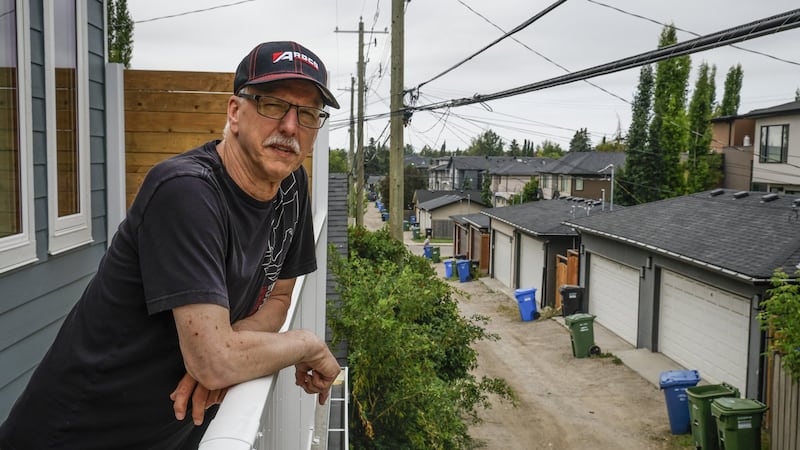
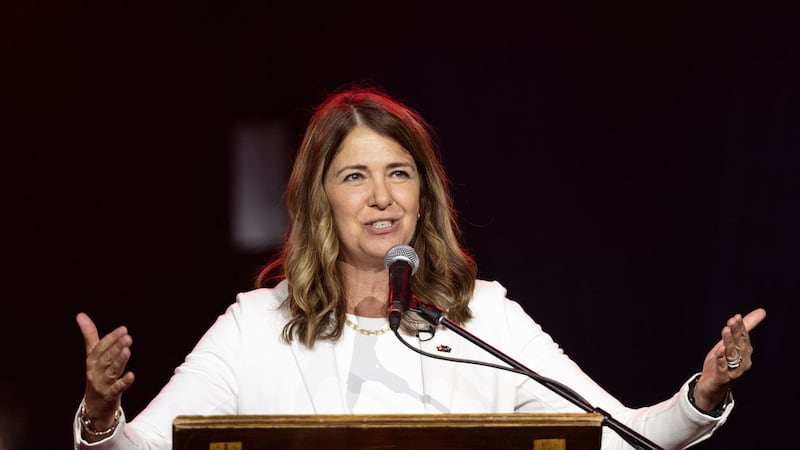
The province says it intends to announce new school construction updates for Edmonton in next month’s budget, and for many parents, that can’t come soon enough. Caitlyn Canniff, for example, says she spends more than an hour each morning carting her eight children to and from elementary and junior high schools due to lack of available options in her southwest Edmonton community of Ramsay Heights. Her closest option for two of her children, Riverbend Junior High School, is “super full.” She ended up choosing a local Catholic school for one of her children, but with another one interested in schools with dedicated sports programs, she’s looking at a smaller selection that could be up to 30 minutes out of the way. “It’s just not possible. We’ve looked into the city bus … we don’t feel comfortable putting our 11-year-old on the bus. So she’s considering homeschooling for next year.” And while she acknowledges her situation is somewhat special, she suspects she’s not alone in making tough calls with her children’s education. “Schools are at such a high capacity, and then it doesn’t allow for that easy movement for people, if they need to switch to not their local school. In our case, the local schools are all lottery now,” she added. The Edmonton Public School Board (EPSB) said its division has grown by more than 40,000 students over the last 15 years. Many schools across the city are considering implementing an enrolment lottery for families moving to new neighbourhoods who put pressure on classroom capacity. “The number one issue I’ve been talking about is lack of school space in Edmonton, and particularly southern Edmonton,” said Alberta NDP MLA for Edmonton-Riverbend Rakhi Pancholi. “We have kids coming from far south of Anthony Henday, travelling into my constituency to attend school, because they don’t have schools in this riding.” School board and provincially proposed solutions The EPSB uses the lottery, and its Growth Control Model, as one tool to track and prepare for rapid population growth, but it’s also looking to the province with proposals for new school construction. Currently, the board has 16 construction priorities for schools in newly developing neighbourhoods across the city, listed in a three-year capital plan. Those include several kindergarten to Grade 9 and kindergarten to Grade 6 schools. “As of right now, there are 34 school projects currently underway in Edmonton and area,” Garrett Koehler, the press secretary to the minister of education and childcare, told CTV News Edmonton. “Even more school projects will be announced for Edmonton and area in the upcoming budget on top of the school projects already underway.” Those projects include public, Catholic and public charter systems. Meanwhile, Pancholi says the Opposition government has been calling out what they perceive to be government inaction on concrete deadlines. “I will believe it when I see it from the minister, when he says he’s promising new schools … they’ve laid out some money for planning and design, but not for construction,” she said. Koehler said putting completion dates on new school projects was “impossible,” but that more would be announced “in the near future.” According to the EPSB director of infrastructure, it takes three to five years on average to build a school. The EPSB says it’s also modifying common spaces where it can in schools or requesting, adding and relocating modular classrooms, or portables, to bolster capacity. The division currently has 529 portables across the city, mostly in southwest Edmonton. It’s set to receive another 17 new modular classrooms before the 2026-27 school year. With files from CTV News Edmonton’s Connor Hogg