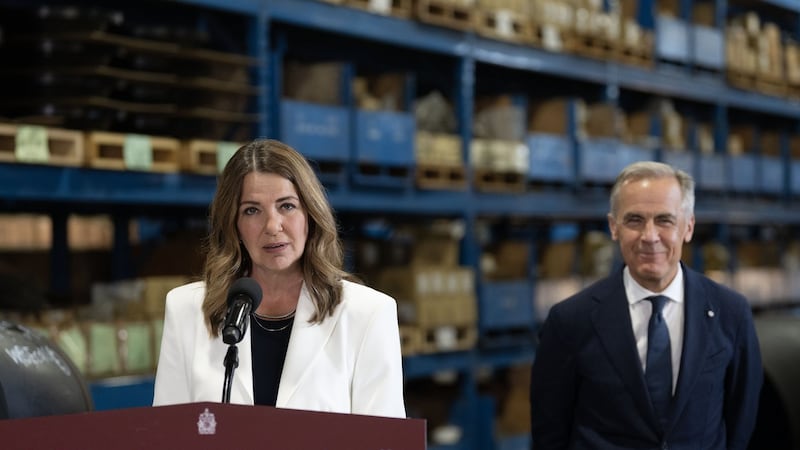
As the federal and Alberta governments commit to a pre-existing southern pipeline route to the British Columbia coastline, Premier Danielle Smith is pushing back against the idea her caucus has settled for a less advantageous route. Earlier Thursday, B.C. Premier David Eby and Prime Minister Mark Carney announced a new agreement that allowed for the optimization of oil transportation along the West Coast. Ottawa maintained, however, its ban on oil tankers along the northwest coast of B.C., a route which Conservative Party Leader Pierre Poilievre has said would “diversify” Canada’s economic portfolio more than a southern pipeline. Because of this, a new interprovincial pipeline will instead transport oil from Bruderheim, Alta., to the southwest coast, following an existing Trans Mountain pipeline corridor to a deep-water port terminal. The oil will then be shipped to Asia. Carney said that route makes the most sense given the line already exists and serves as the “gateway to the world’s fastest growing markets.” Smith says the location comes from consideration of multiple key points: First Nations consultation, environmental concerns and economic viability. The province and federal government both looked at the possibility of a northwest pipeline corridor before the announcement, she added. “In fact, the southern route had key advantages of using an existing pipeline, existing established relationships with Indigenous partners and potential partners along that line, as well as the ability to reduce the amount of time to get it to the market,” she told reporters in Calgary. “As we looked at this one and realized that they’re fairly comparable when it comes to the amount of dollars that would have to be outlaid, but likely we’d be able to build this one a couple or more years faster, that factored into the decision-making.” Just hours before the announcement, and without seeing the final proposal, Poilievre said building the pipeline to a northern B.C. coast corridor was “simple geometry” in that it would deliver product to Asian markets faster due to the “curvature of the earth.” The proposed pipeline project is a joint venture with the federally owned Trans Mountain Corporation and Calgary-based Pembina Pipeline. The Alberta government is also finalizing an agreement with Ottawa and the Oil Sands Alliance to expand oil sands production through the Pathways Project. “We’ve certainly come a long way from talk of phasing out Alberta’s oil and gas, haven’t we?” Smith said. With files from CTV News Calgary’s Cassidy McMackon and The Canadian Press