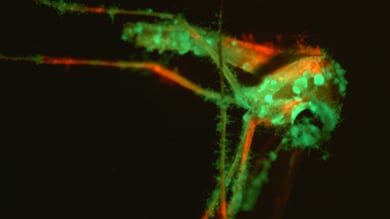
A fungus that pretends to be a flower could help humans outsmart one of the deadliest insects on Earth: the mosquito. New research published in Nature Microbiology shows that scientists have engineered a fungus that smells irresistible to mosquitoes, luring them in before killing them. The secret weapon? A sweet, plant-like scent called longifolene. “Mosquitoes kill (by) the diseases they spread, killing about 600,000 people a year, mostly children in sub-Saharan Africa,” said Raymond St. Leger, co-author and a distinguished university professor of entomology at the University of Maryland, in an interview with CTVNews.ca. “Insecticides no longer work, so what can we use as an alternative? We found this fungus, which is specific to mosquitoes.” Traditional chemical insecticides have been the main tool for mosquito control, but many mosquito populations have developed resistance. Researchers are now turning Metarhizium fungi, a naturally occurring mosquito pathogen, into a mosquito magnet. “We found out that some fungi mimic flowers,” said St. Leger. “They produce more odours to bring insects to them so that they can infect the insects … so, we engineered our specific mosquito pathogen to produce those same floral odours.” Mosquitoes are attracted to flowers because they provide nectar that the insects need for food. “(Mosquitoes) don’t just eat blood all the time,” explained Michael Bidochka, professor of microbiology at Brock University, in an interview with CTVNews.ca. “Only the females take a blood meal when they need to lay eggs. In the meantime, what they will do … is they will actually eat nectar from flowers.” That natural behaviour is what inspired the scientists’ approach. “What this lab has done is they’ve taken Metarhizium, which is a natural insect pathogen … and have put the gene that codes for that particular compound that makes longifolene into the fungus,” Bidochka said. “So it’s … Metarhizium, genetically modified to produce longifolene.” What’s unique about the approach by St. Leger’s team is that, instead of sending the fungus to the mosquito, they bring the mosquito to the fungus. “We can put that fungus in a little trap: a mosquito trap,” St. Leger said. “That fungus produces the floral odours, and it brings the mosquitoes in. The idea came from a natural clue. Dead insects infected by Metarhizium were found to give off longifolene, the same scent used by some plants to attract pollinators. Healthy mosquitoes were drawn to the smell, so the researchers decided to amplify it. St. Leger noted that the engineered fungus is simple to grow and easy to deploy. “We can grow the fungus up cheaply on rice or any derelict bits of plant,” said St. Leger. “So this is not high tech … the general public will be able to do this.” Still, St. Leger says this isn’t about wiping mosquitoes off the map, but more about local control. “We’re talking about the fungus in a trap, so it’s only going to have local impact,” said St. Leger. “Only the mosquitoes in a house or maybe in a village are going to be impacted by it.” Field trials are next on the agenda. “Real mosquito environments are more complex,” the authors wrote. “Field trials will be necessary to comprehensively assess its mosquito control efficacy and inform further research.” St. Leger says the work is already inspiring innovation in places hardest hit by mosquito-borne disease. “We’re encouraging individual entrepreneurs in West Africa who are developing and looking at these fungi,” he said. “(They’re) developing appropriate ways of growing the fungus up and distributing it.”