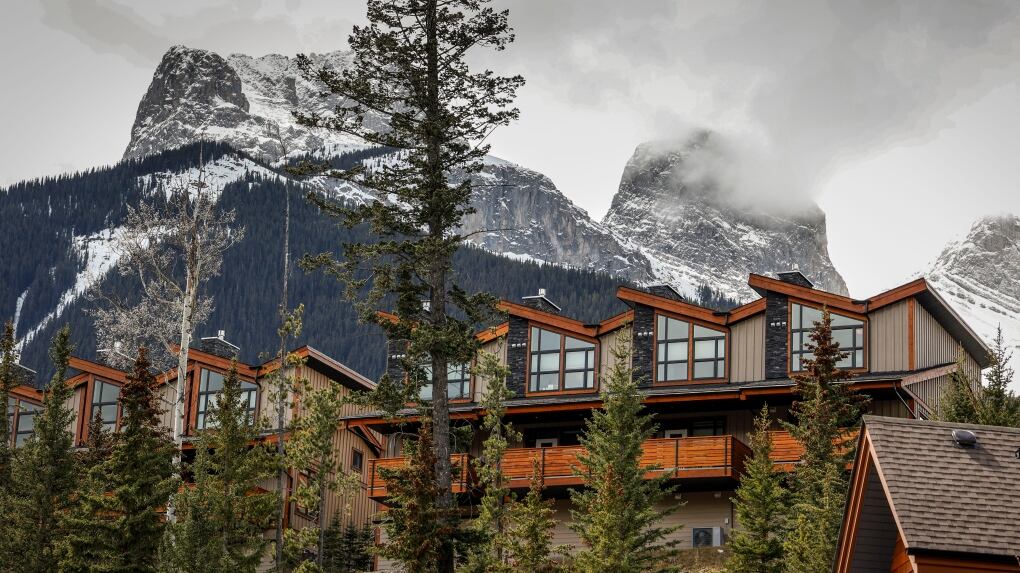
A Canmore resort development, originally approved more than 30 years ago, has won a few more legal battles against its opponents. The Alberta Court of Appeal was faced with four separate appeals over the construction of the Three Sisters Mountain Village, a project that aims to double the population of the town of Canmore. The actions involved applications from the Bow Valley Engage Society and the Stoney Nakoda First Nation, as well as separate applications from the developer itself. According to the court’s decision released Wednesday, Three Sisters said neither one of its opponents held legal standing to call for judicial reviews of the process or common law private interest standing. The court heard that the questions on legal standing came from the two parties’ objections over an environmental assessment, which both Bow Valley and Stoney Nakoda asked the province for. “Three Sisters submits that Bow Valley and Stoney Nakoda do not have ‘standing as of right’, simply because the designated director accepted their letters requesting an environmental impact assessment and responded to them,” the court said. “It says Bow Valley and Stoney Nakoda had no authority to make the requests of the designated director under ss 41 to 44 of the (Environmental Protection and Enhancement) Act and therefore cannot have standing to seek judicial review of that decision.” The appeal court agreed with that argument, saying there is no right under the Act to initiate a request for an environmental impact assessment. “Interested parties cannot through their conduct generate statutory rights under the Act that do not otherwise exist in the Act.” Three Sisters also fought back against a decision that found Bow Valley and Stoney Nakoda held private interests in the property in dispute. “Three Sisters says neither Bow Valley nor Stoney Nakoda own or lease property within the relevant area structure plans, have no development rights for land located in the area, and have no business, professional or employment interests in the decision of the designated director,” the court said. In their defence, Bow Valley claimed it held common law private interests because of its mission statement to “ensure development in the Bow Valley is done in a responsible manner.” Stoney Nakoda, meanwhile, says its common law private interest is since the project lies within its traditional territory. “They say they continue to seek judicial declarations of their asserted Aboriginal rights, including Aboriginal title, over their traditional lands,” the court said. “They say they have a treaty right to hunt, fish, and carry on their traditional way of life on the lands in question, in Canmore and the Bow Valley.” The panel dismissed the Three Sisters’ appeal in the case, saying both parties “have a long history in advocating for and protecting the environment of the Town of Canmore and Bow Valley area.” “They have opposed this project for more than 30 years, either themselves or through predecessor entities or persons,” the appeal court said. “The first chambers judge correctly concluded both Bow Valley and Stoney have a direct and personal interest in this matter and will suffer a disadvantage if they are not entitled to proceed in the judicial review applications.” The other appeals were based on disagreements over whether the designated director of the Act had jurisdiction to order an environmental impact assessment. “An environmental impact assessment is intended to be a tool to provide information to the regulators and the public,” the court said. “While it may inform the responsible regulator’s ultimate decision about whether to approve the project, the outcome of an environmental impact assessment itself does not approve or deny authorization for a project.” Both Bow Valley and Stoney Nakoda contended that the designated director had jurisdiction because each stage of development was a “proposed activity” under the Act. Three Sisters said the area it has been working in for the past 20 years were all included in the original 1992 Conservation Board approval, which was for all 2,035 acres of land to be developed as “a tourism or recreational project.” “Nothing new is starting at this time; the proposed development falls wholly within the activities approved of in 1992,” the court said. “Three Sisters and Stoney Nakoda submit that after 30 years, it would be reasonable to direct a new environmental assessment, particularly considering the advance of environmental science in the meantime. Unfortunately, reasonableness or wisdom of a new assessment is not the test. “An environmental assessment was done at the commencement of the project, a long-term project intended to be completed in phases over 20 years or more. The developers have properly relied upon these early approvals and do not appear to have strayed outside their terms and conditions.” The appeal court agreed that the designated director had no jurisdiction to refer the area structure plans to a new environmental impact assessment. “We note there will be many future opportunities for Bow Valley and Stoney Nakoda to participate in the subdivision, development permit, development approval, and construction phases of the project.”