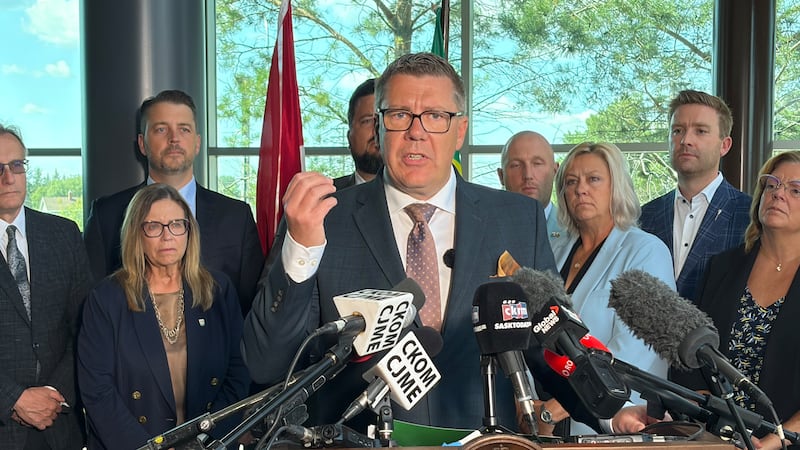
OTTAWA — U.S. President Donald Trump said Tuesday he is directing the federal agency that oversees government procurement to remove all Canadian-origin products from its “awards schedules” in his first comment since Canada’s retaliatory tariffs kicked in just after midnight. In a post on social media, Trump said “the Canadian Government, including Canadian Provinces, have banned American Small Businesses and Companies from selling into their Government Procurement Markets.” “That is not reciprocity, it is a Canadian Trade Scam,” Trump posted. “From now on, NO RECIPROCITY — NO ACCESS!” It was not immediately clear what would be affected by Trump’s latest threats, despite the president claiming “those schedules account for more than 50 BILLION DOLLARS a year.” The General Services Administration says its award schedules are long-term government-wide contracts that negotiate set prices for goods and services with specific suppliers. When a federal department or agency, along with state and local governments, need something, they can opt to choose from the pre-approved list at those set prices, and avoid a new procurement process. Ottawa’s new tariffs — ranging from 15 to 50 per cent on dozens of American products — are a response to the 50 per cent duties Washington hit Canada with last month. Both countries are targeting $27.8 billion worth of the other country’s exports. These latest tariffs come after the two could not reach a deal to solve outstanding trade irritants in August. Canadian premiers and opposition parties stood largely aligned with Ottawa’s decision, though some urged the parties to get back to the table. Conservative Leader Pierre Poilievre repeated his call for more transparency from Carney on Tuesday, posting on social media that the prime minister should release the full cost of the retaliatory tariffs. Saskatchewan Premier Scott Moe called the tariffs a necessary response to “unjustified tariffs” from the United States but said both countries must not forget tariffs increase costs for businesses and consumers on both sides of the border. Alberta Premier Danielle Smith said her province will continue to work with the federal government to take care of the people and businesses hurt by tariffs, while cautioning against any more escalation. Smith is urging Canadian leaders to double down on diplomatic efforts by speaking directly with American people and lawmakers about the benefits of fair and free trade between the two countries. In the days before the new Canadian tariffs took effect, Trump took to social media with some new anti-Canada rants — including an AI-generated cartoon showing him as a hockey player whacking his stick at Carney and shouting, “Get up governor.” But the White House — which has not responded to a request for comment — and Trump were uncharacteristically quiet after the duties were implemented. Trump’s Treasury Secretary Scott Bessent on Tuesday repeated his claim that Trump offered Canada the best trade deal and said he’s not sure why Carney walked away. He told right-wing Breitbart News that “we will see if this can be walked back,” while downplaying the impact of Canada’s tariffs on the U.S. economy. “If I were the Canadians I would be careful because they wanted the benefits of being a state without being a state,” Bessent said. “Now that the arrangements may be splintering everyone’s going to be coming to our side.” It was not until around 4:30 p.m. EDT that he took to his Truth Social website with the order to pull Canadian goods out of the pre-approved contracts, insisting Canada was blocking American companies from its procurements. Trump seemed to be referring to Ottawa’s “Buy Canadian” policy, which was launched after the president targeted Canada with tariffs and threats of annexation. In September 2025, Canada enacted the new policy to prioritize Canadian suppliers and products in all federal spending, and to require domestic and foreign suppliers for key defence and construction projects to use Canadian steel and softwood lumber. Some provinces have implemented similar policies. Quebec Premier Christine Frechette on Tuesday said the provincial government would prioritize local businesses “like never before” in its contracts and purchases. She said Quebecers’ money must put Quebecers to work and that there are only two choices when faced with a bully: bow down or stand tall. The United States also has a “Buy America” policy that prioritizes domestic purchasing in key sectors. Former Democrat president Joe Biden implemented an array of protectionist procurement rules that Trump has kept in place or expanded. Earlier Tuesday, Prime Minister Mark Carney warned that Canada’s pivot away from the United States will come at a cost, but the alternative would be far worse. “In the spring of last year, I warned that America is trying to break us so they can own us. And I promised that that will never, ever happen,” Carney said in a video posted on social media. Since negotiations fell apart last month, Trump has taken aim at Canada almost daily. He signed an order to rename Lake Ontario as “Lake America” and has issued social media posts about the Canadian dollar. Trump on Monday threatened to prevent Quebec’s Bombardier from selling in the United States unless it builds its aircraft there. In a lengthy statement, the company cited the thousands of people it employs at more than 20 locations across the United States. Carney’s comments indicate that Ottawa is preparing for a lengthy battle as Trump’s aim at Canada is proving to be very unpopular with Americans ahead of a critical midterm election in November. An Ipsos/Reuters poll published last week found only 20 per cent of Americans supported higher tariffs on Canada. It also suggested two-in-three Americans disapproved of the Great Lake’s name change. This report by The Canadian Press was first published Sept. 8, 2026 With files from Alessia Passafiume and Nick Murray in Ottawa and The Associated Press Kelly Geraldine Malone, The Canadian Press