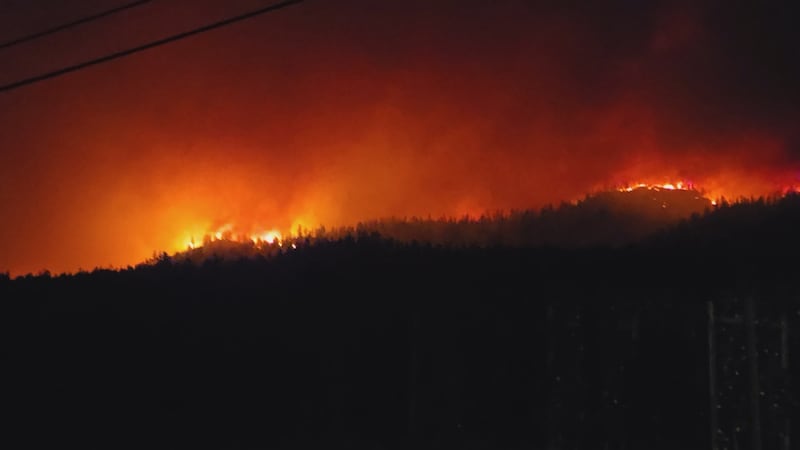
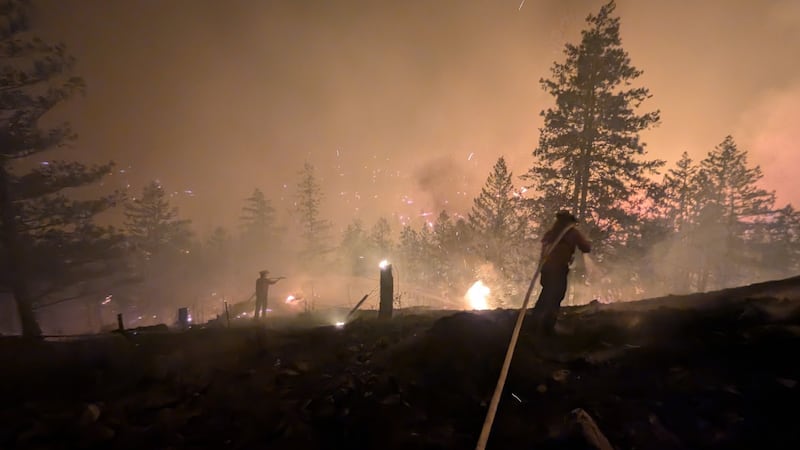
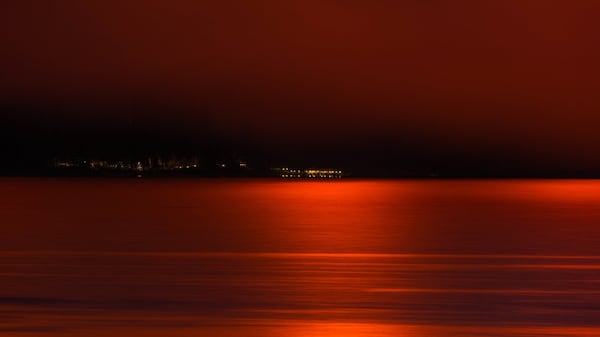
A newly discovered wildfire’s aggressive, sudden growth Friday night prompted the evacuation of the entire district of Summerland, B.C., as well as surrounding areas. The Bald Range blaze was estimated at 10,340 hectares, or 103.4 square kilometres, as of Saturday afternoon, according to the B.C. Wildfire Service. It reached that size in less than 24 hours. Regional District of Okanagan Similkameen communications manager Erick Thompson told CTV News on Friday night that the fire was discovered around 5:30 p.m. “It moved so quickly and grew so fast that it really became a very serious situation very quickly,” Thompson said. One of the first communities to be affected by the blaze was Faulder, a rural area that is part of the RDOS. Video shared with CTV News Friday night shows a line of orange flames advancing down a hillside as the person recording from a vehicle flees the area. John Middleton’s daughter was one of those forced to leave Faulder during tactical evacuations. “It was flames all over,” he said, describing his daughter’s escape. “They tried to get the dogs out. They were being ushered out by the cops. She got some burns on her face and around. They barely got out. It was crazy.” Officials told CTV News 55 people had to be airlifted out of the Faulder area as the fire spread. The BCWS said the wildfire was displaying “aggressive rank 5 behaviour, meaning an organized flame front with a fast rate of spread and moderate to long range spotting.” By Saturday morning, evacuation orders covered the entire district of Summerland, as well as properties in neighbouring Peachland and the regional districts of Central Okanagan and Okanagan Similkameen. More than 20,000 residents are estimated to have been ordered to leave their homes. In its update Saturday morning, the wildfire service said fire behaviour had decreased early Saturday morning, though the blaze remained active with rank 2 and 3 behaviour. “Overnight, personnel worked to evacuate residents and recreationalists, deploy structure protection apparatus, and suppress the fire in interface areas,” the BCWS said. “Thick smoke, elevated fire behaviour and turbulence limited the night vision helicopter’s ability to respond.” The service added that “increased activity” had been seen on the fire’s south flank near Shingle Creek Saturday, with winds out of the west-northwest driving growth toward the southeast. Provincial state of emergency A media availability was held in Vancouver on Saturday afternoon in which Premier David Eby and Emergency Management and Climate Readiness Minister Kelly Greene declared a provincial state of emergency. Greene said the evolution of the wildfire situation in the Okanagan prompted the decision, which will grant the province the ability to restrict travel in regions and commandeer accommodations—moves that would otherwise be unlawful. The province can now ration fuel and restrict price gouging on specific resources if deemed necessary, according to Eby. On the other hand, he and Greene explained that no resource or funding restrictions exist that the declaration supersedes. “We have full access to resources, whether they’re federal resources, provincial resources, local government resources. It’s not like the United States in that way,” he said. “We can access all of the resources that we need to fight a wildfire as well as respond to any other emergency,” Greene added. While there aren’t any travel restrictions in place just yet, Greene has urged everyone to avoid Summerland and other areas impacted by wildfire. “Given the large scale of the evacuation and the number of people and emergency crews on the move, we will not hesitate to take further steps under the state of emergency should that become necessary,” she said. “At every step, our focus is going to be ensuring that the teams on the ground have the tools that they need to respond and save lives and protect communities.” The federal government has been contacted for additional assistance, but Greene said those details are still “being worked out.” Volatile conditions BCWS director of provincial operations Cliff Chapman said an incident management team is working tirelessly at fighting the Bald Range fire in Summerland, adding these are conditions they have “never seen before.” “The conditions we face in B.C. right now, in particular in the southern third, are explosive,” he explained. Heading into the summer, parts of the province were facing extreme drought levels, which caused forest fuels to dry and become “incredibly receptive to ignition,” according to the BCWS. “The conditions combined with elevated gusty winds out of the southwest resulted in rapid growth of wildfire to the northeast,” reads an update on the Bald Range fire. As the fire grew, Chapman said, firefighters from multiple jurisdictions worked together through the night to combat it—with their efforts and tactics evolving as the situation changed. “Our firefighting aircraft quickly became evacuation aircraft. Our firefighting response crews quickly started knocking on doors to get people out of the way,” he said. “I feel very strongly that many lives were saved because of the efforts of so many agencies.” In part, Saturday’s focus has shifted to building containment lines to limit spread, Chapman said. This comes after the fire grew and made a direct run towards Okanagan Lake, with many of Summerland’s structures in its path. He said some crews are continuing structure protection work, while others are engaged in additional search and rescue efforts for anyone remaining behind the fire line. Chapman said the potential for another fire behaving like the Bald Range blaze is “very real.” “When we see a fire start, when we see the smoke lift, we are going to be challenged, and we may see fires do what we saw on this fire last night,” he said. “Our major concern, even heading into this weekend, wasn’t the fires that were already on the land base; it was the fires that could potentially hit the land base, and last night we saw the most extreme version of that.” Further support requests have been made to the Canadian Interagency Forest Fire Centre, Chapman said, noting he expects the province to be in the wildfire fight heading into September. With files from The Canadian Press