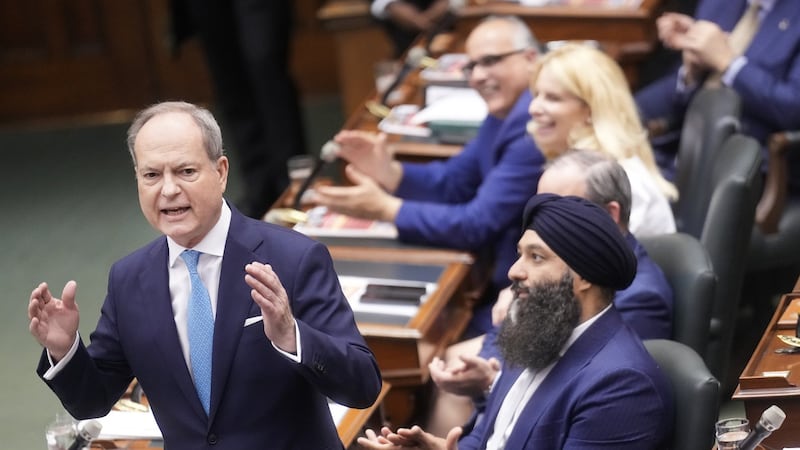
Strong mayor powers that have been rolled out to hundreds of cities across Ontario were supposed to fast-track housing construction – but a new report says in the three years since, housing growth has been slow and the powers have brought unintended consequences. The report, which anonymously interviewed chief administrative officers (CAO) from 32 Ontario cities, found deep concerns that previously professional city staff could become beholden to partisan mayors that can hire and fire them at will. “It’s stress built upon stress built upon stress,” said Sabine Matheson of StrategyCorp, which conducted the survey. “We’re not getting a lot of the upside, but we’re getting the potential risk for the downside, particularly after the next round of municipal elections,” Matheson said. StrategyCorp interviewed the CAOs anonymously so they could speak freely. One said in the report that effectively reporting to the mayor, and not city council, “forces the CAO to play this political game.” Another said, “The administration is no longer separate from the politics and (the relationship) is fundamentally changing. That relationship, another said, could be over when the political winds shift, saying, “I’ve just decided I’m going to be fired at some point.” Ontario Premier Doug Ford brought in strong mayor powers to a handful of cities in 2022, before rolling it out to 216 municipalities. The powers include being able to overrule city council on certain provincial priorities, as well as being able to terminate senior staff. The idea was that the strong mayors could cut through red tape that was standing in the way of housing construction. But, according to provincial data, of the 50 largest municipalities, just 15 have exceeded their targets for 2024. Eight are on track, and 27 have not met their targets. That’s a sign the strong mayor powers may not have targeted the real reason housing starts have been slower, Matheson said. “The big struggle that’s in the way of getting housing built right now has got a lot more to do with the economic fundaments than it has to do with any quirks of decision-making inside city halls,” Matheson said. Continuing down this path could create a new normal where partisan mayors sweep out senior staff upon being elected, eroding the independence of civil servants and costing cities a fortune in severance pay, said Liberal MPP for Orléans, Stephen Blais. “If the premier’s intent was truly about building homes and about building infrastructure faster, he would see the results and see that it hasn’t actually delivered. He would put the strong mayor powers on hold and evaluate why that might be,” he said. A spokesperson for Housing Minister Rob Flack said in a statement that it is up to the cities to meet specific housing targets. “Mayors are elected and have the responsibility to deliver results for their community. This includes ensuring they have a team at City Hall that is working collaboratively to deliver those results. Our government recognizes Mayors know their communities best and we will continue to work in collaboration with all of Ontario’s 444 municipalities to give them every tool they need to build stronger communities,” wrote Alexandra Sanita. “Across the province, we are seeing the over 200 municipalities who have been granted strong mayor powers deliver results. In St. Catharines, they are using strong mayor powers to prioritize housing applications. In Ajax, they are driving housing projects forward to unlock over 2,400 new units and, in Brampton, they are allowing the advancement of 27 new affordable housing units with Habitat for Humanity,” she continued.