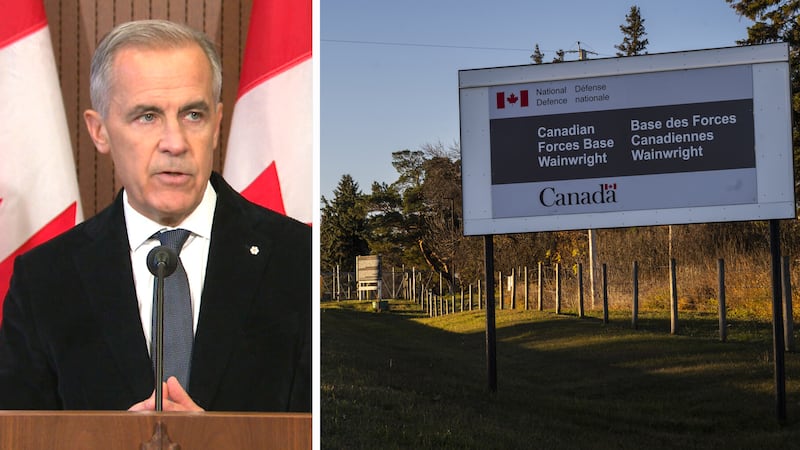
Canada’s ambitious strategy to turn to the European Union to wean itself off American dependency for military equipment could be difficult to deliver and result in political fallout, warns former defence and security officials in a new report. After assessing the political and fiscal risks of the Canada-EU Security and Defence Partnership, signed by Prime Minister Mark Carney in Brussels in June, the authors found that “achieving the partnership’s full potential is highly uncertain” because of obstacles on both sides of the Atlantic Ocean. Those obstacles include trade tensions with the United States, division among the European nations and weak links between the federal and provincial governments. Currently, American defence companies manufacture nearly 75 per cent of the weapons and tools the Canadian military uses, which the report says “leaves Canada vulnerable to shifting U.S. policies and trade tensions.” The report acknowledges that buying more from Europe could result in a “more resilient, innovative and self-reliant Canadian economy that can weather global uncertainties,” but warns that political leaders may need to brace for aggressive lobbying from U.S. companies, which could result in retaliation. “The U.S. is not necessarily going to be happy about losing some of their defence contracts to European competitors. So there may be political fallout in that respect,” said Vincent Rigby, former national security and intelligence advisor to former prime minister Justin Trudeau. Rigby, who is also one of the report’s authors, says he’s currently watching for the outcome of the Department of National Defence (DND) review of the purchase of F-35 fighter jets from U.S. defence giant Lockheed Martin. While Canada has paid for 16 fighter jets, the remaining order for 72 planes is in limbo, as the DND is considering if Saab’s Gripen fighter is a viable alternative. The Swedish company came in second during the initial procurement of the country’s next generation of war planes. Rigby says if the remainder of the F-35 contract is cancelled, the U.S. could counter by cancelling contracts with Canadian companies. That is the type of balancing act that Canada will need to calibrate repeatedly over the next decade to fulfill its military obligations. As part of NATO, the Carney government has committed to increasing the amount it spends on defence to five per cent of GDP by 2035 - a bill that could amount to $150 billion a year. Perrin Beatty, former Conservative defence minister and co-author of the report, says Canada needs to spread out where it spends the money to “ensure we have reliable allies beyond simply one” and build up its domestic military industrial capability. The report notes that under the five per cent GDP benchmark, EU defence spending is likely to exceed $1 trillion by 2035. However, Beatty cautions that the economic benefits Canada stands to reap could be limited by some countries with veto power. “If you look at our free trade agreement that we have with (the EU), a number of countries within Europe still have not ratified it and the structure within Europe where individual countries have to ratify makes it that much more difficult,” Beatty said. Although U.S. President Donald Trump is waging a trade war across the globe, his administration is also demanding access to Europe. In an editorial published in USA Today on Wednesday, U.S. Secretary of State Marco Rubio wrote that “NATO allies must allow American firms to compete for defence contracts” and that only the U.S. has the companies “fully capable of supplying Europe’s defence needs.” Beatty says that’s an example of Trump “playing it both ways,” adding that the U.S. president wants NATO allies to increase their defence budgets in order to boost the bottom lines of American contractors. In the end, the report’s authors say Canada needs to strengthen its own resilience by strengthening the military industrial complex at home. “We can’t just substitute one dependency for another,” said Retired Vice-Admiral Mark Norman in an interview on The Vassy Kapelos Show. The push toward more defence spending also requires the massive development of critical minerals, which the report notes could translate into “tens of thousands of new jobs in regions of Quebec, Ontario and British Columbia.” But the authors found that provincial regulatory barriers could delay the delivery of critical minerals to European supply chains by two to three years. Norman says if the federal government wants to do more business with the Europeans, it also needs to streamline the procurement process, or we may revert back to relying on the United States. “We need to fix the system in order to flow the money through efficiently,” he said. “There’s no shortage of things we need to buy, but we could end up having to go back to the Americans on some of these things because of the speed we need to purchase them.”