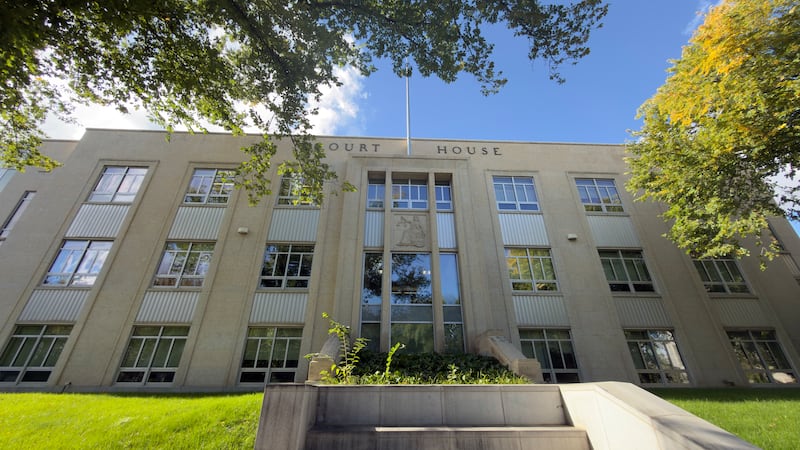
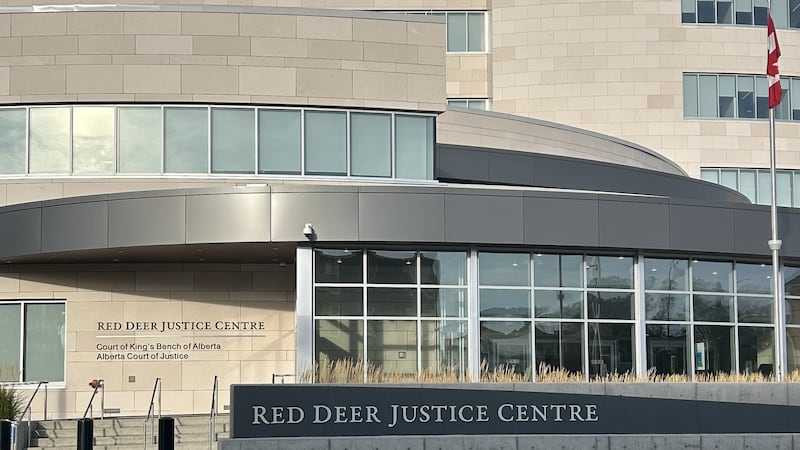
The fate of a 19-year-old man charged in the death of a Barrhaven crossing guard is now in the hands of a judge. Closing arguments were heard Tuesday in the dangerous driving trial of Xzander Wright. Wright has pleaded not guilty to dangerous operation of a vehicle causing death but earlier pleaded guilty to failing to stop after an accident. Wright has admitted in court he was driving the Toyota Tundra truck that struck and killed Peter Clark on March 23 and testified in his own defence that he didn’t see Clark who was wearing a bright reflective safety vest and holding up a hand-held stop sign. Justice David Berg interjected several times during the defence’s closing submissions. “[He] doesn’t see the fellow standing in front of his vehicle wearing a high-visibility jacket?” Justice David Berg asked Wright’s lawyer, Lawrence Greenspon. “If he was standing in front of the truck, part of his body would’ve been visible. If you try and convince me otherwise, this is going to be a very long day.” Wright had testified that he didn’t see Clark but felt a tap at the front of the truck and saw a hand-held stop sign on the hood of the truck after doing a rolling stop through the intersection at Cedarview Road and Kennevale Drive. “If he had stopped, Peter Clark would be alive,” Berg said. “If he had enough time to recognize that something was wrong… or someone had thrown a crossing guard sign and I can’t see the crossing guard, he had enough time to stop,” Berg said. The judge will have to determine whether Wright’s pattern of driving was dangerous in law: Were Wright’s actions a marked departure from the standard of a reasonable driver? Greenspon said the case was a “tragic perceptual failure, not a marked departure.” “This is a very tragic accident, but it was an accident,” Greenspon said outside the Elgin Street courthouse. “If he had seen him (Clark), he wouldn’t have hit him. It’s as simple as that. There were a number of possible obstructions: side view mirror, the A-pillar post, the sunlight was coming in right at the angle of where the driver was seated. And none of these things were measured or taken into account by the reconstructionist police officer.” An Ottawa Police Service collision reconstructionist previously testified that no reenactment of the crash was done and that she didn’t think A-pillars, on either side of the windshield, would have played a role in obstructing Wright’s view because Clark was standing in front of the truck. The Crown argued Wright was looking down when he pressed the gas and advanced into the intersection. Wright testified he was distracted by his vape that had fallen into his lap and was also looking down at the floor mat. The Crown said beyond Wright’s failure to look forward while advancing, he kept driving despite feeling a tap felt on the front of the truck, the stop sign appearing on the hood and feeling bumps under the wheels. “A reasonable person would foresee the risks of advancing as Mr. Wright did and would not have done so. A reasonable person would come to a complete stop, would look forward, and would ensure that the way forward was cleared of pedestrians before making the choice to advance,” assistant Crown attorney Julian Daller told the judge. As for how this happened, Daller said it was a “significant and enduring distraction, coupled with the irrational decision to advance the vehicle without looking forward, directly into the stationary Mr. Clark. A crossing guard that could have done nothing further to make himself more visible is the only plausible answer we are left with.” The judge is expected to deliver his verdict in September.