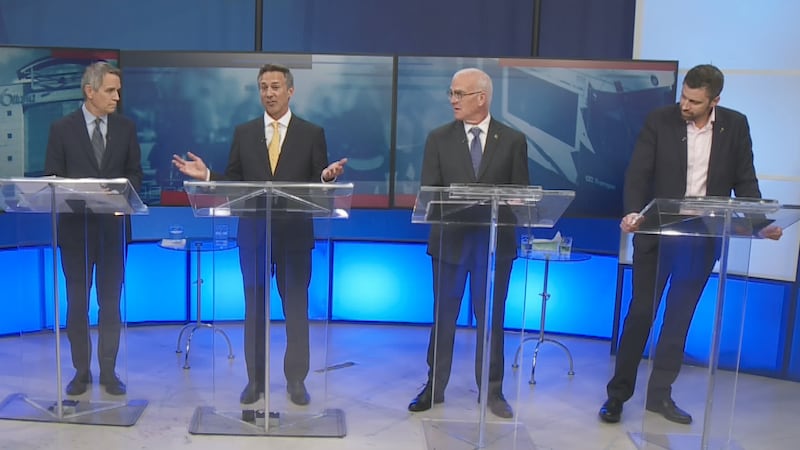
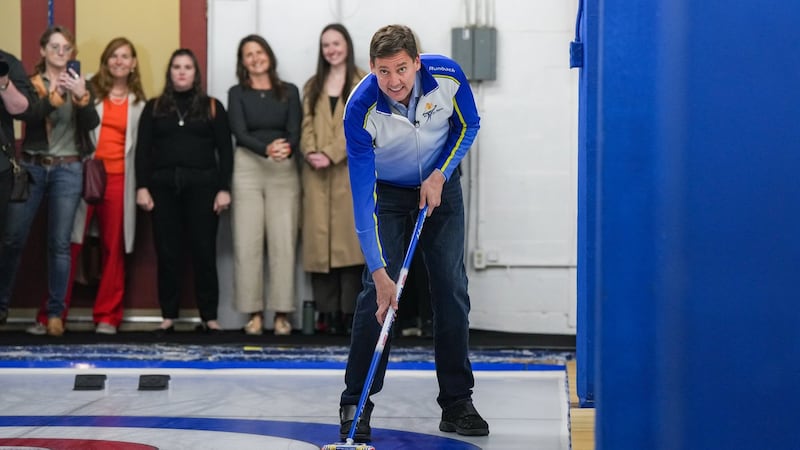
The top four candidates for mayor of Ottawa sparred on the debate stage on Wednesday, with cost of living in Ottawa emerging as the main issue driving discussion. Mark Sutcliffe, Jeff Leiper, Neil Saravanamuttoo, and Alex Lawson debated the issues on CTV News Ottawa in a 90-minute discussion that involved questions from residents, students, and CTV News and Newstalk 580 CFRA journalists and hosts. The issue is multifaceted—encompassing public transit, taxes, infrastructure and housing—but the matter of being able to afford living in Ottawa loomed over the questions and answers. Public Transit Public Transit emerged as the main issue that residents said needs improvement in Ottawa, according to a Nanos Research poll for CTV News Ottawa. On the issue, candidates said the system is unreliable, unaffordable, and in need of changes. Incumbent mayor Mark Sutcliffe said the “dumpster fire” at OC Transpo was part of the reason he ran in 2022, and touted his record on improving the system, with figures released just moments before the debate that showed an increase in performance. Sutcliffe also promised to cut the price of a monthly transit pass to $95. “We have some good data about transit; it’s getting better, but it’s still not good enough, and that’s why I have a plan to upload the LRT to the province of Ontario. We didn’t get a good deal when the LRT project was launched many years ago. Other cities got a much better deal than Ottawa, so we’re going to fix that, and we’re going to get $4 billion that we can reinvest in better and more reliable transit for the people of Ottawa,” he said. Coun. Jeff Leiper, however, said riders cannot count on buses arriving on time and criticized the New Ways to Bus plan that was implemented in 2025, and its cut of 70,000 service hours. “I’m going to restore those,” he said. “The second part of my plan is to ensure that you can begin to trust our transit system again, because I am putting a citizen member back on the transit committee. Somebody who can hold us as politicians accountable, who can advocate for what you need at the table where the decisions are being made, we also need to get more of our bus rapid transit implemented and buy more buses.” Neil Saravanamuttoo pitched a full system overhaul and is promising to cut the price of a trip to $1 per ride, which he said would be paid for through the promised upload of the LRT to Metrolinx. “We need a full bus network redesign, and this is something that needs to be done with passengers, with operators, and with people that want to be passengers. That would include, for instance, bringing back express buses, having more local routes that actually make sense,” he said. “And finally… we need to get financing under control. That means new revenue sources such as real estate development to help fund transit operations.” Alex Lawson promised to have an operator representative on transit committee to ensure council decisions are realistic. “OC Transpo doesn’t have a money problem right now. It has a management problem,” Lawson said. “We’ve got routes that don’t show up. We’ve got routes that don’t get you where you need to go. It’s taking you an hour and a half to get from the suburbs to downtown. To improve reliability, we need to make sure that the buses that we already have are showing up when we say that they’re going to show up. And this is going to mean politicians not making promises that they can’t keep. We need to make sure that we have an operator representative on our transit commission, so that we promise something that we can’t do. They’re going to hold us accountable.” Taxes The issue of property taxes, and what candidates would charge, was a sticking point for Sutcliffe in particular, as he pressed Leiper on his lack of a figure for planned tax increases. “Why don’t you just tell the people of Ottawa what your number is? How much are you going to increase their taxes over the next four years? Tell us the number,” he said. Leiper did not provide a specific goal for a proposed property tax increase over the next term of council, instead saying he would make the budget process more transparent. “You know, Mark, that I am not proposing super high tax increases. You keep repeating it, but that doesn’t make it true. What I am going to do, though, is have a more honest and transparent discussion by fixing the budget process,” he said. “What we’re going to do is we’re going to have a discussion as grown-ups in this city about what the trade-offs are between all of the various different considerations, always keeping in mind that ordinary Ottawa residents are struggling with the high cost of living. I don’t think that Ottawa residents trust today that you are working on their behalf.” Sutcliffe is pledging to keep property tax increases capped at no more than 2.5 per cent a year for the first two years of the next council term. Lawson is promising a property tax freeze in 2027, something that candidates said he could not achieve without service cuts. “Alex has a plan that is basically zero means zero. We’ve seen that film before. In 2006, somebody ran on a zero means zero promise with no plan for how they were actually going to make it happen, which is the same thing today with Alex,” said Sutcliffe. Lawson pointed to Sutcliffe’s own promise to find $250 million in savings in the next four years. “You wrote a budget that you said yourself you could find $250 million in savings—a quarter billion dollars worth of fluff that you’ve written into that budget,” said Lawson. “By opening up the books and inviting actual competition to the table, we can shave a lot off of those numbers. Do you think when you tell somebody that they don’t have a competitor, they’re going to be gentle with the pricing towards the city, the jobs and growth plan?” Saravanamuttoo said he would not comment on tax increases until he’s done a line-by-line review of the budget and says he might even find room to reduce taxes, if possible. “These guys want to argue about whether the tax increase should be two per cent or three per cent or maybe seven per cent. I start with the 100 per cent of current spending that we’re doing and saying let’s find the savings within the 100 per cent,” Saravanamuttoo said. “And the only way that we can do this is by a line-by-line review that the city has not done in over 20 years. So that’s something that I will do.” Housing affordability The cost of housing in Ottawa was in focus during the debate, with candidates making promises to build more homes with the goal of driving down prices. A recent report by Ratehub.ca shows buyers needed to earn an average of $137,400 to buy the average priced home in Ottawa in August, up from $136,570 in July 2026. Leiper said the city needs to look outside regular market forces. He is pledging to focus on the not-for-profit sector to keep housing costs affordable. “We’ve had cuts in fees, cuts in studies, removing red tape to try to make it easier for the private market to build more housing. But we know that that is not going to be truly affordable for very many Ottawa residents,” Leiper said. “My focus is in very much on the not-for-profit sector housing that can be built by people that can keep rents and costs very low, so that the housing is affordable in perpetuity. I also have a plan for a housing acquisition fund that would help the city to purchase housing that is already affordable and to keep it affordable.” Saravanamuttoo touted his “tiny home” plan, offering to build homes in shipping containers to provide shelter for homeless residents first and foremost. “Tiny homes give people a safe place to call home, give them a shelter, give them a bed, give them a desk, enough transitional housing that they can move on to the next stage of life. This is the sort of approach that we need to be trying in the city of Ottawa,” he said. On broader affordability, Saravanamuttoo said a city-owned public housing option is needed. “That’s how other cities have managed to provide beautiful housing at all income levels, so that their residents can remain in the city. That’s what I’ll do. I’ve got a plan to build about 25,000 of these units at no cost to taxpayers because they are self-financing,” he said. Lawson, a homebuilder by trade, said housing affordability requires building more houses, and tied that into providing more jobs that would allow people to afford the homes they’re building. “Let’s listen to the builders and let’s get everything out of their way so that they can actually get things done faster. We need to speed up approvals. That’s not just going to be in the planning department. We need to expand the legal department so that things don’t sit for over a year waiting to get out the door. We also need to look at who we have to actually build these houses,” he said. “We need to identify the gaps in the workforce and get youth into great careers where they’re actually building the houses that they can afford. I mean, one side of affordability is making things cheaper, making them come out faster, bringing competition. The other side is always going to be gainful employment.” Sutcliffe reiterated his plan to ensure Ottawa has 10,000 more affordable homes by the end of the decade than it did four years ago, and touted housing start figures. “Last year in Ontario, across the province, housing starts were down. In Ottawa, they were up 38 per cent, and they’re up another eight per cent this year. So, we’ve seen progress, but we need to do more. We need to build more homes. We need to build more affordable homes, and I have a plan to do that.” Infrastructure A multibillion-dollar infrastructure gap in Ottawa, identified by city staff, led the discussions around how the city would improve everything from roads and sidewalks to sewers and watermains. Adapting to climate change and ensuring resilience in the face of extreme weather was also part of the discussion. Sutcliffe said his plan would bridge that gap in part through deals with other levels of government. “One of the components of that plan is that we’re finally going to get our fair share of investment from other levels of government. For too long, Ottawa residents have been paying sales taxes and income taxes to the federal and provincial governments, and a lot of that money has been going into the GTA to pay for infrastructure in Hamilton, Toronto, Brampton, and Mississauga. That’s just not right. It’s not fair. So, I’ve been fighting for our fair share,” he said. “We’ve started to see more investment from the other levels of government, and that’s how we’re going to pay for a portion of, but not all of, the infrastructure plan that I have.” Sutcliffe added that $500 million of his infrastructure plan is dedicated to climate resiliency. Lawson questioned Sutcliffe’s priorities, pointing to the Lansdowne 2.0 deal as an example where the incumbent mayor saw a need and reacted. “He saw that it needed repairs, and it was going to be profitable to some people and to some of his friends, and so he jumped on the opportunity to redevelop Lansdowne 2.0,” Lawson said. He also criticized the city’s response to the July 1 flooding. “Let’s answer the question of the floods. What actually happened? Why didn’t we have trucks in there within the first week, within the second week, actually looking into the sewers, looking at the sizing of everything, looking at what might have been clogged, and giving people real answers?” Leiper called Sutcliffe’s plan “fake” and said he would implement a one per cent infrastructure levy on annual tax bills to cover costs of major repairs. “My plan is to actually invest more in the maintenance of the infrastructure that we need. I’ve talked a lot about the fact that I would have a levy that would cost every household about $40, and while that would be not all the money that we need, I believe the province and the federal government are going to be more willing to provide us with the help that we need when they know that we’re willing to put our own skin in the game, that we just don’t have a handout asking the federal and provincial government to fund it all on their own,” he said. Saravanamuttoo said the city needs to find a way to lower the cost of infrastructure repairs. “What’s the only thing that’s more expensive than putting new infrastructure in the ground? Having to repair and replace it a generation later, and that’s a problem that we have right now,” he said. “When we go and dig up a road and replace the sewers, that costs an incredible $10 million per kilometer in Ottawa. Other cities do it much cheaper, so we need to get lower costs. We need to benchmark against other cities. That’s how I would go about fixing the infrastructure deficit.” He added that extreme weather is the new normal and said improving existing communities should be the priority over plans such as Lansdowne 2.0, and the Tewin development in south Ottawa. “If we have money to spend, we need to spend it on rebuilding and fixing the existing infrastructure, not going out and building new infrastructure,” he said. Saravanamuttoo promised an environmental plan next week. Closing remarks Candidates closed off the debate, each promising a more affordable Ottawa. Alex Lawson “We were promised an Ottawa that was safer, more reliable, and more affordable, and we didn’t get it. “We ended up with vacant unit taxes. We ended up with increased parking restrictions. We ended up with a garbage limit. It got harder to get around our city, and the city didn’t get safer. “When you’re making a choice this election, it is going to be a quality-of-life election. You can look at the status quo and see if that’s how you want to carry on. Things haven’t improved in the last four years. “I don’t think we should trust that they would with Jeff or Mark. And if we’re looking at Neil, he’s the economist, but all he’s looking at is the numbers. He’s not looking at what actually affects you day to day. I am. I’m here to talk to you. Send me a message on the website or give me a call.” Mark Sutcliffe “I’m excited about Ottawa’s future. We have our challenges, but we’re making progress working together. “In the next four years, we’re going to end youth homelessness. We’re going to build 75,000 new homes, including many affordable homes. We’ll hire hundreds of new police officers and paramedics. We’ll upload the LRT and invest $4 billion in public transit. We’ll build a stronger regional economy working with Gatineau. We’ll fight for Ottawa’s fair share of funding from the other levels of government. We’ll revitalize downtown and the ByWard Market. “This is a critical time for our city. We need experienced leadership. You can count on me to strengthen our local economy, protect affordability, and improve our quality of life. Let’s keep moving Ottawa forward together.” Neil Saravanamuttoo “This election is about the status quo versus change. Now, if the status quo is working for you, by all means, vote for the incumbent. Or if you want the status quo with higher taxes, vote for the councillor. “But if you want real change, vote for me. I’ll bring the biggest shakeup to City Hall in a generation. I’ll take on the big developers and return City Hall to the people. I will keep taxes low while fixing our infrastructure by opening the books, fixing procurement, and by ending the sweetheart deals. I’ll get the homeless off the streets through tiny homes. I’ll make middle-class housing affordable with a new public option for housing. That’s just the beginning. “You can learn more at NeilForMayor.ca. Together, we can build a better Ottawa.” Jeff Leiper “I believe we deserve a city where the buses show up on time, where everyone can afford a home, and where residents feel and are safe. “Mark Sutcliffe has had four years to make housing more affordable, to fix transit, and to address safety in this city. Instead, he cut transit. He watched homelessness double, and he supported return to office mandates. He’s just working for insiders, not for people like us. Mark, it’s time to do things differently. “I’m asking you to vote for shorter commutes, safer streets, buses that show up on time. But mostly, I’m asking you to vote for people like you. The insiders have had their mayor. Now it’s time to do something different.” Fourteen candidates are running to be mayor of Ottawa. In alphabetical order, they are: Queen Divine Priya Amber Bakshi, Zed Chebib, Bernard Couchman, Suraj Harish, Alex Lawson, Jeff Leiper, Geoff Nicholas, Josh Rachlis, Neil Saravanamuttoo, Ali Shayvard, Jacob Solomon, Mark Sutcliffe (incumbent), Amjad Ali Syed, and Peter Westaway Election Day is Oct. 26. One day of advance voting will be held on Friday, Oct. 16, from 10 a.m. to 8 p.m.