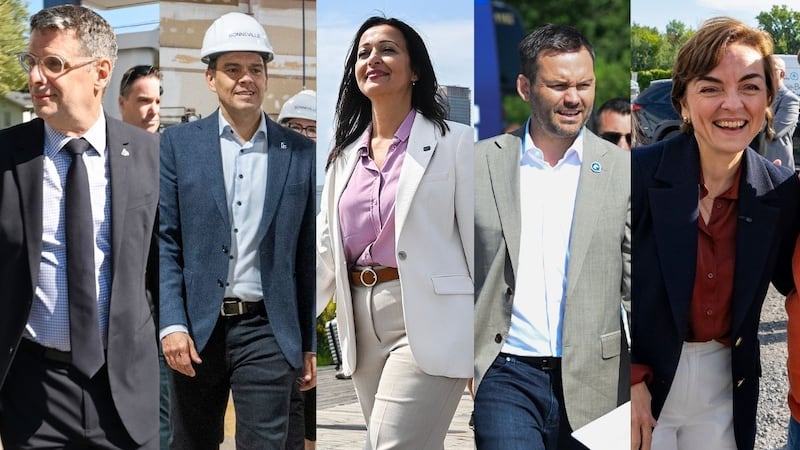
Throughout the election campaign, the leaders of the five official parties are entitled to protection from the Sûreté du Québec (SQ), a practice that has existed for only the past three general elections and is driving up costs. Before 2018, only the incumbent premier could count on close protection from the SQ for the entire duration of the campaign. It was only on Election Day that the other party leaders could receive the same protection, explains SQ spokesperson Lieutenant Joyce Kemp. Since 2012, the police force has made “adjustments,” Kemp noted. It is worth recalling that that year saw the attack on the evening of the Parti Québécois (PQ) election victory at the Métropolis, where PQ party members and the new premier, Pauline Marois, had gathered to celebrate the election results. New technologies and additional resources are now being deployed, Kemp explained. This development, combined with the fact that all party leaders have been eligible for protection since the 2018 elections, has had a significant impact on costs. In the 2022 elections, the SQ’s spending on security for party leaders totaled $5.11 million, compared to $2.44 million in 2018—more than double the amount. In 2014, the SQ’s expenses totalled more than $722,000, and in 2012, they were $1.58 million, according to figures provided by the police organization in response to a request under the Act respecting access to documents held by public bodies. Kemp notes that various factors must be taken into account to explain the variation in costs, such as the duration of the campaign and the number of trips. During the 2022 campaign, personnel covered between 150 and 200 events, the spokesperson said. ‘Constantly Adapting’ During the campaign, the SQ provides protection for the five party leaders through a “special operation.” This operation is coordinated by the police force’s emergency response division. From the start of the campaign through Election Day, an operations control center is in operation, Kemp said. “In this operations control centre, there are several specialized teams from the Sûreté du Québec who are deployed and working with various partners on the ground,” she said in an interview. In particular, the SQ monitors potential threats or events that may arise. The SQ refuses to specify the number of officers deployed during the election campaign. Police deployment may vary depending on activities. “It’s not a fixed number. It can change at any time,” said Kemp. She notes that the SQ will be “constantly adapting” and will not have “a specific model” until the end. Not a copy-and-paste approach During the 2022 election campaign, the heavy police presence around most party leaders drew attention, appearing more imposing than in previous elections. Parti Québécois (PQ) leader Paul St-Pierre Plamondon revealed at the time during a press briefing that the police had provided him with bulletproof vests as a precautionary measure. What will security measures and police deployment look like for the current election campaign? Without going into details, Kemp said that we should not expect a carbon copy of what happened four years ago. The SQ adjusts its level of response based on the information received or potential threats. “It wouldn’t be fair to consider the measures that were put in place in 2022 as a standard applicable to all elections. Instead, we’re taking a flexible approach based on continuous risk assessment. It’s not a rigid model from the outset,” she explains. The Canadian Press asked the five parties whether they had any concerns regarding the safety of their leaders and whether they had requested enhanced protection for the campaign. The Coalition Avenir Quebec, the Quebec Liberal Party, the Quebec Conservative Party, and Quebec Solidaire (QS) essentially responded that they rely on the SQ’s services and defer to its recommendations. Only the PQ declined to comment. QS clarified that “the vast majority of threats or hateful comments” directed at its spokesperson, Ruba Ghazal, “are primarily focused on the fact that she is a woman of color.” “That said, she does not necessarily have additional security measures in place specifically for this reason,” said a party press secretary. Threats against elected officials in the National Assembly have increased in recent years. However, SQ data on reports of threatening remarks or threats against members of the National Assembly show a decline over the past four years or so. In 2023, 2024, and 2025, the SQ received 183, 166, and 159 reports, respectively. This represents a significant decrease compared to previous years, when the number of reports reached nearly 400 in 2021 and 333 in 2022. However, the number remains higher than in 2019, when the SQ received 16 reports. This report by The Canadian Press was first published in French on Sept. 5, 2026.