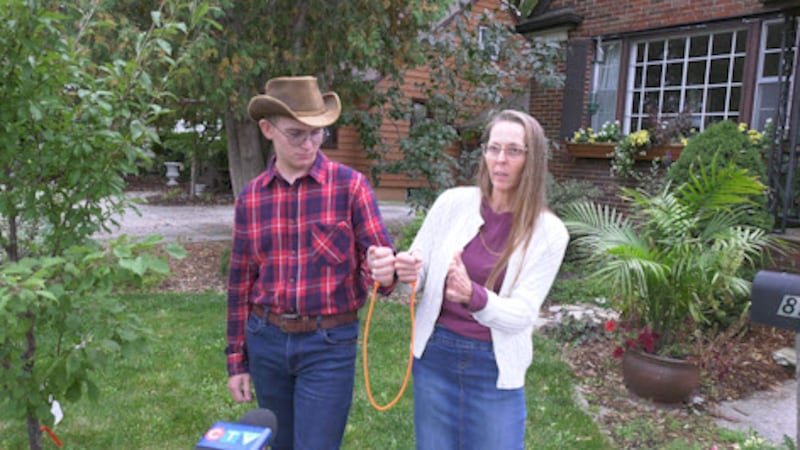
Allan Lubberding can’t step a few feet into his backyard without finding a grasshopper. The St. Albert man has been dealing with the insect infestation at his Goodridge Drive property in Grandin for the past two weeks. “I’ve killed, by now, at least 2,000. They just keep coming,” he said. Lubberding blames the field behind his house, which belongs to the Alberta government. He said grasshoppers are coming in “droves” over the fence into his yard. “They’re just destroying my plants. They’re chewing up everything,” he said. He’s contacted the city and hasn’t heard back yet. Now, his neighbours are seeing the same problem on a slightly smaller scale. One neighbour told CTV News Edmonton that her backyard was just as bad. Lubberding, who’s been living in the area for 30 years, is only concerned because he’s never seen an infestation this bad. “I spend my day trying to kill grasshoppers. I even got my granddaughter catching them,” he said. He compares this summer’s pests to a “bad horror movie,” like Alfred Hitchcock’s The Birds. The city of St. Albert issued a statement acknowledging calls they’ve received from residents about a high grasshopper population in the area this year. “This issue is not exclusive to the city and is something that areas around the province are experiencing,” said communications advisor Kathy DeJong. “Grasshoppers are an agricultural issue, so municipalities do not generally take significant action.” DeJong said the city is currently monitoring the situation. ‘No easy solution’ The province’s website has a page dedicated to management practices for grasshopper infestations. The site said that temperature, rainfall and snowfall each play a major role in determining the severity of a grasshopper outbreak, with temperature being the most important determinant of just how many grasshoppers we see. Dan Johnson, a professor of environmental science at the University of Lethbridge, said there’s “no easy solution” for Lubberding’s problem. He said the infestation could be because a specific type of invasive grasshopper managed to reproduce as long as there’s “fresh green food” to destroy. “Agricultural insecticides will stop them, but they don’t last as long as they used to. That’s on purpose, because they used to cause so much environmental damage in the city,” he said. The provincial website also notes that chemical control isn’t always effective if grasshoppers are already winged, or if you spray at the wrong temperature: too hot, and they’ll metabolize the chemical quicker; too cold, they’ll be hiding underground. “We’ve come up with natural enemies that attack and kill them and so on … but they’re slow. They’re very slow, and they’re not perfect. All they do is suppress a little bit,” said Johnson. Grasshoppers don’t like being wet, Johnson said, but that doesn’t make them easy to stave off. “[Lubberding] could kill thousands and probably not make a dent,” Johnson said. However, Johnson notes that “most of the grasshopper species are not pests.” “Sometimes nature will catch up with grasshoppers and take care of the problem, but usually it’s weather that slows them down,” Johnson said. In the meantime, Lubberding is killing every grasshopper he sees. “I’d like to think they’re dying off … but there’s one on my leg,” he said. With files from CTV News Edmonton’s Marek Tkach, Nicole Weisberg