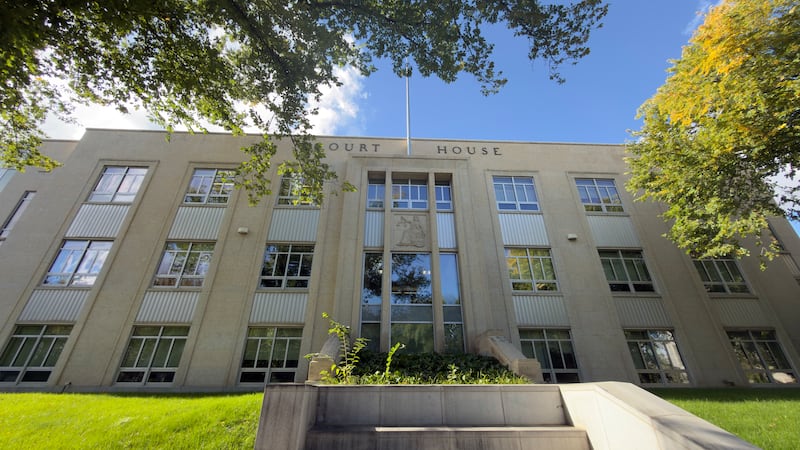
A violent, repeat offender brought a loaded handgun stashed in a “murse” to an appointment with his probation officer at a B.C. courthouse, according to a recently published sentencing decision. John Michael Aronson had racked up 22 criminal convictions as a youth and another 42 as an adult before he was arrested at the Kelowna courthouse in 2023 and charged with five additional offences, the court heard. He was also bound by two lifetime weapons prohibitions when the 9-mm Walther P38 handgun—fully loaded, with one bullet in the chamber and the safety disengaged—was found in a black, over-the-shoulder bag the judge referred to as a “murse.” ‘Sheer coincidence’ Officers with the Kelowna RCMP intercepted Aronson before his Aug. 31 appointment with his probation officer to arrest him on a warrant for driving while prohibited, according to the sentencing decision. In addition to the gun in the murse, police found a switchblade in Aronson’s pocket when they searched him, the decision said. “Mr. Aronson did not brandish either the firearm or the switchblade, nor is it asserted that Mr. Aronson’s conduct at the courthouse was consistent with any intention to use either weapon at the courthouse,” Justice Briana Hardwick wrote in her Feb. 18 decision. “His possession of the firearm and the switchblade was discovered by sheer coincidence, because of the search conducted incidental to arrest for the driving offence.” Aronson was charged with four weapons offences and breach of probation and convicted after a trial last year. The sentencing decision summarizes Aronson’s defence, explaining that he claimed to have grabbed the wrong “murse” while groggy after a night of partying and distracted by an argument with his girlfriend. The murse and the weapon, he testified, belonged to his girlfriend. Further, he told the court he was unaware the loaded gun was in the bag until police found it. Hardwick said the defense was one she “simply did not believe and effectively rejected in its entirety.” Apology with AI assistance At last month’s sentencing hearing, Crown argued a fit sentence would be seven years in prison while the defence argued for a sentence of time served followed by three years of probation. At the time of sentencing, Aronson had been in jail for 1,262 days. If additional time in custody was warranted, the defence argued it should not exceed two years less a day, which would allow Aronson to stay in provincial custody. Aronson addressed the court at the hearing, reading what the judge described as a “lengthy” handwritten statement wherein he expressed his remorse and desire to be accountable for his actions and change his life. “Upon a review of the written statement, I have a strong suspicion that Mr. Aronson had the significant benefit of assistance from some sort of artificial intelligence in preparing his address to the court, because the statement contains grammar, punctuation and vocabulary that are the hallmarks of AI output,” the judge wrote. Still, Hardwick accepted that the sentiments represented Aronson’s actual feelings and were tailored to his circumstances, rather than a mere copy-paste of an AI-generated script. The judge did, however, find difficulty accepting the statement on the grounds that “actions speak louder than words.” Federal sentence necessary While no one was harmed at the courthouse, Hardwick highlighted the risk to the public and court workers when handing down the sentence. “The fact that there was no victim can be somewhat attributed to sheer luck. The firearm was fully loaded with seven bullets, including a bullet in the chamber, without the safety on. It was truly capable of being fired by a simple activation of the trigger, whether intentional or accidental,” the judge wrote. “It is truly concerning that Mr. Aronson had such a careless disregard for the safety of these front-line individuals that he considered it appropriate to bring a fully loaded, unsecured firearm, into the courthouse.” The judge found Aronson’s “most unenviable” criminal record aggravating, noting he had spent significantly more time behind bars than in the community over the past eight years. His criminal convictions include those for assault, assault with a weapon, obstructing a peace officer, flight from police, robbery, various driving offenses, property crimes, and multiple breaches. Aronson had also been shot five times, stabbed twice, broken dozens of bones and ended up in a coma after a crash while fleeing from police, and almost died after an “apparently unprovoked” jailhouse attack, the court heard. “Neither incarceration nor the various serious physical injuries that he has sustained and continues to have to deal with solely because of his criminal conduct, have truly resulted in achieving the objective of specific deterrence,” Hardwick wrote. “A lengthy period of incarceration is required on this occasion. Namely, I am satisfied that a federal sentence is necessary for the first time.” Aronson was sentenced to six years and four months in prison, which works out to just under three years after credit for time served.