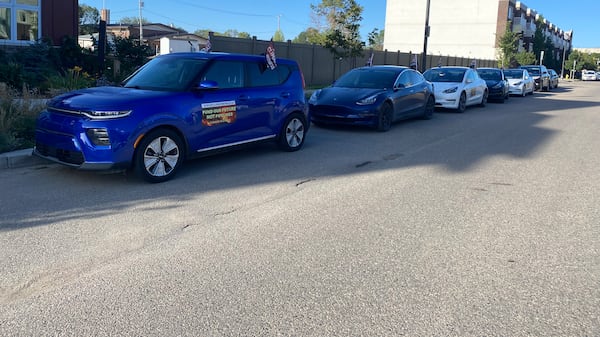
A rally for neurodivergent individuals was held outside of the Saskatchewan Legislative Building on Saturday. The group “Indigo Alert Canada” is looking for every province and territory to build an alert system that focuses on protecting “vulnerable people who rely on caregiver support, cannot self rescue, and are prone to wander into danger,” according to their website. “Right now, I don’t think there is the supports in place provincially or federally available if a child goes off in an elopement situation or wandering — we’re just not equipped to navigate it,” said Katie Emde, the national director of advocacy and operations for Indigo Alert Canada. The group’s goal is to get a new alert to be implemented federally, that can ensure the safety of neurodivergent individuals from coast to coast. The group has established that they do not wish to replace the Amber Alert, but to give “law enforcement a second, faster tool for a different kind of emergency that current criteria were not designed to catch.” An Indigo Alert would “follow the same discipline with clear, verified risk factors, not a blanket trigger.” Their goal is for a small number of alerts that people take seriously, rather than a larger number that people start to ignore. Many of these alerts would come from neurodivergent individuals, especially children, that would be eloping in communities across Canada. Indigo Alert Canada website defines eloping as: “when a vulnerable person — such as an autistic individual or someone with dementia — wanders away from a caregiver or safe place without realizing the danger or knowing how to return.” “There actually is thousands upon thousands of individuals that are in the vulnerable sector in our communities, and we need to do our part to make sure that we’re protecting them,” said Emde. According to Indigo, 49 per cent of autistic individuals elope after the age of four. “They have a place in mind that they want to go to. You might have taken them to the wrong park that they weren’t expecting, and they’re trying to go somewhere else,” said Kayla Bye, the mother of a four-year-old autistic boy. “They may see water and go on to explore it. They may be in the backyard and be like, ‘I don’t really want to be here anymore.’ They might be missing a parent and go running to try to find them, but they don’t understand why they can’t do that.” From southeast Saskatchewan, Emde has two sons that are on the autism spectrum. She’s hoping that a new alert can prevent worst-case scenarios. “We’ve worked really hard in our family to put things in place to feel safe, but ultimately, sometimes those things fail, sometimes those things aren’t enough,” said Emde. “So this is just one more line of defence, having Indigo Alert Canada in our community.” Emde added that her family deals with extra challenges brought on from costs like speech, occupational and nutritional therapy as well as complications from one of her sons attending a day home. Much of the initiative for a new Amber Alert-style system derives from the death of Parker Wells, an 11-year-old boy with autism who went missing in July. Nearly two weeks later, his body was found in a four-foot water pipe that was part of a network of pipes and tunnels. “Going through Facebook, it really hit me because of the story around Parker and what happened to him because that easily could have happened to my son,” said Bye. The house of commons petition, e-7703, has over 9,500 signatures so far.