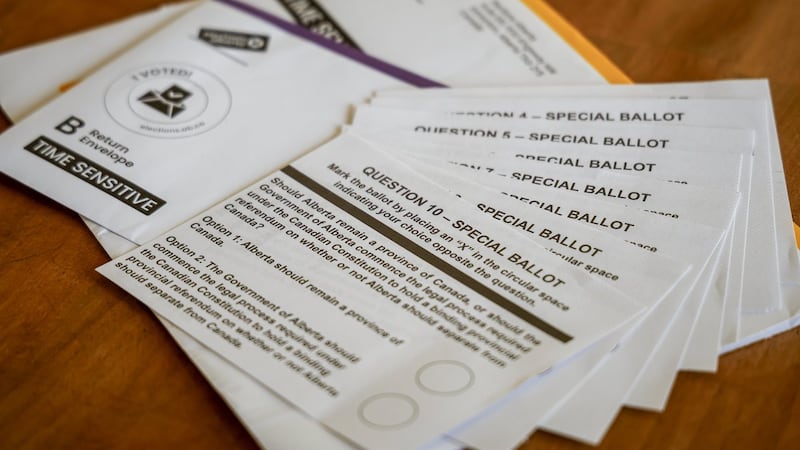
Premier Danielle Smith will be in Toronto early next week for the Canada Investment Summit. It’s a first-of-its-kind gathering in Canada bringing together global investors, Canadian CEOs, and public sector representatives in order to accelerate new investment into Canada. On her radio call-in show Saturday, Smith said Alberta has 34 projects in its idea book that are each worth $200 million or more. Those ideas touch much of Alberta’s economy. “We’ve got the west coast pipeline on there,” Smith said. “We’re looking to have equity and debt investors in that one so that we can get that one built to the BC coast. “We’re also looking to have a conditional approval on that by October,” she added, “and I’m hearing that we’re on track for that so there’ll be more to say. “Across the board, we’ve got – not only conventional fuel projects but also new fuel projects, as well as carbon capture projects, as well as agriculture investment projects. “We’ve got 34 projects in our deal book that are of $200 million or more and I bet we could have a whole bunch more,” she added, “so I’m really looking forward to making contact with the future investors who might fund these things.” In an interview airing Sunday on CTV Question Period, host Vassy Kapelos asked Smith whether allowing a referendum on separation to go ahead has handicapped her ability to pitch Alberta as a stable environment to invest. “I don’t think so,” Smith said, pointing to Meta’s recent announcement that it plans to build a $13-billion data centre in Alberta as an example of a recent investment in the province. “I think there’s lots of things that investors look for,” Smith also said. “Investors look for low corporate income taxes. They look for an environment where people and workers are going to want to be. They look for a well-educated workforce. We have all of those things.” The premier added: “That value proposition doesn’t change.” Kapelos then pressed Smith on whether she bears any culpability if the vote in October does not go the federalist way, and whether she could draw in even more investment at the summit this week if the referendum were not on the horizon. In response, Smith said previous “terrible federal policies” drove away investment, which contributed to Albertans’ dissatisfaction with Canada. “I think they were worried that we were going to see a repeat of that for the next decade,” Smith said. “Fortunately, I’ve been able to work with the prime minister to undo most of those terrible laws and to demonstrate that the federal and provincial government can work together.” In March 2026, Alberta’s Chambers of Commerce said talk of separation was not good for business investment because it created uncertainty. Calgary Chamber of Commerce president and CEO Deborah Yedlin said, “People (are) saying, ‘You know what, I’m just going to wait and see what happens because if this goes in the direction that I don’t support, I will be either not expanding my business in this province or I will be leaving.” “There have been inbound questions from larger companies who do have operations outside the province and outside the country saying, ‘Is this real?’” Smith herself has repeatedly said she is on the side of Alberta staying within Canada. Catalyzing $1 trillion in investments: Carney The investment event is being co-organized by the Prime Minister’s Office with the Canada Pension Plan Investment Board and Public Sector Pension Investments, two of the country’s largest asset managers. The summit is, in many ways, the manifestation of the capital-focused agenda Carney laid out 18 months ago when he first took office. Since that time, he has reoriented federal policy and Ottawa’s budget framework to funnel spending to critical infrastructure and other major projects. Carney has set what experts consider a lofty goal of “catalyzing” $1 trillion in investments in Canada over five years. Open for business Jeremy Kronick, president and CEO of the C.D. Howe Institute, said Carney has taken a number of steps to show that Canada is “open for business” since taking office in March 2025. The major projects office and One Canadian Economy Act look to streamline approvals for nation-building projects, for example. Kronick said that’s enough to start shifting conversations about Canada as a destination for investment. But he suggested there’s more work to be done on other problems such as interprovincial trade barriers — the kind of regulatory snarls that can cause uncertainty about an otherwise viable project. “I think there’s been enough done on the change in tone. I think regulatory processes are harder to change,” Kronick said. With files from The Canadian Press and CTV News’ Spencer Van Dyk, Judy Trinh and Stephanie Ha