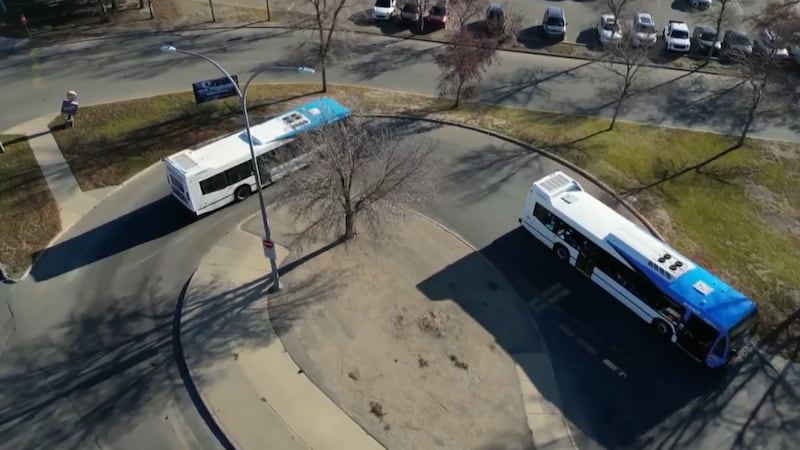
MONTREAL — Quebec political leaders are entering their 17th day on the campaign trail Sunday with their first debate approaching on Tuesday. Voters head to the polls in just about three weeks, on Oct. 5. Key details: Follow along for key updates: QS wants to establish front-line service to combat cyberviolence Québec Solidaire (QS) announced Sunday morning that a QS government would strengthen women’s safety by tackling online hate and the rise of masculinist rhetoric targeting women head-on, while also strengthening support for women who are victims of domestic violence. To combat online violence, the left-wing party proposes creating a front-line intervention service that will allow victims to report the individuals behind the hateful messages they receive. QS has allocated $10 million to establish the service. To achieve this, the party intends to model the initiative after the “Netsafe” platform, which has been in use in New Zealand since 2015. QS spokesperson Ruba Ghazal explained at a press conference in Montreal that this tool would include a one-stop shop for reporting cases of cyberbullying “without having to navigate a multitude of resources.” Such a service would also include a specialized team to support victims while intervening with those who commit cyberviolence. QS also wishes to implement a new legal remedy that would allow judges to quickly order an end to online harassment. “We need a service that can act quickly, support victims, and intervene directly with the perpetrators of this violence,” she said. “Because freedom of expression does not mean the freedom to intimidate, threaten, or harass.” Ghazal explained at a press conference in Montreal that her government will grant 10 days of paid leave to women who are victims of domestic violence, at the employer’s expense. To support this measure, the QS candidate hopes to allocate $600 million to create up to 1,000 new shelter beds across the province. “When a woman starts to wonder if it’s really worth speaking out because she knows she’ll face a barrage of hate, our entire democracy loses,” Ms. Ghazal emphasized. “Facing online hate simply because you’re a woman who dares to speak out publicly isn’t normal,” she added. “It’s not normal to think there’s a price to pay for being a female journalist, an activist, a content creator, or simply a woman who dares to speak her mind. Enough is enough—it’s time to act.” The Canadian Press PQ proposes new women’s shelters The Parti Québécois (PQ) also addressed violence against women on Sunday by proposing the construction of six new first-stage shelters, which should eventually add between 70 and 80 beds for women who are victims of violence. It would allocate $35 million over four years to first-stage shelters and increase funding for second-stage shelters by $52 million over four years, province-wide. The Canadian Press Milliard’s face added to redesigned Liberal campaign bus The Liberal campaign bus got a makeover on Sunday. Leader Charles Milliard’s face—which was missing at the start of the campaign—was added to the party’s bus. “I think Quebecers want to get to know the people who aspire to be premier. So I recognize that being on the bus—which is an incredible advertising tool—was the right decision,” he said. On Day 1 of the campaign, Charles Milliard had stated that “the cult of the leader” should not be the focus of the campaign. Instead, he was banking on “the cult of the team.” The Canadian Press Liberals’ fiscal plan a return to ‘economic realism,’ says Milliard This is not the time for election “giveaways” or “enticing” tax cuts, said Charles Milliard Sunday as he presented his fiscal framework, in which he proposes a return to “economic realism.” The Liberals’ promises are estimated at $12 billion, and the target for a balanced budget is set for 2029–2030. The Liberals are aware of the $6-billion hole in public finances. They claim to be able to close it and pay for their promises by reforming the government, refocusing certain tax credits, and cracking down on illegal online gambling, among other measures. They also anticipate a $4.36-billion increase in federal transfers by 2030–2031. “This is not the time for election-year giveaways or tax cuts—which, while certainly appealing, are unrealistic in the current context,” the Liberal leader stated at a press conference in Quebec City. Milliard has previously committed to cutting 12,000 public sector jobs. He reiterated that public services in health, education, and culture will not be affected. Over the next five years, departmental spending will increase by only 2.4 per cent on average. Milliard assured that this was not austerity. The framework includes $4 billion in contingency reserves due to the unpredictability surrounding Donald Trump’s trade war. The Liberals also want to end the welcome tax refund and the tax exemption for certain foods—measures implemented by the CAQ. They estimate they can recoup more than $980 million over five years. The Quebec Liberal Party has committed to increasing the Quebec Infrastructure Program (PQI) to $195 billion over 10 years starting in 2027. For CAQ Finance Minister Eric Girard, that’s too much. The Canadian Press Fréchette believes victory is within the CAQ’s Reach CAQ leader Christine Fréchette told a group of enthusiastic supporters “this victory is within our reach” on Sunday, holding out the prospect of a third term for the party. “In 2026, our new victory will open a new chapter in this great history,” she also declared before some 400 supporters chanting “Christine!” during her first major campaign rally in Kingsey Falls, in the Drummond-Bois-Francs riding (Centre-du-Québec). After spending several days trying to explain to reporters her convictions about Quebec’s future and refusing to say where she was staying, Fréchette extensively justified her stance in favour of autonomy, which she prefers over independence or federalism. The person who had taken the stage before her—her candidate in Richmond, constitutional expert Guillaume Rousseau—hinted at the possibility of reforming the Canadian Constitution to Quebec’s advantage—something that has not been attempted since the Meech Lake and Charlottetown Accords in 1990 and 1992. He even suggested that one day the federal government will be open to constitutional reform, allowing Quebec to rejoin the 1982 Constitution—the repatriation of the Constitution imposed on Quebec, which the Lévesque government had refused to sign. “We are in the ‘Yes’ camp on constitutional reform, more than ever,” he said, whereas under François Legault, the CAQ had never dared to float the idea of a round of constitutional negotiations. “I am confident that, in the medium term, there will be an opportunity for Quebec to see its traditional demands succeed,” he said. The message could appeal both to PQ voters who are not ready to launch a referendum process toward independence, as well as to Liberals who had set aside their party’s former hope of reforming the federation. Fréchette, however, did not go out on a limb at all in her speech regarding constitutional reform or Quebec’s accession to the 1982 Constitution. The Canadian Press Fréchette prepares for two debates this week After hitting rock bottom in the polls at the beginning of 2026, Christine Fréchette’s CAQ staged a comeback but now appears to be stagnating. This week’s televised debates could influence the outcome of the campaign. Fréchette is expected to take a break for the rest of the day and on Monday to prepare for the televised debates on TVA on Tuesday night and on Noovo on Wednesday night. On Saturday, the CAQ leader campaigned in the Estrie region, as well as in the Centre-du-Québec region. The Canadian Press