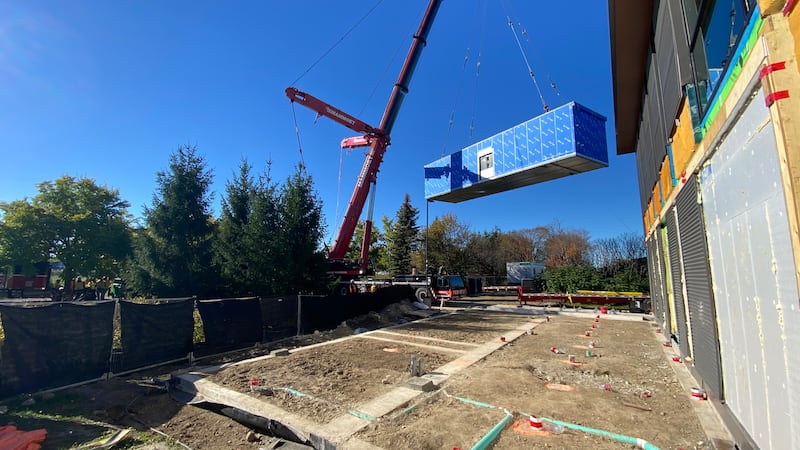
One thousand people marched through downtown Ottawa on Labour Day, celebrating workers’ rights while reflecting on a softening local job market and uncertainty surrounding Canada’s ongoing trade dispute with the United States. The annual parade brought together union members, workers, and their families on Monday, as the latest Statistics Canada figures showed the unemployment rate in the Ottawa area rose to 7.4 per cent in August, up from 7.0 per cent in July. For Tristan Mallett, a carpenter with Local 93, the outlook in Ottawa’s construction industry remains promising despite a slower stretch. “It looks like things are picking up again. Major infrastructure projects are going. So, we have the hospital, Lansdowne arena. If you look around the city, you can see a number of tower cranes going up every day,” Mallett said. He said construction activity has been more moderate over the past year and a half, but major infrastructure projects and private development are helping maintain steady work in the region. The broader employment picture, however, is creating concern for some workers. Sean McKenny, president of the Ottawa and District Labour Council, said uncertainty about the economy and the future of certain industries is weighing on union members. “Some folks are getting laid off because there just isn’t the product to build anymore. So, again, back to the unknown, back to the worry,” McKenny said. The Labour Day celebrations also came ahead of a new round of Canadian counter-tariffs on U.S. imports, set to take effect on Tuesday. The federal government says the measures are in response to American tariffs on Canadian goods. David Meinzinger, a security guard who is active with the United Steelworkers and Labour Council, said the trade dispute is affecting workers in industries with closely connected cross-border supply chains. He pointed to the automotive sector, where parts can cross the Canada-U.S. border multiple times during production. “If you’re adding 25 or 50 per cent tariff to a bumper that’s going from Windsor to Detroit, it’s, you know, it is hurting a lot of workers,” Meinzinger said. He said Canada should continue seeking new markets to reduce its reliance on the United States. Some sectors remain optimistic. Noah Vineberg, president of Amalgamated Transit Union Local 279, said transit workers are relatively insulated from the broader employment shutdown, although changing demands can create challenges. “Job security is always a concern for anybody, and I think we’re cushioned or insulated in an industry that, when society needs more public service, our particular industry is available to that,” Vineberg said. He said OC Transpo is continuing to hire and that the union is not currently seeing staffing reductions beyond natural attrition. However, he noted that changes in transit demand and working conditions can still affect employees’ work-life balance. For Mallett, continued investment in infrastructure and housing is providing reason for optimism heading into the fall. “Our private industry is moving along quite well. Housing is going up, rentals are going up. It seems that it’s a reasonable and manageable pace that we’re building things right now,” he said.