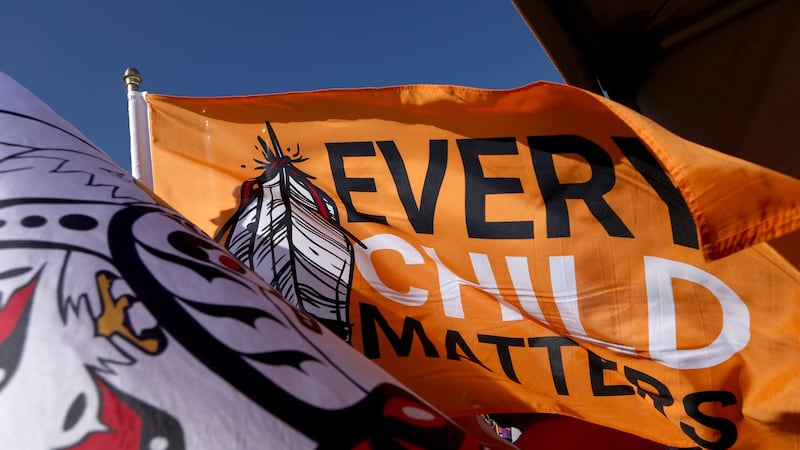
The ‘Every Child Matters’ flag was raised at North Bay city hall ahead Tuesday morning ahead of the National Day for Truth and Reconciliation. The event recognizes the damage caused by residential schools and honours survivors across the country. On Tuesday, dressed in orange shirts and sweaters, people gathered for a moment of reflection and healing. The pain of forced assimilation is etched on Nipissing First Nation Coun. Samantha Stevens. Her uncle attended the Dokis First Nation Indian Day School, a Roman Catholic federal Indian day school near Monetville. “This caused my family to move away from there and to be disenfranchised from the First Nation,” Stevens said. “Many people from Nipissing First Nation went to the Spanish residential school just down the road from us.” At Tuesday’s event, there was condemnation of an apparent white nationalist demonstration that took place at Tk’emlúps te Secwepemc native reserve near Kamloops, B.C. A video surfaced showing people wearing white masks and black clothing bearing patches matching those of the Second Sons, a white nationalist group. The Second Sons “see violence as necessary and inevitable to defend their movement, attack their opposition, and ethnically cleanse Canada,” according to the Canadian Anti-Hate Network. The group was seen displaying a sign on an overpass that appeared to question the existence of children’s remains at the former Kamloops Indian Residential School. RCMP is investigating. “Racism and denialism are well alive in Canada,” said Scott McLeod, the Anishinabek Nation Lake Huron regional chief. “It’s just simply disgusting that they’re taking space away from healing for Indigenous people.” McLeod and Stevens called for a law to criminalize residential school denialism. “Our people need to feel safe. There’s already been enough oppression and trauma suffered,” Stevens said. At the same time, McLeod is challenging both the Canadian and provincial governments to stop the “breach of the treaties” and using critical mineral extraction as a ploy to tear down Indigenous lands. “We have to make sure that those people are in a place where they can actually survive, maintain and live healthy lives,” he said. “That is legally irresponsible and cannot continue. The first on any list of national importance in this country should be upholding the treaties.” The last residential school closed in 1997. It’s estimated that more than 150,000 First Nations, Inuit and Métis children attended one of these schools that were aimed at assimilating them into Euro-Canadian settler society by destroying their culture and identity and suppressing their history. Of the Truth and Reconciliation Commission report’s 94 calls to action, independent watchdogs have reported that only 15 recommendations have been fully completed. The Canadian Government says that since 2015, Canada has been working with Indigenous partners to respond to the calls to action. The government says more than 85 per cent of the 76 calls requiring the federal government’s sole or shared leadership have been completed or are well underway. “We need more allies. We need people to fully understand the harmful wrongs that have been done to Indigenous communities,” McLeod said. “A lot of Indigenous people are feeling that truth and reconciliation or in Shirt Day is just becoming performative.” The 2021 Statistics Canada Census found North Bay’s Indigenous population made up about 10.7 per cent of the total. “It’s not just a day. It’s not just a symbol. It’s not just a platitude,” Mayor Peter Chirco said. “It’s something that we have to embrace. We have to continue to learn from past experiences.” Chirico remembered being touched when his granddaughter asked him about Canada’s dark residential school history after learning about it in her classroom. “It’s a dose of reality … when your eight-year-old grandchild comes home and says, ‘Grandpa, do you know that we were learning about Truth and Reconciliation and some children they took from their homes never came home again?’ How can you not be emotional about that?” he said. While Indigenous leaders are happy to see allies standing by them, they want to see it every day and not just one day of the year. “Moving forward and going to powwows and taking part in cultural events and making it safe to be Indigenous, that’s healing people that have suffered before,” Stevens added.