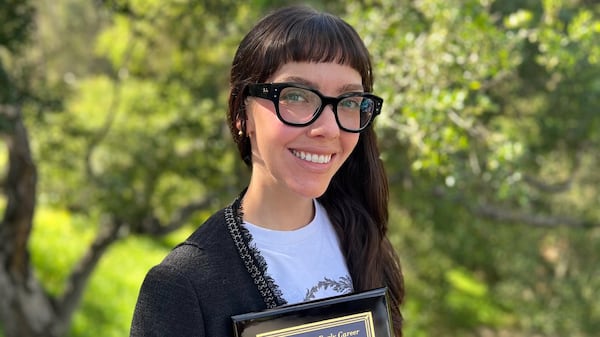
In a quiet lab, deep in the heart of the McGill University Research Institute (RI-MUHC) in Montreal, a researcher puts on a virtual reality (VR) headset. No, she’s not preparing to drive an F1 racecar or kill a horde of zombies. Rather, she’s taking a walk through a lung, searching for a way to combat severe respiratory complications. Armed with VR technology, a handful of 3D printers and a revolutionary idea, MUHC researcher and Canada Excellence Research Chair in Lung Regenerative Medicine, Dr. Darcy Wagner, and her team are on a mission to make lung transplants a thing of the past. The researchers are creating 3D-printed patches, or bridges, which can bypass damaged sections of a lung to connect healthy tissues and encourage cleaner airways. The first step, Wagner explains, was to formulate specific inks that are compatible with tissue in the respiratory system. “We are making lung-specific inks. I would not recommend using the inks that we have for heart or for skin,” she said. “We really try to bring tissue specificity to what we are generating with that, and we hope that that’s going to lead to better outcomes in terms of what we can generate, that it’s closer to what lung or airway tissue is like in the body.” Wagner, who is also a mechanical engineer, says she was in Munich, Ger., when the idea for the project first came to her. “We actually made a pretzel,” she said. “I know it sounds pretty cheesy, but this was the ‘aha’ moment that I really believed that it was possible, when we first found materials and process, that we could actually make something that looked like a complex object that otherwise would be very difficult to generate.” One of the many complications the lab is facing is how complex the lungs truly are. Some areas are so small that a printer simply can’t mimic the microscopic details. “In the area where we have gas exchange, we have features that are one micrometre [one-millionth of a metre], so extremely tiny, and we’re not able to print those yet,” said Wagner. The researcher says her hope is to get as close as possible using the printers, and then find a way to give the body’s natural cells the right cues to do the rest on their own. Though the research is still in its infancy, it has already shown great promise. “We actually saw that when we transplanted, we had these cues that these vessels from the eventual recipient, that they could actually grow into the grafts that we transplanted,” said Wagner. A complicated surgery Worldwide, about 7,000 lung transplants are done every year. In Quebec, only one hospital, the Centre hospitalier de l’Université de Montréal (CHUM), is equipped to perform the complicated, precise procedure. According to the most recent statistics by Transplant Quebec, 14 people are currently on the waitlist in the province. “We really can’t transplant as many of those lungs as we can, for example, kidneys or hearts,” Wagner explains. She notes that due to climate change and longer life spans, more people are being affected by respiratory issues, and there is a dire shortage of organ donations. “If you are really lucky enough to get one of those rare lungs that are eligible for transplantation, you have the worst outcome of any solid organ transplants right now,” she laments. Propelling innovation Wagner, an American who was working in Sweden prior to coming to Montreal, was recruited by the MUHC as part of its push to propel innovation. “Recruiting people like Darcy to come and work at the MUHC is really important to ensure that our community has access to the latest and greatest and excellence in health care,” said Marie-Hélène Laramée, MUHC Foundation President and CEO. She points out that the foundation is drawn to, rather than repelled by, curious ideas and research that could one day revolutionize the world of science and health care. “We are very aware that technology and AI are fields that are propelling research forward, and one of the biggest pillars in our mission is supporting innovation,” she said. Wagner’s research is still far from human trial, but if eventually approved, may one day save many lives.