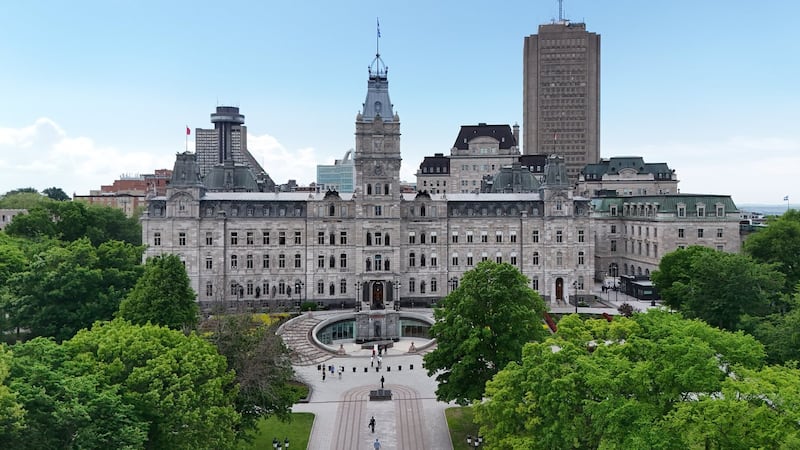
Premier François Legault announced the introduction of special legislation to break the deadlock in negotiations with doctors. The bill will be introduced on Friday if no agreement is reached between the government and the doctors’ federations by then. “If we can’t reach an agreement by Friday morning, we will introduce a bill to change their method of remuneration and put an end to the pressure tactics,” the premier said in a video posted Wednesday evening on social media. “We are not doing this against doctors, we are doing this for Quebecers,” Legault said, who addressed the public to take stock of the “persistent” impasse between the government and doctors. Earlier on Wednesday, the government had tabled a fourth offer, which was rejected the same day by the Fédération des médecins spécialistes du Québec (FMSQ), while the Fédération des médecins omnipraticiens (FMOQ) expressed its dissatisfaction with the proposal. “This morning we received a proposal that is a declaration of war, an ultimatum ... we are facing an affront,” said FMSQ negotiator Lucien Bouchard at a press conference in Montreal alongside the federation’s president, Vincent Oliva. The FMSQ did not accept that this offer was “final,” and for its part, the FMOQ also stated on social media that this “final and non-negotiable” offer did not demonstrate a “genuine desire to restart negotiations and find mutually agreed solutions.” Quebec, however, argued that its offer met the doctors’ demands and added at least an additional $800 million over four years, in the hope of concluding the negotiations once and for all. It is a “pseudo-offer” that even includes “some setbacks,” said Dr. Oliva, who believes there is a “high risk of disengagement” among his “angry” members, in his words. The issue of compensation is at the center of the negotiations, with the government seeking to pass Bill 106, which would tie 15 per cent of doctors’ compensation to the achievement of performance indicators. “This is not the time to bash doctors,” argued Dr. Oliva. Hoping to pressure the government into backing down on this measure, the two medical federations have put teaching medical students on hold. “The unions are delaying the arrival of new doctors with their pressure tactics in teaching. We cannot accept that,” said Legault. The Liberal Party also stated that the conflict had “gone on long enough.” In a press release issued Wednesday evening, it called on the government to suspend Bill 106 and draft a new bill in collaboration with doctors. “Given the state of our health-care system, we can no longer afford to spend time and energy on battles that lead nowhere,” said Marc Tanguay, the Liberal health critic. Like the government, the PLQ is also asking doctors to stop using pressure tactics. Injecting money into the healthcare system. Both the FMOQ and the FMSQ have taken a hard line in recent months, opposing Bill 106. Among other things, the federations argue that doctors are not solely responsible for the failures of the health-care system and that they need more resources, such as extended opening hours for technical facilities and operating rooms. Quebec therefore proposed to remedy this with its offer on Wednesday: an additional $100 million per year over four years would be allocated to increase the availability of operating rooms for a total of $400 million. In addition, an additional $50 million per year was offered for family medicine groups (GMFs), for a total of $200 million over four years. The government also added $30 million per year over four years to add professionals to the Centres de répartition des demandes de services (CRDS), which refer requests for specialist consultations (total $120 million). This would allow for the hiring of nearly 300 people to reduce waiting lists. In addition, Quebec committed to investing $40 million per year over 10 years in the CRDS to modernize their information technology equipment. The total will therefore be $160 million over four years and $400 million over 10 years. Another concession: the government wanted to link the compensation of the vice-presidents and president of Santé Québec to the achievement of the same performance targets set for physicians. Finally, the government was prepared to limit some of the minister’s discretionary power: there could be no changes to the regulations for a period of two years. This report by The Canadian Press was first published in French on Oct. 22, 2025. By Samira Ait Kaci Ali and Patrice Bergeron, The Canadian Press