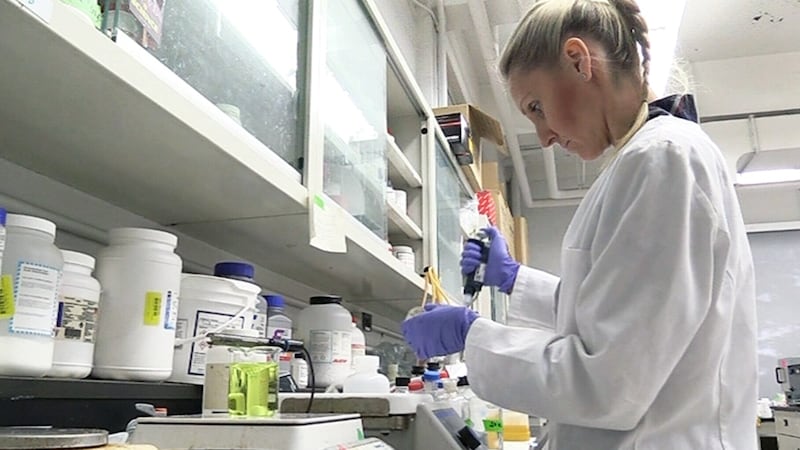
Researchers at Western University are using lessons learned from the COVID-19 pandemic to help fend off future viral diseases. And while we stayed home, kept our distance, and masked up - it was during COVID that the medical community found out just how much more there is to learn about viruses and pathogens. “So, we found this out during the pandemic, that, you know, you hear all the time, someone say, ‘Oh you have to be three metres away to have protection against someone who might cough or sneeze on you.’ Well that was really just based on models. It wasn’t really verified. And that understanding just goes way beyond just that three metre rule, or various other things that we practiced during the pandemic. And that’s because we were just erring on the side of caution,” explained Eric Arts, Schulich Medicine & Dentistry professor and Canada Research Chair in HIV Pathogenesis and Viral Control. But such scientific predictions could soon become more certain, as Western University has begun construction on a $44 million Pathogen Research Centre. Located in the Western Research Park off Windemere Road, the centre will house two facilities. Firstly, a Good Manufacturing Practice, or GMP, designed to manufacture products for clinical trials on humans. Secondly, a microbial transmission facility. A first of its kind in the world, it will enable scientists to test how viruses like influenza or COVID-19 spread through the air in real-life settings. “We will release the virus into those facilities, and using mannequins that are mimicking human respiration, and will have human lung cells in them, we can see how you transmit from one to the other,” said Arts. Just as important, he says the facility will work with industry on how to mitigate transmission. “You know, through various air filtration systems, UV systems, things that we were doing in the pandemic, but had to do in very small scales because no one in the world had a facility where you could do this in a real-world situation,” explained Arts. The two new facilities will operate alongside Western’s existing ImPaKT facility, which studies how diseases behave inside the body. ImPaKT Operations Director Rick Gibson says it’s about producing home-grown solutions. “Very costly to send these kinds of things overseas and then back. And I think we’re trying to solve the problem of being able to it all here, locally, affordably,” said Gibson. The new Pathogen Research Centre is also expected to produce economic dividends, helping further solidify London as a medical research hub. The centre is expected to attract even more medical industry to the region, and almost right away. “But we anticipate bringing millions of dollars of industry to London within the first years of operation,” said Gibson. The Pathogen Research Centre is expected to open in 2027.