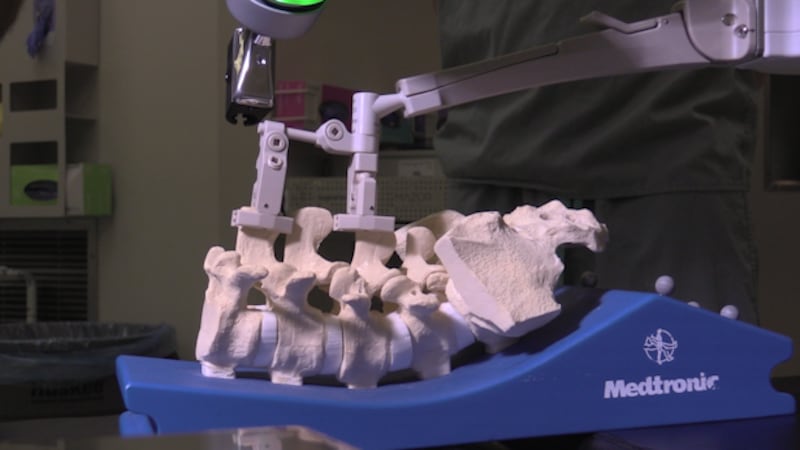
Children’s Hospital at London Health Sciences Centre (LHSC) has become the first hospital in Ontario to use a robotic spine platform to correct scoliosis in a child. The Medtronic Mazor robotic system is designed to help surgeons plan spinal procedures using detailed images of a patient’s spine before surgery, then guide them during the operation. 14-year-old Paige Hillman was experiencing back pain that was affecting her everyday life. Her doctors confirmed she had scoliosis, an abnormal curvature of the spine and recommended surgery. Paige’s mother, Melissa Hillman, says she was especially concerned because she also lives with scoliosis. “I have scoliosis as well. I am in a lot of pain and so as soon as I noticed it on her, I wanted to make sure that she gets treated for it. So she’s not in any pain because I don’t want her to feel like I do all time,” Melissa said. Paige became the first paediatric patient in Ontario to undergo scoliosis correction using the Mazor platform in March 2026. The technology combines detailed imaging with robotic assistance. Surgeons can map out the procedure before entering the operating room and use the robot to help guide the placement of screws in the spine. Dr. Patrick Thornley, a paediatric orthopaedic surgeon at LHSC, says the technology represents the next step in spinal surgery. “We’ve modernized that to use navigation, which is intraoperative or preoperative, utilizing things such as a Cat scanner which will come around the bed three dimensional as the spine. And then we’ll use navigation, sort of like a video game to place screws in the spine. And this is sort of the next step forward, which is using the robot to help align us to the pedals, and then utilizing the robot’s arm to place these screws in a safe way,” Thornley said. For Paige, the robot was used to help place some of the most challenging screws in her spine. A task that can take about 20 minutes manually took roughly three minutes using the robotic system. Thornley says there is a learning curve when introducing new technology, but the robot can significantly reduce the time needed during certain parts of surgery. “There’s a big learning curve anytime you adopt new technology. And we’re still experiencing that with the robot for sure. Once the robot is up and running, our time to instruments, once we’re actually doing that is dramatically reduced. Even in this as our first case here. We saw that for sure,” Thornley explained. The spinal correction itself took less than four hours. Thornley says one of the most noticeable changes for patients can be their confidence and how they see themselves following surgery. “The biggest change we see immediately for patients is that they have a dramatic improvement in their self-image score. So how she perceives herself and how her friends and parents and other caregivers see and experience Paige. And she’s been really happy with this,” Thornley said. For Paige, the biggest change has been being able to live without the pain. “Before the surgery, it was really hard to do a lot of stuff. And then now after the surgery, I can do a lot of stuff without my back hurting, it changed my life a lot,” she said. Her mother says the improvement has been clear. “It’s great because she can do the normal everyday stuff that sometimes I can’t do. So it’s nice to be able to see that she’ll be able to do that,” Melissa said. Children’s Hospital is now one of three LHSC sites using the Mazor robotic platform. The robotic systems were funded through the London Health Sciences Foundation.