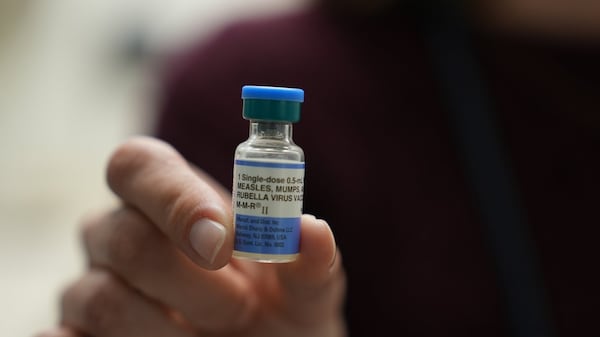
A Saskatchewan woman who contracted measles last month wants more people to get vaccinated against the disease to prevent others from getting sick. Michelle Knorr, 55, was hospitalized late last week after fighting a high fever, body shakes, dehydration, vomiting and diarrhea for several days. “I just kept on thinking it was the worst flu bug I had ever had in my life,” she told CTV News from her home in Kindersley. “Once the rash hit, I knew it was a problem.” A bright red rash extended from Knorr’s scalp all the way to the tips of her toes. It radiated heat, she said, and caused the pores in her face to stretch from the swelling. “I felt like I was on fire,” she said. The blotchy rash is a telltale sign of measles, which often appears a few days after the initial symptoms. Knorr was taken by ambulance from Kindersley to a hospital in Saskatoon. She had to be treated for sepsis, high blood pressure, jaundice and liver damage that led to hepatitis. “If I would have been a less healthier person, I might not be here today. I was in very critical condition,” she said. The latest data from the Government of Canada shows there were 1,117 confirmed measles cases in the country as of April 19. Ontario has recorded the most with 993 cases, followed by Alberta with 120. Knorr joins at least 12 others who have tested positive for measles in Saskatchewan this year – the highest amount of people to contract the disease in the province since 2014 when 16 patients got sick with it. The substitute teacher believes she contracted the disease from one of the schools where she works. “It’s beyond frustrating because as teachers, we’re given a lot to deal with but the least of which we should have to be worrying about is a 19th century disease,” she said. Measles vaccines are offered routinely in two doses. They are typically given at 12 months and 18 months of age. Knorr falls under the age group that received a single dose of measles vaccine before a second one was made routine. “That second dose of measles vaccination was added in 1996 in most parts of Canada,” said infectious diseases physician Dr. Isaac Bogoch. “There were catch-up campaigns, but they were far from perfect, and there are people walking around who have had a single dose of a vaccine.” Canadians born before 1970 are presumed to have acquired natural immunity to measles, according to the federal government’s website. “This is largely an infection in people who are born after 1970, and usually in younger cohorts who are not immune,” Bogoch said. Knorr counts herself lucky. She is back at home and on her way to recovery. Her rash has faded but she’s still tired and dealing with lingering symptoms. She wants to remind others that her situation was preventable through vaccines. “This didn’t have to happen. It did not have to be like this for me,” she said. “There’s no way a measles virus should be running rampant.” Two doses of measles vaccine are “extraordinarily effective” in preventing the infection, Bogoch said. A single dose is “pretty good,” too. People with a single dose of vaccine should receive a second dose if they are travelling to or living in areas where there is an outbreak, he recommended. If a person is unsure how many doses they’ve received, Bogoch said it is a good idea to consult a healthcare professional. With files from CTV’s Kristen Yu