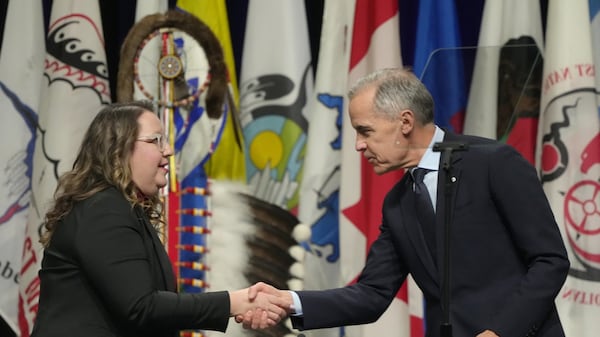
Prime Minister Mark Carney and Premier Danielle Smith will update the state of the pipeline deal between Ottawa and Alberta on Friday. Adam Legge, president of the Business Council of Alberta, discusses the reaction in the province’s business community. This interview has been edited for length and clarity. Michael Higgins: It certainly appears the federal and Alberta governments are a whole lot closer to getting the pipeline memorandum of understanding (MOU) over the finish line, details of which we’ll find out tomorrow on Friday. What’s your read on the signal this sends to Alberta’s business community? Adam Legge: We’ve seen a change in this federal government’s belief about our natural resource sector and growing our export capacity to other markets, which is a welcome change from the previous administration. That is a tremendously positive signal. It’s a sector that largely has been held down for the better part of more than a decade, and just really has not been able to contribute to Canada’s success and prosperity. We’re very happy to see that we have a federal government that really understands the importance of our energy sector and the ability for it to contribute to the prosperity of Canadians. We’ll see what the agreement says in terms of some of the finer details. MH: Might it be enough to tip the scales on investor confidence, even though there are still potential hurdles for a pipeline going forward, lack of a commercial proponent, challenges that may come with consultation? AL: I think, overall, industry will be disappointed with the fact that there still will be an industrial carbon price. There have been a lot of calls to ensure Canada can be competitive in that we don’t really have any other global centres or nations that are oil-exporting nations that are putting a price on their oil at this time. So this is a bit of an uncompetitive position. The devil will be in the details in terms of the full package, in terms of what does that mean, versus, say, some of the offsets, credits, incentives, et cetera, for the carbon credits. There may be some creative work that’s been done to make a more enticing package, but at the end of the day, it’s important to recognize this is a pure cost to industry. They’ll evaluate the opportunities in front of them with respect to what that price looks like, and then after that, it really is about if the decision is that they can produce more and that they can fill additional pipelines. Is the regulatory environment going to be supportive of a very fast-tracked and expedited pipeline approval? Will those projects be protected from litigation? And, frankly, will the provincial and federal governments work together to make sure that we can actually produce more and grow production of oil to fill those pipelines? MH: Does this turn a page where there may be any uncertainty over the status of a possible referendum on separation? AL: The message that we’ve been sharing with Ottawa is that Albertans are frustrated, and they’ve been frustrated for quite some time. The MOU is a signal that the federal government understands the importance of Alberta’s contribution to the economy, largely through its resource sector, but the MOU in and of itself will likely be insufficient to really be enough of a message to Albertans that Ottawa is serious. It’s a very important message that it sends and that government does understand and appreciate Alberta’s energy sector. But there are a variety of other long standing grievances that Albertans have, everything from equalization and the amount that Alberta contributes to federal coffers, et cetera. I do think Ottawa does need to think a little bit more about a message to Alberta, that it’s important it wants to remain in the federation, but I think this will go a long way to addressing some of the concerns that many Albertans have about Alberta’s position in the federation. MH: Adam, are you able to give us a sense of the degree of impact the whole separation dialog is having on Alberta’s business community? AL: It’s very dependent upon the industry and the stage in many companies’ life cycles. We have heard from some of our members that it is impairing their ability to do business or their ability to attract investment. Frankly, any conversation of separation and the uncertainty that it creates is not a good look for Alberta, it’s not positive for the business community, it’s not positive for the investment climate. But given that it is still an uncertainty and yesterday’s court ruling cast further uncertainty about separation, there really hasn’t been a widespread implication or challenge to Alberta’s economy. It’s still a hypothetical in many ways, so I think people will be waiting to see whether a referendum question actually is going to be voted on, and what the outcome of that would be. Overall, it’s not a positive for our economy and our investment climate, but I would say, from what I’ve heard, the number of companies that are actually facing challenges right now are limited. MH: Your organization came out just this week with its spring economic snapshot for Alberta. How do you see our province faring compared to the rest of the country? AL: The economic picture for Alberta has changed materially as a result of the situation in the Middle East and, frankly, that’s not through any work of our own. It’s just the fact that so much of our economy is tied to the commodity markets and particularly oil prices. The higher the oil prices are, the more the economic value that is generated through that and hence, the more royalties and the more taxes that are paid. So the economic outlook for the province has improved on the back of a higher oil price globally. It’s not through any endeavors of Alberta’s making that are really going to be about driving the economy. There’s some positive developments there in terms of everything from defense and advanced manufacturing and technology, but the real story around Alberta’s economic prosperity shift from when the premier delivered the last budget is really the story around oil prices. That can change, it can go south as quickly as it went north and so we have to be thoughtful that this is not necessarily a long-term shift and so we need to be very thoughtful about what we do with those additional revenues that the provincial government is taking in right now.