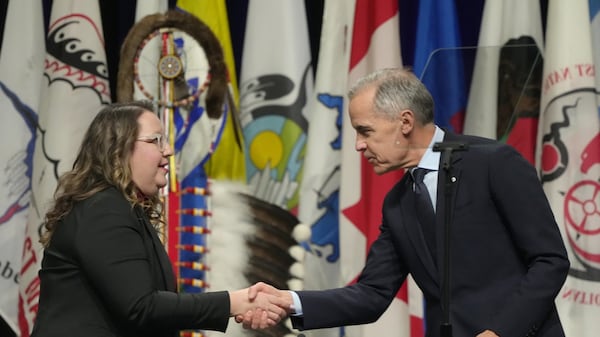
Federal Conservatives have sent a letter to Prime Minister Mark Carney, calling on his party to show some “backbone” in ongoing trade negotiations with the U.S. Conservative MP for the riding of Calgary Heritage Shuvaloy Majumdar discusses this topic with Alberta Primetime host Michael Higgins. This interview has been edited for clarity and length. Michael Higgins: The Canadian team is remaining tight-lipped for now, but word is the two sides aim to put a trade deal in front of the U.S. president early next week. What does that say to you about progress in these negotiations? Shuvaloy Majumdar: We’ve had a year and a half of the prime minister approaching this entire negotiation with a wait-and-see approach. He failed to make the big decisions on our commodities, our manufacturing base, and other things that would have been positive incentives to negotiate for North America, for Canada. Only in the 11th hour, after having provided concession after concession after concession, he’s now negotiating terms with Washington on terms that he did not define. Remember, these negotiations were imposed on Canada through these unjustified tariffs by Washington, and have brought the prime minister to the table. This is after he spent several months pursuing a wait-and-see approach, turning to Beijing, organising middle powers, not making the big decisions to unleash domestic strength. It’s sad to see that we’re negotiating this from a position of weakness, and so we’re calling on the prime minister to make the big decisions that Canada needs, to use these positive incentives, for example, strategic reserve for energy and critical minerals, an auto pact 2.0, a defence industrial base that’s reanimated, all the big things that should have been happening and we’ll see what we’ll see what these negotiations result in. I know there’s a lot of Canadians feeling a lot of anxiety right now. MH: The message in your letter to the PM was that Canada should be negotiating from a position of strength, stop the concessions, and show some backbone. To what degree does that reflect an elbows up moment for your party? SM: Our party has been consistent about these positions for several months. Pierre Poilievre won the consensus in this country on the direction that we needed to take when it came to unleashing our resources and ending anti-development legislation on shovel-ready projects within six months, on things like renewed manufacturing base with auto pact 2.0, on being able to establish a strategic energy and minerals reserves - we’re the only G7 country that doesn’t have one with scalable capacity to stabilise markets for tariff-free access. All of these things were things that Conservatives have been proposing, a backbone for our country, the kind of strength that we need all along. The prime minister’s intransigence with that … Instead he turned to Beijing, turned to organised middle powers and other countries, rather than focusing on the 75 per cent of trade that Canada needs to focus on with the United States and how that relationship would be managed, he pursued wait-and-see. That came out as a confession when he went to New York to say that Canada is going to build its strength to make America great again. That was a real turning point for him because it was an admission that everything he had done prior to that was essentially putting Canada in a position of weakness. MH: To expand those U.S. trade opportunities, could that not need concessions on the Canadian part? SM: I think a lot of big decisions need to be taken for Canada. Whether it’s things like repealing the Netflix tax, which was a decision Canada needed to make, whether it was thickening our border, which is a decision Canada needed to make, to unleash our resources or critical minerals, which are decisions Canada still has to make. These are all decisions that Canada needs to make and should be woven into a comprehensive negotiation for Washington and for the world. That’s something that the prime minister has failed to accomplish and that’s why we don’t want to see any more concessions. The country has offered up so much to Washington, expecting things back in good faith and received nothing to show for it. We need the government to stand for the Canadian worker, particularly for those who are tariff-affected in aluminium, in steel, in lumber, and in various kinds of manufacturing industries that have been impacted so hard. I think it’s important that Canada has a government that has the self-respect to fight for our own people and our own sovereignty. MH: Where relations are concerned, what’s the position of your party on the petition to be tabled in the House calling for U.S. Ambassador Pete Hoekstra to be declared persona non grata? SM: Canadians have had to deal with Republicans and Democrats across generations in terms of our relationship with the United States. Our geography is North America, which defines our national and economic security. We should be able to have a negotiation with different counterparties, no matter how tough it gets. So, I think that while I understand the sentiment that many Canadians have about this administration and how President Trump has been using Canadians as a punching bag - none of us stand for that - it’s important for us to stay focused on the Canadian worker and doing the best possible diplomacy we can to accomplish the certainty that they deserve. MH: You have a background in foreign policy prior to being elected to Parliament. If it is that the two sides are unable to land a deal by that Trump-imposed deadline a week from today, what should Canadians then expect of the Carney government? SM: Having been an advisor to Prime Minister (Stephen) Harper and others, I can tell you that trade negotiations are indeed complex. The prime minister has the support of Conservatives to make these big decisions, to grow the backbone he needs, and to deliver a good deal for the country. He has our sympathy as well in dealing with a tough and unpredictable negotiator. So, it’s probably better for me to wait to see exactly what this negotiation produces, whether it’s a deal or not, to review the facts of what has been delivered, and then to come back and offer views at that point.