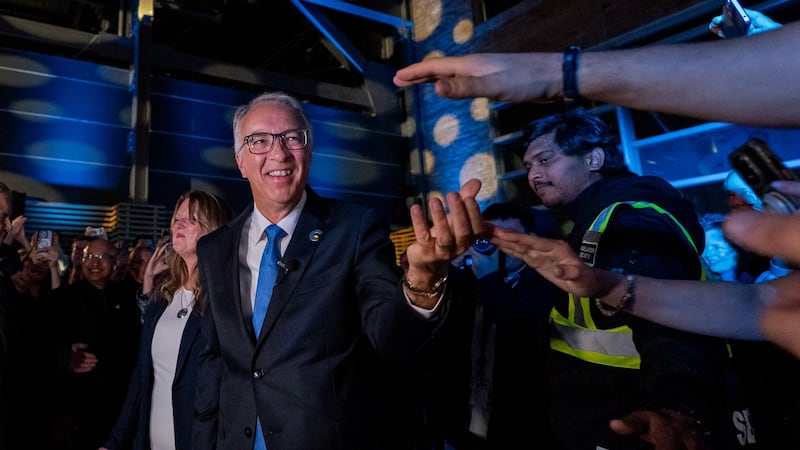
Michael Solberg, a partner at New West Public Affairs and former Stephen Harper government political staffer, discusses Pierre Poilievre’s upcoming leadership review with Alberta Primetime’s Michael Higgins. This interview has been edited for length and clarity. Michael Higgins: How would you describe anticipation heading into this leadership review? Michael Solberg: I think anticipation is very high. I think Conservatives are eager to convene and get back together as one party under one roof, and of course, at the beating heart of conservatism, which is, of course, in Calgary and Alberta. Ultimately, all eyes on Pierre Poilievre, where we’ll see him in his truest form, as this is a venue he can totally curate. The schedule, the speech – everything is firmly under his control. So I think we’ll see him at his best at a very interesting time for the party. They’re looking for renewal. Not perhaps in terms of who their leader is – but ultimately, if they can beat Mark Carney. If they can finally defeat the incumbent Liberals. And I think there is a sense among some members in the lead up to this convention that we’re probably on the eve of another election. So I suspect that the rhetoric, the speech, the energy, will all reflect a party that’s ready to once again hit the pavement and ultimately hit the polls. MH: How much effort will either the party or the Poilievre team put in ahead of this vote? MS: That’s been the primary focus of Pierre Poilievre, of party leaders, to focus on this leadership review. I think an enormous amount of resources and time has been put into the planning of this convention, into reaching out to delegates, working with constituency associations, because they want their leader to have the broad endorsement from party members and party delegates so they can put this behind them, and then get to the real work. Which is, of course, planning for another campaign and another election, and figuring out how they can differentiate themselves from Mark Carney, propose an alternative view to Canadians, a Conservative view and a Conservative alternative to Canadians. They’ve racked up consecutive losses here, and that’s not lost on members. We’re pushing now well over a decade here of Liberal incumbent rule. And Conservatives want to change that. And I think they want to do it with Pierre Poilievre, and they want to get to the task of actually planning for that campaign, which will happen after this convention is over. MH: Polling out from Nick Nanos this week puts the Liberals and Conservatives within five points. However, when it comes to the leaders, Mark Carney sits at roughly 53 per cent compared to Pierre Poilievre at 25 per cent, and there are similar numbers from Angus Reid. How heavily do you expect some of those numbers will weigh on party members when they take into consideration the bigger voting perspective? MS: It’s no doubt a concern, I think, of members. It’s obviously got to be a concern of Pierre Poilievre himself. If this race does centre again on personality, that, of course, does not favor the Conservatives. Those numbers are not new. Pierre Poilievre has been trailing Mark Carney on the preferred (prime minister) metric for quite some time. So do I think that they’re going to go and vote with this in mind? Probably. I think certainly some will. But really, there’s no alternative right now, and Pierre Poilievre has remained popular. At least, he’s been able to keep the Conservative Party, broadly speaking, popular in that two-party horse race polling metric. So I think there are ways that they have to correct for that, and I think that centres on policy. They have to avoid this Pepsi-Coke scenario that they’re suddenly in with the Liberals. On the big policy issues, they’re very, very similar and and in the absence of policy differentiation, it could center on personality – and as I just said, that does not favour Pierre Poilievre. You know, 10 years ago, a 35-point basement would have won them a majority government every single time. Obviously, the landscape has shifted significantly with the ushering in of the new era that we’re in, the two-party system that we’re in with the eradication of the NDP. But Pierre Poilievre has done an enormous amount to keep the party competitive, and I think party delegates will vote with that in mind as well. MH: How much of a focus do you expect there to be on the percentage outcome? How much will that fixture end up mattering? MS: You just need 50 per cent plus one, technically, in order to stay on. But every leadership review has different expectations for where they should be in order to really capture that broad support and feeling like they’re leaving with some momentum. I think in this case, 80 per cent plus is probably what Pierre is looking for. I point to Stephen Harper’s leadership review in 2005 after the 2004 election loss where he got 83 per cent. I think Pierre Poilievere would be looking for similar numbers to put questions about his leadership behind him, unify his caucus once again, grab a tighter hold on the leadership again, and then march them into what’s very likely the eve of the next election, which I think will be very, very soon. MH: On your earlier point about the importance of this being in Alberta, on Alberta dynamics, what are you watching for? Maybe conversations around the drive for separatism; how dominant a talking point might that be on the floor? MS: I’m not sure it will be, again, because this is the one time where the Conservative party can control every aspect of the venue. It’s not the interest of the Conservative Party to be distracted, I think, by what so far is a provincial issue. Yes, it’s about an issue that affects the Confederation as a whole. And ultimately, I think the party needs to have a viewpoint on this. I don’t think they have a viewpoint of anything but Alberta should remain in the Confederation. This is a national party, after all. Pierre Poilievre is vying to be the Prime Minister of Canada, after all. It’s possible that they weigh in on this, but I think the controlled message out of the convention will be that the Conservative party is ready to form (the) government of a unified Canada with Alberta within it.