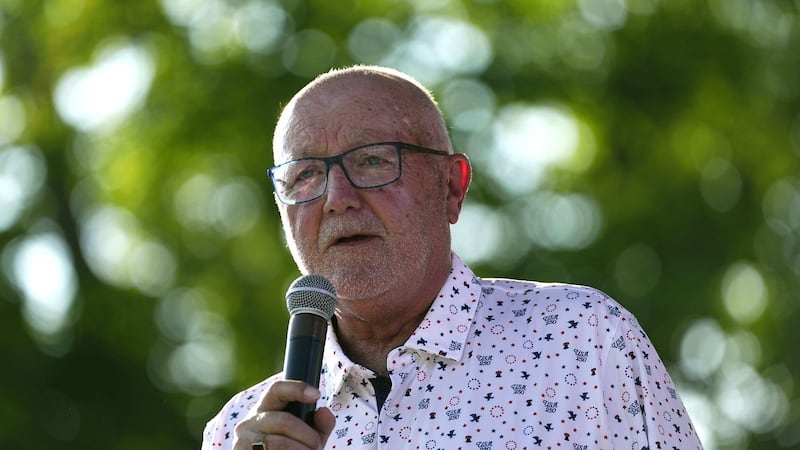
A man leading a movement against artificial intelligence data centres in Alberta says provincial officials can expect to get an earful at an upcoming town hall. Ben Baril says he and other protesters will be at an Aug. 20 hearing in Sturgeon County to tell Premier Danielle Smith’s government that true public consultation would mean halting the projects until concerns are addressed. “If there’s an open mic portion (at) these halls, we’re gonna try to flood it as much as possible,” said the 20-year-old business student at the University of Alberta. “If they were genuinely interested in public opinion on this, then they would have held the public consultation before they had already approved all of these projects.” Data centres are physical facilities that house the computing hardware needed to store and distribute information for a variety of tech applications that use AI. They are popping up across the country, and a study by York University’s Schulich School of Business has found that Alberta is at the epicentre of that boom. In July, Alberta announced that the tech giant Meta is building a massive facility in Sturgeon County, north of Edmonton. The government has also said other AI data centres are in the works. Meta’s facility is set to be online in the next two to three years. Alberta’s government calls the more than one-gigawatt and $13-billion facility the largest AI data centre investment in Canadian history. The announcement raised some eyebrows. Baril organized a protest earlier this month outside Sturgeon County’s office that opposed Meta’s centre and other data centres planned for the province. The rally drew hundreds of attendees. Protesters said the community wasn’t consulted on the Meta centre, and that the government hasn’t been transparent about the others planned for the province. They also expressed concerns that Meta’s operation will increase their water and utility bills and create noise because these facilities use a lot of electricity and water to both power and cool hardware. Some were against the use of artificial intelligence altogether. Days after the protest, Alberta announced the town halls. The event in Sturgeon County is one of four the province will host, with the first one scheduled for Aug. 19 in the central Alberta town of Ponoka. Technology Minister Nate Glubish is hosting the events. “We know Albertans have questions about AI data centres, and they deserve clear, factual answers,” he said in an email Tuesday. “These town halls are designed to provide Albertans with information on what data centres are, why they’re being built here, and the opportunities they create.” He said the meetings will address concerns Albertans have publicly expressed, and attendees can ask questions. The government has also launched a website describing what data centres are, how they will impact bills and the environmental impact assessments they are required to undergo before they are approved. “This website puts the facts about power, water and community impact in one place, so people can see for themselves how Alberta is responsibly developing AI data centres on our own terms,” Glubish said last week. Last month, Alberta’s Opposition NDP launched its own AI consultation tour. The next one is planned for Wednesday. The NDP said the government wasn’t listening to concerns from Albertans so it will listen instead. “The premier has made her position clear - AI data centres are coming to Alberta, whether Albertans support them or not,” the NDP said in a statement. “The Alberta NDP supports investment and good jobs. But major projects must be in the public interest, transparent, and supported by communities.” Alberta has set up a “concierge” service to attract so-called hyperscale developers to set up shop in the province and help companies navigate provincial regulations. The new government website on data centres said some will develop their own on-site energy. Others will use a combination of on-site energy and surplus energy from Alberta’s grid. For example, in Meta’s case, Smith has said the corporation will use Alberta’s surplus energy to power the centre until a new natural gas-fired plant — called the Greenlight Electricity Centre — starts powering it in 2030. The Alberta Utilities Commission has said it reviews applications for any utility infrastructure required to support a data centre, such as electric power plants, transmission lines and natural gas pipelines As for water, the government says it will assess every drop centres want to use. “Every drop a data centre wants goes through the same Water Act review as any other industrial project,” the website said. “A newly issued data centre licence is the most junior in its basin: last in line in a shortage, first to be cut off. Household water needs no licence and is never curtailed.” Smith has said Meta’s data centre will also use the same amount of water used by a typical golf course and features a closed-loop water cooling system so it won’t draw water from the surrounding area. Alberta’s government said every facility must also go through an environmental assessment. Baril said the government’s reassurances on Meta and other data centres aren’t enough. He said he worries about the impact their massive energy consumption will have on the environment. A recent United Nations University report said the environmental footprint of data centres globally already rivals some of the world’s largest countries. “Citizens should have a say,” Baril said. “If people are not in favour of it, then they just shouldn’t be built.” This report by The Canadian Press was first published Aug. 11, 2026. Fakiha Baig, The Canadian Press