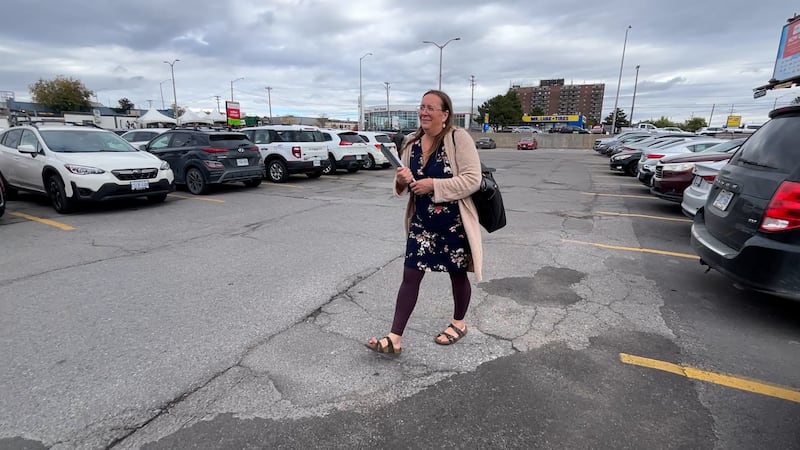
Katherine Strongwind had been looking for her biological family for several years. She was only a year old when she was taken from her family in Winnipeg in 1973. She was adopted and placed in a non-Indigenous home in the city. “I always knew I was adopted, I always knew I was Indigenous, but I didn’t know what my connection to the community was,” she said. In 2015, Strongwind put in a request for her birth certificate, which had her biological mother’s name listed. Her biological father’s name, on the other hand, was not listed as her parents were not married. “They wouldn’t give it to me at the post-adoption registry, so I didn’t have anything to search for his side of the family,” she said. Three years later, she was able to get a record of her father’s last name, which was Dumas. She then hired a genealogist and sifted through hundreds of groups on Facebook, determined to find out about her past. She eventually tracked down biological siblings and extended family. “I didn’t know that I had four siblings and that my parents had passed away before I turned 11 years old,” she said. “It was a long process.” The next step for Strongwind was to meet her siblings. She got in touch with her brother and had plans to meet him. “There was a lot of pressure on my biological brother to meet in a public setting,” she said. “Looking back, I think maybe we should have done something a little low-key where media was not involved and taken a step back a little bit.” She did find other siblings and tried to connect with them on numerous occasions, but that has been a challenge. “They have refused to meet,” she said. “When I came looking for family, they were surprised. They didn’t know about me, and they were suspicious about who I was what I was looking for.” In addition to finding no success in meeting her siblings, she also never knew her parents or her grandparents, who have since passed on. “It was difficult to navigate that connection to community and try to reunify with siblings without some kind of intervention,” she said. “It’s really sad.” Strongwind is one of an estimated 20,000 Indigenous children who were taken from their homes between the 1950s, all the way to the mid-1980s. Many were removed from their families and placed into non-Indigenous homes across Canada and around the world. Survivor Jonathan Hooker from New Zealand returned to Manitoba for the first time in 50 years on Wednesday, after tracing his roots back to Moose Lake in northern Manitoba. ‘Extension of the residential school system’ Karen Froman says thousands were put in foster care and placed for adoption for decades, but she says the term “Sixties Scoop” is misleading. “It gives people the idea that ended in the 1960s, when in reality, this is still happening today,” said Froman, who is a history professor at the University of Winnipeg. She said the idea of the “Sixties Scoop” was a combination of government policy and a misunderstanding on society as a whole, as it related to social issues. “Rather than looking to solve these social problems that are a direct result of government policies, the easier solution was to remove our children from us, which is unfortunate,” she said. Froman says the long-lasting negative effects on survivors is considerable – ranging from a loss of cultural identity to feelings of shame. “A lot of these adoptees are learning about their true heritage later in life,” she said. “And a lot of them were lied to. They were told they were either French or Italian to explain why they were a little bit brown.” “Imagine being a parent and having a social worker come into your hospital room and demand that you give up your child for the sole reason that you’re an Indigenous mother that happens to be on social assistance, or you’re a single mother,” she said. “We would not do this to a Canadian mother, but no one blinks twice when it’s an Indigenous mother.” ‘It’s so important to know who you are as an Indigenous person’ Coleen Rajotte is also a survivor of the “Sixties Scoop.” She said the journey to reunite with her biological family took years. This is one of the reasons she became an advocate, to help others in the same situation. “Up to three thousand of our children were sent out of Canada and around the world and we need to make sure that everyone of those children can come back home, reconnect with their family and communities and know their family,” she said. She’s also been fighting for the federal government to do more. She wants to see a permanent federal repatriation program to help survivors navigate the reunification process. “We need more outreach, and we need a permanent office that helps people come back home and find their family,” she said. Strongwind agrees with Rajotte. She wants to see provinces allow Indigenous families to access child welfare records to assist survivors in their search. “There are still some pieces of the adoption act that needs to be changed, to respect privacy, but also to give information to adoptees so they could do a significant search,” she said. And she wants to see a national inquiry into the entirety of the “Sixties Scoop.” “We still don’t know how many children were taken, where they were taken to, and how many died in care. Some of those pieces are still missing for survivors,” she said.