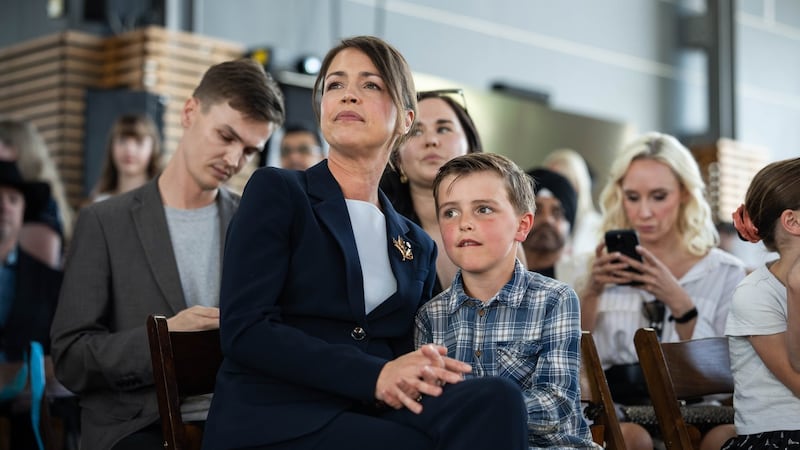
It was an emotional Sunday morning at North Glenmore Park as hundreds of people gathered to raise awareness and funds for ovarian cancer. “About 3,100 Canadians are diagnosed with ovarian cancer each year, and there has been no significant improvement in life expectancy,” said Ovarian Cancer Canada CEO Tania Vrionis. “Ovarian cancer is the deadliest gynecologic cancer,” she added. “That is a statistic we certainly want to change. The survival rate is only about 44 per cent. If you’re a woman diagnosed with ovarian cancer today, less than half will be expected to live another five years.” The walk brought together survivors, people currently living with the disease and others walking in memory of loved ones. Among them were hundreds wearing “Team Jenna” shirts — the largest team in the country. They were walking in honour of Jenna Sauer, a ringette player who died of ovarian cancer nine years ago at the age of 18. “It’s a very emotional day for us,” said Jenna’s father, Leigh Sauer. “It’s sad and we miss Jenna, but it’s great seeing everybody here. We feel the love and support, and it means so much.” “It’s overwhelming to see the support, that people still come out,” he added. “We saw a young woman Jenna played ringette with when she was seven years old. They just found out about the walk this year and came out to support.” Others, like Tiffany Morin, are still living with ovarian cancer. She said she was diagnosed with a rare form of the disease eight years ago. “I have essentially been on a trial-and-error process since I was diagnosed for treatment options,” Morin said. “I have been through five surgeries, chemotherapy, nine different treatments, and still have yet to find the right treatment for my type of cancer.” “I would love there to be a well-researched treatment for my condition so I can continue to live,” she added. Research is a key fundraising goal of the walk. Vrionis said women’s health research and funding “has been underfunded for decades.” “With ovarian cancer, there is no screening test,” she said. “That’s ultimately what has led to the very poor survival rates. More often than not, ovarian cancer is detected at a later stage — stage three or four — where it’s harder to treat.” That cause brought the walkers together, along with a shared sense of community. “It’s the importance of coming together, of supporting each other,” Sauer said. “It’s a very uplifting day in that respect, and it helps you to keep going. Even though you feel sad and miss your daughter tremendously every day, life still goes on.” “We have lots to live for, and we hope that everybody else here does, too,” he added. Premier attends walk Premier Danielle Smith was among those in attendance. She said the issue is personal, as her mother-in-law died of ovarian cancer. During a speech, Smith expressed gratitude for organizations like Ovarian Cancer Canada and outlined steps the Alberta government says it is taking to improve cancer care. “We aim to cut wait times in half over the next 10 years by investing in equipment, facilities and medical professionals, and by expanding access to diagnostic imaging and providing clearer pathways to care,” Smith said. She pointed to an $800-million partnership with Siemens Healthineers announced last year. “As Siemens replaces its equipment, they’re going to use AI tools to get diagnoses faster,” Smith said. “The goal is to detect cancers within two hours rather than two weeks, and connect people with care immediately.”