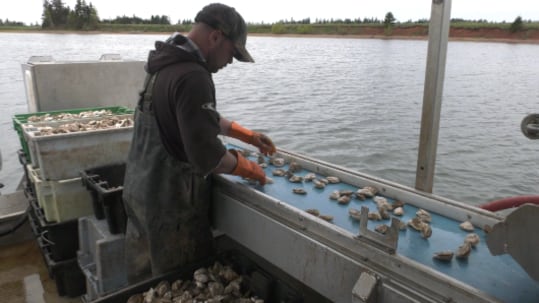
The federal government has announced a retirement grant plan aimed at supporting Atlantic Canadian oyster harvesters facing major losses from the spread of MSX and Dermo. “The growing threat has significantly impacted wild oyster populations and harvesters, requiring strong action from governments and industry partners,” reads a government news release. Minister of Fisheries Joanne Thompson announced the launch of the Oyster License Retirement Grant Program on Monday. “I know this is a hard moment for the people who make their living on the water. For harvesters who decide the time is right to permanently retire a licence or permit, this program is there to support that decision,” she says. The voluntary grant program offers $40,000 to eligible licence and permit holders on the basis they retire. “Oysters have been harvested in Atlantic Canada for generations, and the diseases moving through these populations are a serious threat to that,” Thompson says in a news release. MSX, or Multinucleate Sphere Unknown, was first confirmed in Prince Edward Island in July 2024. Dermo, also known as Perkinosis, was confirmed in July 2025. The diseases have also been found in Nova Scotia, New Brunswick, Newfoundland and Labrador, and Quebec. Mortality rates for oysters affected by MSX are 90 to 95 per cent, according to the government. For Dermo, the mortality rates vary but are typically 50 to 75 per cent. “The impacts of MSX and Dermo have been devastating,” says Minister of Agriculture and Agri-Food Heath MacDonald. “Disease has hit our harvesters hard,” echoes Bobby Morrissey, MP for Egmont, P.E.I. “This program is about allowing those wild oyster fishers who wish to exit for the fishery the means to do so.” The government notes one of the new program’s goals is to stabilize the wild oyster population for long-term recovery. P.E.I. produces over 90 per cent of all wild oysters in Atlantic Canada, with some harvesting taking place in Nova Scotia and New Brunswick, according to the government. Active wild oyster licence holders, including holders of spring permits, fall licences and mollusk unspecified permits can apply for the new grant, with applications opening in September. Licence holders will have to show at least a 50 per cent dependency on wild oyster landings for their fishing revenue and at least $3,600 in landed value. If approved, the harvester’s wild oyster fishing access would be permanently retired. The government says the plan aims to support an “orderly transition” for affected harvesters in the Maritime provinces, and more information will come in the following weeks.