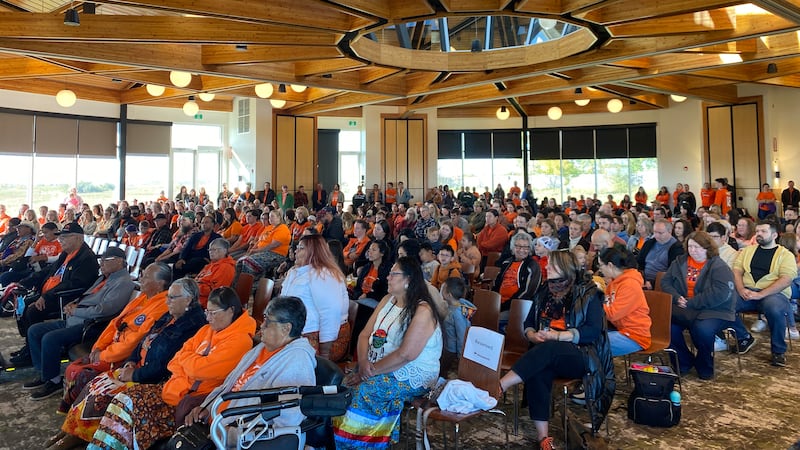
A First Nations chief is renewing calls for Canada to criminalize residential school denialism as people dressed in orange filled downtown Winnipeg on the National Day for Truth and Reconciliation. Chief David Monias of Pimicikamak Cree Nation spoke at the start of the annual Orange Shirt Day Healing Walk, which began with a ceremony and speeches at The Forks. He said it is time to act on denialism, the denial or minimization of the harm done at residential schools. “What hurts the most is that there’s still people denying this stuff. Denialism exists in Canada,” said Monias, who was among several First Nation leaders who addressed the crowd. “It hurts me because I had family members who went to residential school. I was a day school survivor. I went to boarding school,” Monias said. “A lot of us are hurt.” Monias also shared that his community recently unveiled a monument for St. Joseph’s Residential School in Cross Lake, about 520 kilometres north of Winnipeg, to serve as a lasting reminder. He is asking politicians across the country to press the prime minister to criminalize denialism. He is also urging people to write to their Member of Parliament. “We have to make it illegal. It is not enough just to walk and recognize and wear orange. You have to take action, Canada,” he said. The Assembly of First Nations passed an emergency resolution this summer calling on the federal government to criminalize residential school denialism as hate speech. Monias’s push comes days after Indigenous Services Minister Mandy Gull-Masty would not commit to criminalizing residential school denialism when asked about it after a white nationalist-linked group reportedly held a demonstration in B.C. last weekend. “I walk today, even though it’s difficult for me to come here with all the hatred we’re seeing out in the world,” said Chief Derek Nepinak of Minegoziibe Anishinabe, formerly Pine Creek First Nation, where a residential school operated for decades. “I came here today to walk as part of my responsibility for my family, and so that my kids see that I’m stepping up to do my part to keep the message strong that we can never forget what happened in these schools.” ‘Wearing orange is to remember’ Grand Chief Kyra Wilson, who leads the Assembly of Manitoba Chiefs, also spoke at The Forks, saying the colour orange is about remembrance. “Wearing orange is to remember all the children that were taken from their families and their nations, and forced into these schools, and we also remember the children that were never returned home,” Wilson said. “So we honour those that survived these schools, and we acknowledge all of the families and the generations who continue to carry the impacts of those schools and those institutions.” Families Minister Nahanni Fontaine spoke for the province, saying Premier Wab Kinew was walking with Sioux Valley Dakota Nation. A day earlier, the province and the City of Brandon announced they had partnered to acquire the Turtle Crossing Campground, where historical records show a burial site for children from the former Brandon Indian Residential School. Fontaine said Sioux Valley has “been working for years” to acquire the land. “We weren’t meant to be here today, we were not meant to be on our lands. We were meant to be gone,” Fontaine said. “And yet here we are, and we’re here because of residential school survivors.” The walk departed from The Forks and prompted several street closures, including parts of Main Street and Portage Avenue. It ended at the Canada Life Centre in the afternoon with a powwow inside. The sixth annual event was hosted by the Southern Chiefs’ Organization (SCO). “This is a moment to reflect on what has occurred in this country, but every single day, we have to take action,” said SCO Grand Chief Jerry Daniels. “Let’s remind people every single day that we will stand for the youth. We will stand for the children.”