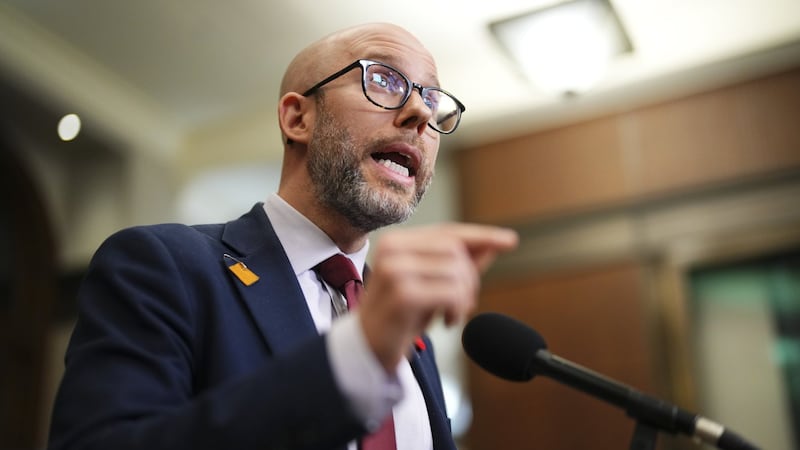
Can - and should - Canada get a national automaker off the ground? It’s a provocative question, and one that Flavio Volpe, president of the Automotive Parts Manufacturers’ Association (APMA), believes the country can no longer avoid. The backdrop to the conversation? Tariff-fueled pressure on Canada’s trade ties with the United States. Volpe says it’s time to stop relying solely on foreign companies and start thinking seriously about a made-in-Canada solution. Speaking at a Canadian Club Toronto panel on Wednesday, Volpe laid out what he sees as both a challenge and an opportunity: to move beyond Canada’s long-standing role as a host to foreign automakers and explore the possibility of building a homegrown brand. “We never said we couldn’t make cars,” Volpe told the panel. “We just never took the ambition to take that other step — to say, why can’t we? Why don’t we?” He argues that Canada already has the raw materials: top-tier talent, advanced research institutions, manufacturing infrastructure and close access to the U.S. market. What’s missing, he said, is the political and economic ambition. “Beyond shelter, the biggest expense for anybody in the world is transportation... Why wouldn’t we be in the business?” Volpe asked. His call isn’t for an immediate government-run company — but rather for a feasibility study into what it would take to launch a Canadian automaker. Volpe envisions a collaborative effort between government, industry and academia to assess what such a project might look like. Canada has already proven its capabilities in concept development. Through Project Arrow — an APMA-led initiative that built a prototype EV using entirely Canadian-made parts — suppliers and engineers have shown what’s possible, though Volpe is quick to note that Arrow was never meant for production. He pointed to other countries that are already making that leap. In Vietnam, VinFast has emerged as a new player on the global electric vehicle stage. In Turkey, the government-backed TOGG brand is producing its first cars. And Mexico is moving forward with a plan to build La Linea, a low-cost vehicle intended to suit local disposable incomes. “The big leagues are changing in Mexico and Turkey and Vietnam … and we’re in the minor leagues,” Volpe said. But while Volpe sees momentum and inspiration abroad, others in the industry caution against assuming Canada could replicate those paths. Greig Mordue, professor in the Faculty of Engineering at McMaster University and former Toyota Canada executive, says the idea is not just ambitious — it’s financially and logistically daunting. “It is not a $20-million design problem,” Mordue told CTV News Windsor. “It is a multibillion-dollar commitment that extends out over decades… Tesla was 15 years before they started making a profit.” He broke down what a Canadian automaker would realistically require: an assembly plant costing billions and taking years to build, a reliable supply chain of willing partners, thousands of skilled workers and 150 to 200 dealership locations nationwide — each demanding multi-million-dollar investments. “And then we have to do this all over again because we can’t say, oh, here’s our Canadian-made vehicle, we have one of them,” he said. “A dealer would want seven or eight or ten vehicles in a lineup to make it worth their while.” Volpe maintains, however, that he’s not calling for a factory to break ground tomorrow — only for the government to bring experts together and ask what launching a Canadian automaker would actually take. “What I’m suggesting is that we take the greatest minds in this country — advanced manufacturing, finance people, engineering people, advanced applications of technology, AI, machine learning… and say, if you were going to do it — which would just buy some insurance — how would you do it?” he said. “You also have to be humble enough to accept that if we get Chris Casey [Industrial Manufacturing and Automotive Sector Lead , PwC Canada] to lead a team to look at this and his team says it doesn’t really work… you say, okay, look, we gave it a shot.” His frustration lies not in failure, but in not even attempting to find out. “We should be embarrassed for always listening to people say, ‘no, let’s do the more comfortable and safe way,’” Volpe said. Mordue, however, questions whether such a vision would gain national support — or serve as a true unifying initiative. “I don’t understand how you build nations by tearing Southern Ontario apart from the rest of the country and dealing with a multibillion-dollar annual loss trying to build a company,” he said. “If they can find investors for this with deep, deep pockets and a lot of patience, then there might be some nation-building aspects associated with that. But… I don’t sense that that would have a strong sense of nation building across the totality of Canada.” As for what should be Canada’s next move in the global auto space, Mordue says it starts with realism. “The challenge that Canada has is that very practically Canada has tethered itself to the U.S., and that has worked for 60 years,” he said. “But over the long term, if we continue our tethering to the U.S., we are going to be tied to an uncompetitive industry… and eventually we’ll fall too far behind to catch up.” For now, Volpe’s pitch hasn’t sparked a feasibility study — but the conversation continues as the auto industry remains under pressure.