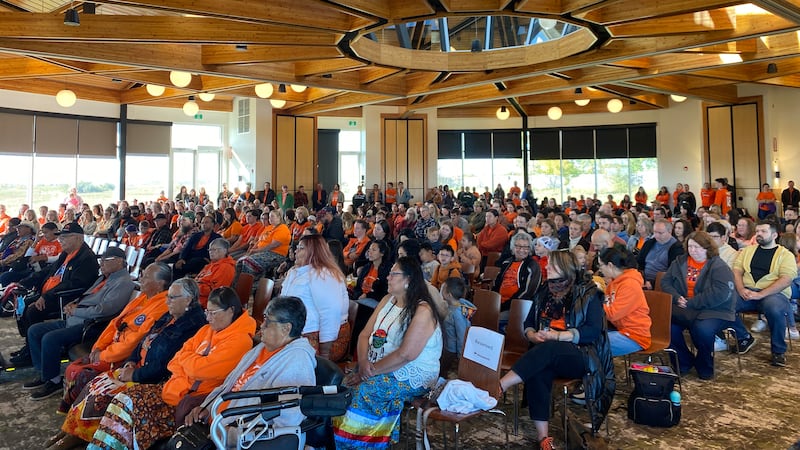
Thousands of striking public service workers gathered in downtown Victoria on Monday, marching from Centennial Square to the B.C. Legislature in a massive show of solidarity. The Fund the Frontlines rally comes as the B.C. General Employees’ Union enters its sixth week of job action, urging the provincial government to return to the bargaining table with what it calls a credible wage offer. Union president Paul Finch says the current stalemate reflects a broader problem with the government’s attitude toward collective bargaining. “Government needs to find that reasonable middle ground, and so far I think that’s eluded them,” he said. “They have not sought that out. We have not seen a sincere idea to go there. And so we just need government to shift its attitude and its thinking.” Talks stalled, impacts growing The strike began six weeks ago outside the ICBC office in Surrey’s Guildford neighbourhood — the first picket line in what has now become a province-wide movement. Since then, more than 20 government ministries and dozens of liquor and cannabis stores have been affected. Negotiations broke down again last week after the province put forward a five-per cent wage increase over two years. The BCGEU is calling for four per cent annually, saying workers have fallen too far behind amid record inflation. “I believe that there is a deal to be found here at the table for civil servants,” Finch said. “Just as I think there’s a deal for the other sectors that are, or probably will soon be, taking some form of job action... government needs to find that reasonable middle ground.” Other public sector unions join What began as a BCGEU-led strike is now widening as other unions reach similar impasses with the province. The Professional Employees Association (PEA), which represents engineers, foresters, and inspectors, has also launched job action. In recent days, community health workers represented by the Community Bargaining Association (CBA) — roughly 23,000 employees in home support, mental health, seniors care and substance use recovery — have taken strike votes or declared impasse with government employers. Finch says this wave of unrest is no coincidence. “The contracts all expired at the same time. However, the negotiations were in different stages, and so it’s a coincidence, or rather, they decided to take a strike vote,” he explained. “Really, this is five weeks into our strike, so definitely not timed — but it is very indicative of the general attitude towards this government’s approach to collective bargaining.” He added that the growing unity among unions is a direct response to years of stagnating wages. “Well, I think what you’re seeing now is less strategy and more simply the result of this government’s approach to collective bargaining — which has been more confrontational and less about finding a deal.” Workers say it’s about fairness The BCGEU says its members have reached a breaking point after years of wage suppression. Finch says inflation and the province’s handling of wage talks have pushed workers to act. “We went through a significant inflationary period,” he said. “Every time, about for every 40 years in B.C. history, we’ve had an inflationary period like this and after every period there’s basically a wage and price discovery. What happens is the cost of everything goes up, and wages lag behind.” In this case, wages in the civil service have lagged behind the average wage in B.C. by over 12 percentage points over the last decade, said Finch. “Wages can only lag behind so much before it hits a breaking point, and that’s what you’re seeing.” Broader fallout across public services The ripple effects of the ongoing strike are growing. Job action has disrupted government operations, delayed licensing and permitting, and even forced the postponement of a scheduled coroner’s inquest last week due to staffing shortages. Union leaders say they don’t want disruption — but insist their members deserve better. “Look, BCGEU workers as well as many of the other civil servants and broader public sector workers across the province are very reluctant to take strike action,” said Finch. “It’s a rare thing we do. It’s not something that is normal — we’d rather be at work. But obviously, it’s hit a breaking point.” What happens next? With the fall legislative session underway again on Monday, Finch says the timing of today’s rally is intentional — meant to draw political attention to a growing labour crisis that now involves multiple public sector unions. So far, the province has not announced any new bargaining dates. The BCGEU maintains it is ready to return to negotiations — but only if the government comes forward with a substantially improved proposal. “They need to realize the experience of working people in this province and incorporate that into their planning — and how they approach negotiations, but also how they approach governance,” Finch said. For now, picket lines remain active, the standoff continues, and public servants across B.C. are promising that Monday’s march in Victoria won’t be their last.