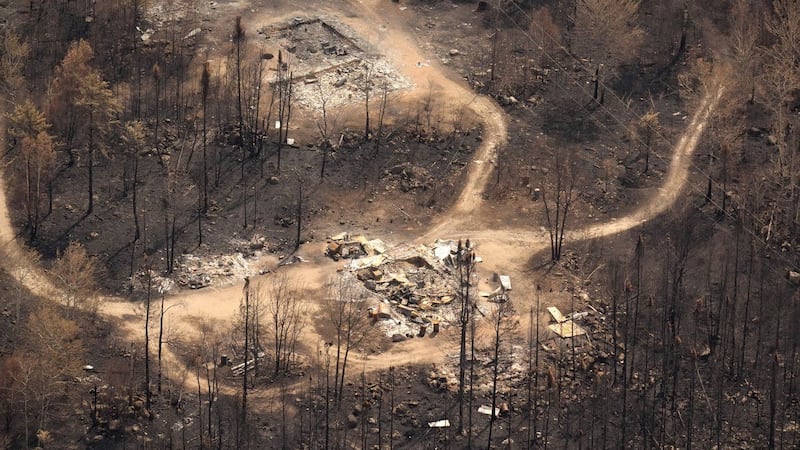
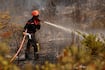
Attila Banhegyi said a tree was burning in the backyard of his home in Boston Bar, B.C., a community now surrounded by fire. Banhegyi, who runs a campground and also has a mail-order cosmetics business, was one of the handful of residents still left in the Fraser Canyon township on Wednesday, after regional authorities issued an urgent plea for them to get out a day earlier. He said in an interview that his home was shrouded in white smoke, like “flying through a cloud in an airplane,” after the flames got to within nine metres of his home, having been ignited around midnight by embers he thought came from the new fire to the south of the township. “It got up in the trees,” said Banhegyi. “It’s very extensive, but mostly it was managed and is being managed, but they’re still burning, so it could not be extinguished.” The new Anderson Creek blaze has left residents like Banhegyi only one escape route, north along Highway 1 that is shut to the south, as the BC Wildfire Service prepared for what it said would be another challenging day on Wednesday, battling a fire that had shown aggressive behaviour overnight. Detected Tuesday, the fire now spans 43 square kilometres. It added to the complex of fires surrounding Boston Bar that threw up a vast pyrocumulus cloud that could be seen from Vancouver, 200 kilometres to the southwest. Boston Bar was already under evacuation order before the new fire prompted the Fraser Valley Regional District to tell remaining residents to leave immediately. The wildfire service said the fire was suspected to be human-caused and was discovered by aircraft responding to one of the other nearby fires. It said in an update on Wednesday that the blaze started next to Highway 1 and spread rapidly upslope. Resident Kelly Anderson said her husband spotted the fire south of their home in Boston Bar on Tuesday afternoon. “The fire just lit up. It went so fast up the hillside, like incredibly fast, and we could see the flames from our backyard and the plume of the smoke.” Within five minutes, they and their six-month-old Bernese mountain dog were fleeing the home where the couple has lived since 2022. They grabbed some clothes, photo albums, passports, guns and a 130-year-old oil lamp that had belonged to Anderson’s father. “When I’m looking through my bag, I just realized I grabbed a lot of jammies rather than a lot of clothes to wear,” she laughed. Now they are staying with a family friend in Hope, checking on the fate of their home via their property’s security camera. Banhegyi said he was staying in Boston Bar for now, adding that his services were still needed, and he also wanted to protect his home. Power and water have been shut off. “I’ve got fuel, I’ve got a generator. I’ve got a local resident who has his own water rights, helping fill up my water containers, and I’ve been actioning hot spots around my property … and livestock will need to be cooled down,” he said. Other holdouts had their reasons too, he said. “It depends on the individual but one person says ‘they can shut off the power, they can shut off the water, it’ll be fine’ — he can fast for days,” he said. “Another person is going to save their home as they don’t have insurance. Another person actually just came here today … he’s here to assist those that have remained. It’s some resilient individuals.” Banhegyi said he might leave Wednesday afternoon, depending on how the winds develop. The community is now surrounded by the Anderson Creek fire to the south, the Brunswick Creek fire west of the Fraser River and the Ainslie Creek fire to the northeast, all of them listed as wildfires of note. The existing evacuation orders were expanded late Tuesday to the Hells Gate area south of Boston Bar, as well as properties along Scuzzy Creek Forest Service Road, on the west side of the Fraser River. Officials said they had set up an evacuee reception centre for those displaced by the Brunswick Complex of fires at McArthur Island Sports Centre in Kamloops. A separate fire, meanwhile, cut Highway 3, another main artery for the B.C. Interior, between Sunshine Valley and Manning Park. The eruption of new fire activity came as about 40 heat warnings blanketed B.C., where temperatures in Lytton in the Fraser Canyon passed 41 degrees on Wednesday, the hottest temperature recorded in Canada this year. The Thompson—Nicola Regional District in south-central B.C., issued an evacuation order for 182 properties on the Bonaparte Plateau late Wednesday, while the Village of Clinton is under alert due to a nearby wildfire that is burning out of control and is more than 100 square kilometres in size. Further east, an incident commander for a complex of fires burning near Kimberley, B.C., said more resources were on the way to help firefighters as heat peaks this week. Hugh Murdoch said Tuesday that crews were expecting what he called a “significant weather day” on Thursday due to dry and warm conditions. The Regional District of East Kootenay said Wednesday that Kimberley residents may see additional smoke as crews fighting the fire complex conducted a planned ignition on its eastern flank. Environment Canada said temperatures in the region may reach well into the 30s for the next two days as a ridge of high pressure moved across the province. Murdoch said there were seven fires in the so-called Bootleg Complex in the Kootenay region near Kimberley, including two wildfires of note that have prompted evacuation alerts in the city. He said there was minimal growth on the fires in the previous few days, crediting the work from the crews with “assistance from Mother Nature.” But Murdoch said crews were looking to develop what he called a “large water delivery system” using helicopters in light of the weather forecast, noting that low streamflows were also posing a challenge. Environment Canada issued air-quality advisories covering much of the province due to smoke from about 90 wildfires burning across the province. The service said in its situational report that smoky skies were expected to continue and may worsen in the northeastern and central regions. It also warned that warming and drying conditions were expected to persist throughout this week. “Increasing temperatures and limited precipitation will continue to reduce fuel moisture levels, elevating the potential for new wildfire starts,” it said. This report by Wolfgang Depner and Nono Shen, The Canadian Press, was first published July 22, 2026. — With files from Chuck Chiang and Brieanna Charlebois in Vancouver