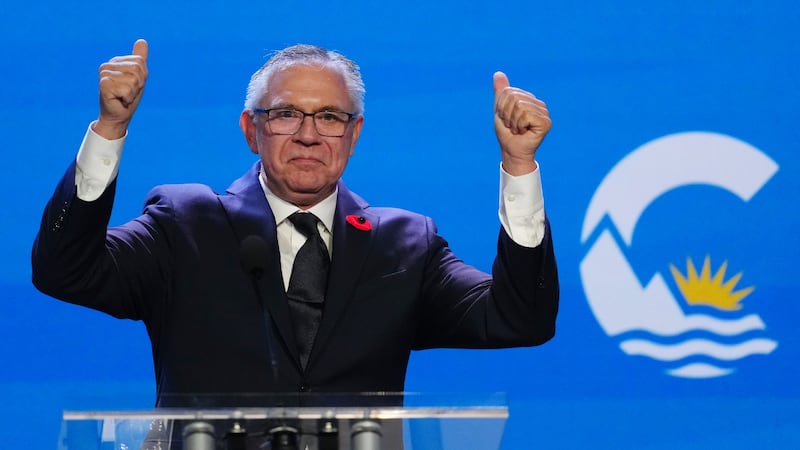
Premier Scott Moe says the province will table a deficit budget when the spring sitting of the legislative assembly begins next month. Speaking to members of the North Saskatoon Business Association during a luncheon at Prairieland Park Tuesday, Moe said trade uncertainty with the United States and the impact to countries across the globe will be felt in Saskatchewan. “Saskatchewan is not immune or exclusive in the challenges that we face,” Moe said. “Do you want to run a massive deficit? Do you want to hike taxes? How do you want to deal with these revenue numbers that aren’t where they should be.” Moe suggested the province will do none of the above. He said taxes will not be rising to help lower the 2026-2027 deficit as funding will continue to flow to Saskatchewan services like healthcare, policing and safety and highways. Using British Columbia’s recent provincial budget — which projects a $13 billion deficit — as an example, Moe says Saskatchewan’s deficit will not be as large. On a per capita basis, $13 billion is roughly $3 billion for Saskatchewan’s population. Moe declined to divulge specifics when asked if the budget would approach a $1 billion deficit. In November’s mid-year budget update, the province reported a $427 million deficit. However, last week, NDP leader Carla Beck criticized the provincial government for approving $650 million in special warrant spending — which would push the deficit past $1 billion. “You’ll have to wait ‘til the budget,” he said. Finance Minister Jim Reiter is expected to present the budget on March 18. Moe wouldn’t hint at which sectors could be in for cuts or claw backs. He pointed to innovations or technology as one way to supplement spending, particularly in health care. “I don’t mean private versus public,” Moe said. “I mean enabling and utilizing the innovations that maybe are available today that weren’t available just a few years ago. Virtual care, for example.” Going to India Moe says as the United States resets its trade relationship with countries across the world, the indirect impacts are forcing countries to rework trade agreements with other partners. That’s part of the reason behind Moe joining Prime Minister Mark Carney for a trade mission to India on Thursday. India implemented a 30 per cent tariff on yellow peas late last year, which is where Saskatchewan exports a significant amount of the pulse crop. “We’ll engage on having those tariffs reduced or removed, or if they’re not removed for anybody, at a point when they are under should be reduced for Canada first,” Moe said. Moe said his approach to talks in India will differ from his trade mission to China earlier this year. He says the federal government has opened more broad trade talks with India in a number of sectors and he hopes those conversations will progress this week.