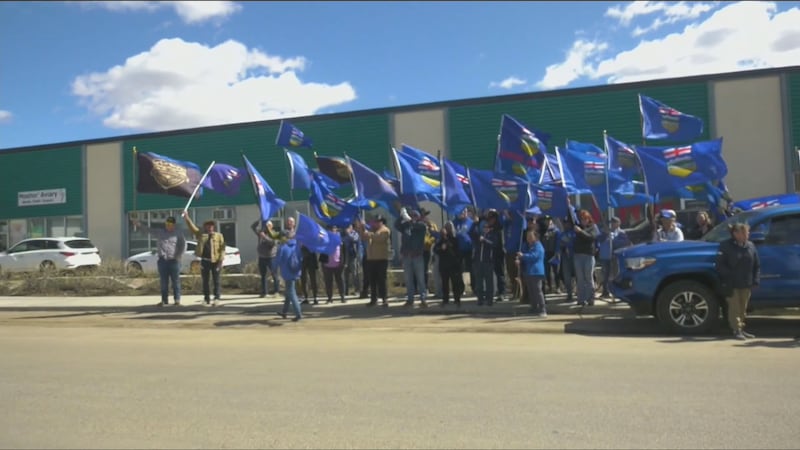
Despite the cold winds and sputtering snow, many gathered in Yorkton on Tuesday morning to raise awareness of missing and murdered Indigenous women and girls. The annual memorial walk for Red Dress Day was set to begin at the Yorkton Tribal Council’s King Street building. Newly re-elected Tribal Chief Isabel O’Soup sought shelter from the elements near the entrance alongside Yorkton’s former mayor Mitch Hippsley. Others were waiting on the grounds for the prayer that would open the walk. Organizers and volunteers were handing out red T-shirts and coffee to anyone who attended. The crowd was visibly smaller than it was a year ago, but it attracted school groups and politicians, such as Yorkton’s mayor Aaron Kienle and Saskatchewan NDP leader Carla Beck. The focus, however, was on families whose members have gone missing or were murdered. Diane Bigeagle’s daughter has been missing for almost two decades. “She went missing in 2007, and it’s nearly 20 years since she’s been gone. Her name was Danita Bigeagle,” Diane told CTV News, holding a picture of Danita. To this day, Diane still doesn’t know what happened to her daughter. Her story is one of many. According to the Public Service Alliance of Canada, about 16 per cent of women who are missing or murdered are Indigenous. It is a shockingly high number for a community that makes up about 5 per cent of Canada’s population. Every year on May 5, people gather on Red Dress Day to raise awareness of this issue. “We get together at City Centre Park and we talk about [and] we listen to mothers, families who have lost a daughter or whose daughter is still missing,” Tribal Chief Isabel O’Soup told CTV News before the walk. She was glad to see people showing up, but said she would be happier if there were no need for it. “Honestly, our goal is to have none. That would be our goal when we know we’re having success, that we don’t have to bring awareness to an issue like this,” she said. While the community may gather on May 5, O’Soup said the work to put an end to violence continues year round. “We also have a lot of educational programs teaching the younger generation, you know, the younger men and women about good choices, safe choices, and being safe. So it’s an everyday thing,” she added. The Tribal Chief highlighted the work of the Yorkton Tribal Council’s (YTC) Safe Haven shelter for women, which provides services and support for women and children fleeing from domestic violence situations. “While we take two weeks off over at YTC for Christmas, Safe Haven is open 24 hours a day, seven days a week, 365 days a year,” she explained. Bigeagle said community support is the most impactful form of help to those who have already experienced tragedy. “Come out and support families ... financially or just verbally,” Bigeagle said. “We don’t need much, we don’t ask for much, but we’d sure like support.” The walk ended at Yorkton City Centre Park with speeches.