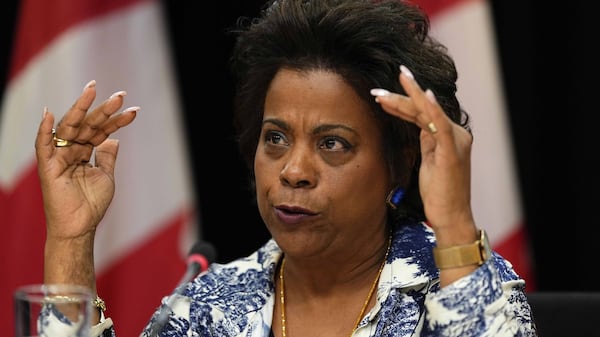
Despite refusing to say whether next Tuesday’s budget has been finalized, Finance Minister François-Philippe Champagne signalled the document will show the size of the public service has grown too large. “We need to bring back the civil service to a sustainable level,” Champagne told reporters following a funding announcement on Wednesday, adding that the federal government is looking for efficiencies and ways to make “workforce adjustments” that better align the size of the civil service with the needs of Canadians. “And I think people have seen, and they will see in the budget, if you look at how many people we have today and what we had before COVID-19, we need to get back to something more sustainable,” Champagne also said. Champagne added the federal government will be “very transparent” and “very compassionate” in how it manages the size of the public service. According to data on the Treasury Board website, Canada has 357,965 public service employees this year. That’s a 24 per cent increase from 2019, when Canada had 287,978 public service employees. While the federal public service decreased by approximately 10,000 employees in 2025 compared to 2024, federal personnel spending increased by about $1.5 billion, according to an August report from the parliamentary budget officer (PBO). Multiple government sources, meanwhile, confirm to CTV News that the entirety of the budget has not been finalized. At this point, sources say, the Carney government is looking at cuts to the public service through both attrition and “workforce adjustments” — including the possibility of incentives for early retirement — though the budget is still subject to change just five days out from being tabled. Asked directly on Wednesday whether revisions are still being made, Champagne said: “Obviously we will be ready to deliver something that Canadians will be proud (of).” For months, Prime Minister Mark Carney and his cabinet have framed the highly anticipated budget as one of “investment” and “austerity.” That has prompted some to question how the federal government can earmark billions of dollars in new spending while fulfilling its promise to balance the operational budget in three years. Over the summer, Champagne, along with Treasury Board President Shafqat Ali, asked ministers to find 7.5 per cent in savings for the 2026-27 fiscal year, beginning on April 1, 2026, followed by 10 per cent in 2027-28 and 15 per cent in 2028-29. In a speech to students at the University of Ottawa last week, Carney said the upcoming budget will include “generational investments,” but cautioned that transforming the economy will “take some sacrifices.” Asked specifically on Wednesday what those sacrifices entail, Champagne wouldn’t say. “I’m not sugar coating it to people,” he said. “Yes, we have to make tough choices, but when you make tough choices, you’re able to focus, you’re able to prioritize, you’re able to invest in places that makes a difference.” “We will own these choices, and Canadians can judge us for that,” he also said. The Liberal election platform promised to cap and not cut the federal public service, and early last month, Carney insisted any cuts would “happen naturally through attrition.” In an interview on CTV Power Play with Vassy Kapelos last month, however, Government Transformation Minister Joël Lightbound said that while the federal government plans to reduce the size of the federal public service through attrition, he conceded “there will be adjustments.” In a statement to CTV News on Wednesday, a spokesperson for the union representing public servants said the world has changed in the last six years, putting more pressure on the public service. “Cutting tens of thousands of public service workers’ jobs when Canada’s population is growing and rapidly aging means that more workers, families, veterans, and elderly people will go without the critical services they rely on,” PSAC spokesperson Gina Gratten wrote. “Gutting the public service now is a recipe for disaster.” Some have also warned that attrition is unlikely to be enough for the government to meet its savings targets. “For the order of magnitude that you’re looking at, it would be highly unlikely that you’d be able to close a deficit or reach a number that big without the path going through personnel costs, so without some sort of reduction or substantial changes in the composition of the public service,” interim PBO Jason Jacques said in an interview on CTV Power Play with Vassy Kapelos last month. Three seats shy of a majority government, the Liberals will need votes from another party to pass the budget. This budget — set to be tabled Nov. 4 — will be the first with Carney as prime minister, and the first test of his government as a confidence vote. With files from CTV News’ Vassy Kapelos, Stephanie Ha, David Smith and Brennan MacDonald