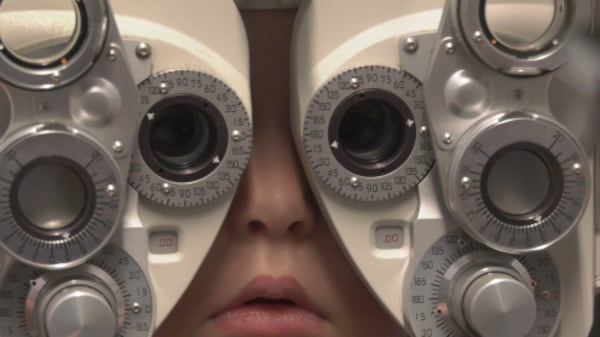
CHARLOTTETOWN, P.E.I. – Seven-year-old Rosie put her sight to the test during an eye exam at Boyle’s Optical, with her mother watching nearby. “All you have to do is sit in the chair,” she said ahead of the appointment, which came during Children’s Vision Month. Optometrists highlight how easily problems can go undetected when children don’t realize their eyesight is impaired. One-in-four school-aged children has a vision problem, according to data cited by the Canadian Association of Optometrists. Meanwhile, myopia, or nearsightedness, is developing earlier and progressing faster than in previous generations. “We know that kids spend more time on screens than they used to, which can contribute to myopia,” said optometrist Marie-Christine Dubois-Lebel. Dubois-Lebel hasn’t noticed a significant surge in her own practice, she said, noting that research suggests urban areas are more affected, while she works in a predominantly rural setting. Spending more time outdoors, whether playing sports or simply enjoying nature, might help reduce the risk of developing nearsightedness, she said. Research has shown that outdoor activity can delay its onset, though evidence that it slows the progression of existing myopia is less conclusive. There are warning signs parents can watch for, including squinting, rubbing the eyes, frequent blinking or, particularly with nearsightedness, holding objects closer. But sometimes, problems go unnoticed. Not because of neglect, Dubois-Lebel said, but because children often don’t complain. That’s why she recommends annual eye exams, even without noticeable symptoms. “Eighty per cent of learning comes through vision. We want them to have the best advantage to get through their education the most successfully they can,” she said. Rosie’s mother, Katie Dorgan, knows that even when children think they see just fine, they might not be aware of what they’re missing. “Even if they’re not complaining about blurriness or if they don’t realize that something is not clear, they are adapted to it, so they don’t notice it right away,” she said. Dorgan, who is also an optician, has been bringing Rosie for checkups since she was eight months old. She was initially referred by public health over concerns that one of her eyes was turning inward. P.E.I. introduced its Program for Elementary Eye Care last year, covering annual eye exams and helping pay for up to three pairs of glasses, if needed, for children in grades one to six. But across the country, public coverage is a patchwork. Most provinces help pay for children’s routine eye exams, but eligibility and costs vary. In Ontario, for example, children aged 19 and under are covered for one major exam every 12 months. In British Columbia, public insurance contributes toward the cost, although families may still face an additional bill depending on the optometrist. Other provinces have tighter age restrictions. In Newfoundland and Labrador, the province provides an exam and, if needed, a pair of prescription glasses to children preparing to enter kindergarten. Families receiving income support may qualify for additional vision-care benefits. Financial assistance for frames and lenses also differs. Some provinces have no universal benefit, instead offering support to qualifying low-income families. Quebec, meanwhile, provides a $300 reimbursement every two years for prescription glasses or contact lenses for children under 18, regardless of family income. This summer, Ottawa tabled the National Strategy for Eye Care, the first of its kind in Canada to outline a shared plan for all levels of governments. Health Canada says developing an implementation plan is the next step.