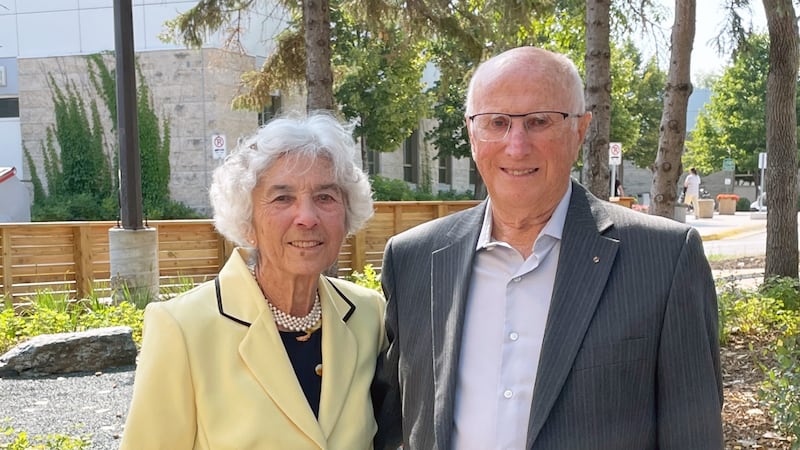
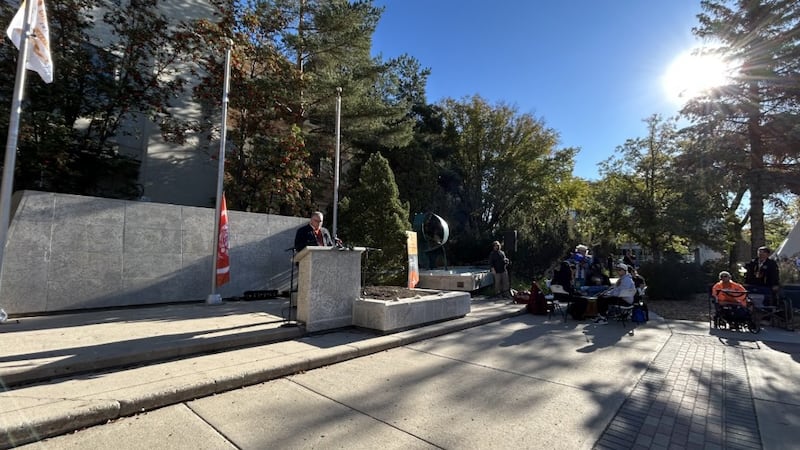
Prayer echoed across the National Holocaust Monument on Tuesday as members of Ottawa’s Jewish community and the public gathered to mark Holocaust Remembrance Day, Yom HaShoah. The annual commemoration honours the six million Jews murdered during the Holocaust, while recognizing survivors and reaffirming a commitment to remember its lessons. Despite steady rain, those who attended, including dignitaries, faith leaders and residents, stood alongside Holocaust survivors like Agnes Klein. Speaking at the podium, Klein shared her family’s story of escape, describing how acts of kindness from strangers helped them survive. “We were sheltered by the chief editor of one of the local newspapers. He sheltered my father and somebody fronted a business for him so he could make a living,” she said. “We were hidden for six months in that village towards the end of the war … I ended up coming to Canada in 1962 and then the rest of my family eventually followed.” A helping hand, then and now This year’s theme, ‘Helping Hand, Then and Now,’ focused on not only remembrance, but on the responsibility to act in the face of injustice. Rabbi Idan Scher says the turnout, including many outside the Jewish community, was a sign of that message. “They were here to show their support, to say, ‘We refuse to forget the lessons of the Holocaust, and we are going to apply them in our daily lives,’” he says. “I think that’s the message of hope, the same message of hope as the courageous people that risked their own lives all those years ago to ensure the survival of Jewish people during the Holocaust.” A candle-lighting ceremony underscored that message, with each flame representing lives lost and the importance of carrying their memory forward. Leila Stambouli and her son, Taavi, attended the event, hoping to help to highlight how remembrance is passed between generations. Stambouli said her own family history includes survivors saved during the Holocaust. “The message here, and in many spaces, is the power of the ordinary person and ordinary people coming together,” she said. “In the face of challenges, not only moral but bureaucratic and otherwise, to do what was said was impossible. And there are many of us and the descendants are growing, and these stories become more common, of resilience, encouraging, and perseverance.” Speakers, including Israeli ambassador to Canada Iddo Moed, also emphasized the need to confront rising hate and discrimination. Lawrence Greenspon, co-chair of the National Holocaust Monument Committee, said remembrance must also come with action. “The whole point of Yom HaShoah, the day of remembrance, is not just to memorialize that horrible event of the Holocaust, but also to learn the lessons from it,” he said. “It’s that call for action that really has to be heard and acted upon because we’re seeing many of the same signs of the 1930s happening all over again.” For Klein, a living link to history, her message, and hope, is for kindness. “People are people and you have to consider them for who they are and not discriminate against anybody,” she said. “And if you start with one group, then that will extend that to another group, and that is almost a crime against humanity itself.”