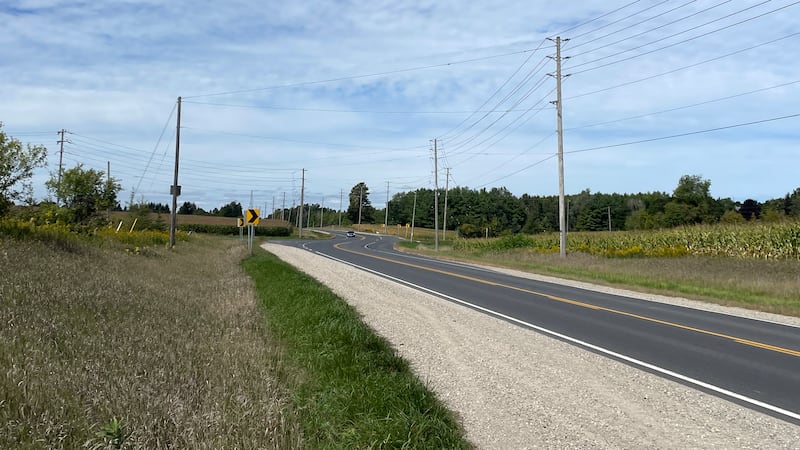
The City of Ottawa admits government regulations on road paint cause “durability challenges” on Ottawa roads, as some councillors raise concerns about the fading white and yellow lines on city streets. In a memo to councillors on the Public Works and Infrastructure Committee, the city outlines steps the city is taking to address the disappearing paint, including using different materials for certain situations, prioritizing repainting arterial roads and strategically using durable materials to “improve efficiency and conditions.” In May, Coun. Tim Tierney said new requirements for volatile organic compounds (VOC) in commercial products have resulted in disappearing lines on roads. In a motion for the Public Works and Infrastructure Committee, Coun. Riley Brockington said the road painting program has fallen behind in refreshing both regular road painting lines and road paint related to traffic calming measures. Brockington said the quality of the road paint “is difficult to see at night and/or when wet, is also a safety issue.” In response to inquiries from Brockington and Tierney, Public Works general manager Alain Gonthier said the transition to low-VOC road marking materials has presented “operational challenges,” particularly under “Ottawa’s winter conditions and high traffic volumes.” “These challenges include reduced durability and diminished visibility of pavement markings, particularly in wet conditions,” Gonthier said. The transition to low-VOC road marking materials was mandated by the federal government in 2012, according to the city. Targeted material strategy for road paint Gonthier says the city has adopted a targeted material strategy to “balance safety, cost and environmental concerns.” The strategy includes: Gonthier says the city has refined its application strategy for line painting by prioritizing arterial roads, creating optimized routes for road repainting and strategically using durable materials to “help improve efficiency and coverage.” According to the memo, the city has acquired new equipment for “high-volume, durable applications” that reduce the need for frequent re-application, and integrated GPS-enabled Skip-Line systems on new trucks to track paint application in real-time. “The City also continues to explore and test new products and techniques in consultation with manufacturers and other municipalities,” Gonthier said. “Emerging technologies such as pavement dryers and Methyl Methacrylate truck agitators are also being tested and implemented to reduce weather-related delays and improve application consistency.” Gonthier says while more durable and visible marking materials are available for road paint, “broader use is currently limited by federal and provincial environmental regulations.” In a separate inquiry, Coun. Tierney asked staff for an update on talks with the Association of Municipalities of Ontario, Ontario Good Roads Association and other professional associations to discuss emerging best practices and technologies. “Participation in these associations has yielded several benefits, including Ottawa’s exposure to and adoption of the use of other products such as Methyl Methacrylate (MMA) and Thermoplastics as accepted durable markings,” Gonthier said. “These forums also provide valuable opportunities to share operational realities with policy-makers at the provincial and federal levels.” Changes needed to paint regulations: councillors In an interview on Newstalk 580 CFRA’s The Morning Rush with Bill Carroll, Tierney said that the city is applying “water paint” to roads until federal regulations for road paint. “This is a lot of word salad that basically says, until the federal government changes things, it’s going to cost taxpayers still a ton more money and that is what it comes down to,” Tierney said Wednesday morning. Tierney is meeting with the Federation of Canadian Municipalities president this week in Alberta, where road paint came up. “We actually did talk about line painting and pressuring the federal government to change it to make it cheaper, to make it safer and to allow us, as municipalities, not have to spend all this money on extra machines while nothing changes – it’s the same paint,” Tierney said. “We’re still applying water paint to the roads, and we just have to do a heck of a lot more. We’ll find the targeted areas because that’s all we can do right now.” Tierney says the city must repaint the roads more often. Road painting guidelines According to Gonthier, the city’s maintenance standard for pavement markings requires that yellow dividing lines, white edge lines and white vehicular and bike lane lines be reapplied once a year. “The policy also requires that all signalized and unsignalized intersection markings such as stop bars, crosswalks, directional arrows, etc., are applied twice per year,” Gonthier said. The city’s pavement marking program runs from mid-April to mid-November, with staff restriping over 5,500 kilometres of existing roadway, 6,500 intersections and thousands of special markings.