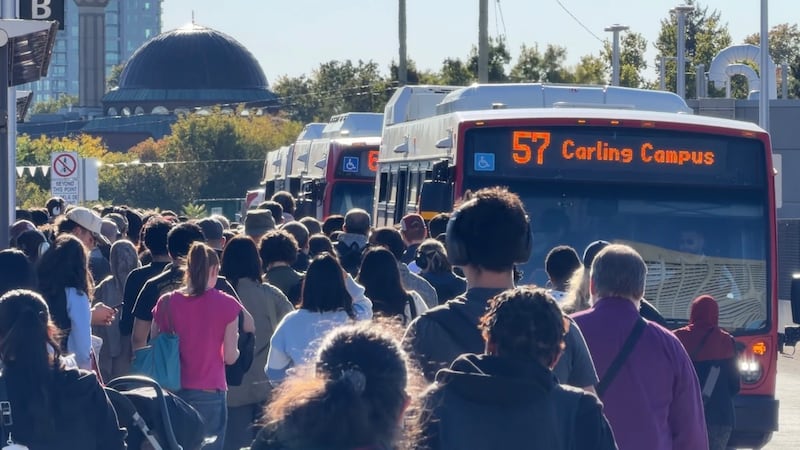
Ottawa’s Worst Commute: CTV News Ottawa travels with viewers on OC Transpo buses, the O-Train and Para Transpo to see what’s happening on the transit system. Visit our special Worst Commute page for more coverage. Ottawa transit riders who travel between Gatineau and Barrhaven are finding their trips to be frustratingly unpredictable. It’s a commute that appears simple on paper, two buses and no train, but it became a focus earlier this year when councillors voted to extend OC Transpo’s ticket transfer window, partly in response to long travel times for riders making multiple bus connections. Christine Solomon, a commuter often making the weekday trip to and from Place du Portage and Barrhaven, says delays are common. “It’s a disaster most of the days,” she says. “The very first bus leaving Gatineau at 2:55 p.m. is usually delayed, which then bottlenecks with the other bus and then you miss your connections when you get to Tunney’s Station because of the delay.” Solomon says her commute can stretch well beyond the expected one-hour travel time. “That first week of January, it took me over two hours to get home that first day back after the holiday break,” she says. “The first bus was 20 minutes late, then I had to run for the bus at Tunney’s to make my connection.” The journey begins with the OC Transpo No. 13 bus from Place du Portage in Gatineau’s Hull district, around a cluster of federal office buildings, to Tunney’s Pasture Station in Ottawa. The ride is roughly 16 minutes when running on schedule, but riders say the transfer point is often where problems begin. “Before April last year, there was the nonstop bus, which was perfect,” says Solomon. “Only having one bus made the trip 15 to 20 minutes shorter.” Last spring, OC Transpo overhauled its bus network to prepare for future expansions of the city’s light-rail system, introducing more connections intended to link riders to O-Train lines, even where rail service has not yet opened. Barrhaven East Coun. Wilson Lo says many current routes reflect a network designed for a future system, including Gatineau-Barrhaven, and adds that particular trip was also separated out because of multiple delays crossing the Ottawa River into Quebec. “That transfer point was added as kind of a final state for when the western extension of the LRT opens; however, it is my understanding that right now there are a lot of trips at Tunney’s Pasture in the afternoon where the 13 bus falls behind,” he says. “We keep talking about the fleet shortage, it is still an issue. The good news is that fleet deliveries, the deliveries of the new electric busses that we keep talking about, that has stabilized and become quite steady. Over the last month and a half or two months, we’re averaging three-to-five new buses a week … as those buses come on, and we retire the oldest of our fleet, the most maintenance intensive parts of our fleet, the reliability and also our spare ratio will improve. But this also frees up some resources that are currently, stuck, covering other routes.” After arriving at Tunney’s Pasture Station, many commuters, like Solomon, bound for Barrhaven wait for a limited number of express routes. “The express routes are the 277, the 275, and the 279,” says Solomon, who notes there is also a non-express No. 75, which she tends to avoid, calling it a “milk-run.” But only one of those buses continues to the southern-most neighbourhood in Barrhaven, Half Moon Bay. Many say the bus’s frequency is patchy, and when it does arrive, those buses often fill quickly. “It came but I couldn’t get on, it was too full, there was like 300 people on it,” says one commuter waiting at Tunney’s Pasture, around 3:25 p.m. on a Thursday afternoon. Salah Dau, another commuter, says on top of needing more buses, more of the larger articulated buses should be on the route too. “When I’m here and a bus comes, it gets packed right away,” says Dau. ”And that means you’re going to be going from Tunney’s all the way to Fallowfield Station standing up. That’s too long, that’s too much.” Dina Alansari says she transferred to a job outside Gatineau in part because of the commute. “In Gatineau, the rush hour bus was not operating during the day, so if I get a call from school — child is sick or injured or whatever — I cannot go home. I have to Uber, and that’s just not practical,” she says. “I loved my team, but parking was too expensive to do it every day so I ended up getting a job somewhere else.” Alansari says she also has concerns about whether the transit system can handle the federal government’s upcoming four-day return-to-office requirement. “More people will be getting back into office but without a dependable transit system this is not going to work for young families, this is not going to work for working professionals. We need accessible transit service if you would want us to take it,” says Alansari. “We need to be able to get to our families on time, we need to be able to have accessible routes.” Barrhaven West Coun. David Hill says rebuilding confidence in the transit system will depend on improving reliability. “I’m very concerned about accountability. I’m concerned about reliability. I’m concerned about safety, and those are all issues that I have addressed with my colleagues at transit committee and in council to get better results on,” he says. “Over the next few months, I believe we’re going to see probably a delta of an additional hundred busses or so come in service, which will improve the bus reliability. And now what we need to do is get to consistency with the light rail trains so that we can get back to double car train service. “For Barrhaven residents, though, the big change is going to happen in about a year to 18 months, when we see Stage 2 coming out to Algonquin College. That one change is going to probably save about 15, 20 minutes per commute downtown. And I know right now that’s the piece that people are frustrated with because that person that goes to Gatineau, it’s unacceptable for it to take more than an hour and a half.” On one of Solomon’s most recent trips, the ride from Tunney’s Pasture to Fallowfield Station took about 27 minutes, bringing the total commute time to roughly an hour, but on this day, she drove her car to the station’s park and ride. Nevertheless, she described the trip as a “good day,” noting most trips take significantly longer. For riders continuing past Fallowfield Station and into Half Moon Bay, the journey can include another 15- to-20-minute bus ride and, depending on the neighbourhood bus stop, there can be an additional 15-minute walk from the stop, assuming buses arrive on time. Some Barrhaven bus commuters say they choose to drive their cars, or take taxis to Fallowfield Station instead, saying the uncertainty of waiting for neighbourhood bus routes often isn’t worth the hassle. “Transit is cheap and should be a good option, because for me paying $20 a day to park in Gatineau is not feasible,” Solomon says. “Buses need to be more reliable, and staggered out a little bit more, so they don’t come all at the same time. People shouldn’t have to wait another thirty minutes or even an hour for their express bus just because they missed it or one was late. What we need is predictability.”