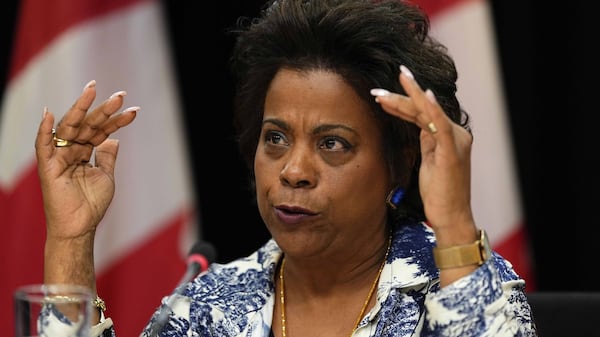
More than half of Quebec manufacturing companies have had to cut their margins as a result of trade tensions between Canada and the United States, according to a survey conducted by Manufacturiers et Exportateurs du Québec (MEQ). The survey of the organization’s members shows that 56 per cent of Quebec manufacturers have experienced a “moderate to significant” contraction in their margins. Of these, half said they could hold out for a year at most before having to take other measures, such as layoffs or postponing investment. “This pressure is real,” said MEQ president and CEO Julie White. In a similar proportion, 51 per cent of respondents had observed a “moderate or significant” increase in their production costs. The situation varies from company to company, but some have been financially affected by the U.S. tariffs or by Canada’s response. Other companies have seen their American customers wait longer before granting or renewing an order. “It plays on companies’ liquidity,” said White. “U.S. tariffs are not the main problem for manufacturers. They are more concerned about economic uncertainty,” said White. In fact, 50 per cent of Quebec manufacturers say that the Trump administration’s policies have changed nothing in their relations with their American customers. In fact, 20 per cent of respondents said it had improved their company’s situation with customers in the United States, while a further 20 per cent said it had worsened. “It’s really more a question of slowing investment and revising business plans that’s hurting at the moment,” White said. The sector has already seen job losses, but the situation could be more critical in the medium term, if economic uncertainty continues. In fact, 17 per cent of companies have reported job losses in their organizations. A further 58 per cent are considering this difficult decision if the headwinds continue. Manufacturers will think twice before laying off staff. Despite the economic slowdown, the labour shortage remains an issue. “No one wants to have to relive the labour shortage of recent years,” insisted the head of the MEQ. White said she was pleased to see her members “in action mode” and looking for solutions to prosper in this more volatile environment. Among the solutions being considered by companies, the most popular was the reorganization of the supply chain, identified by 60 per cent of respondents. Market diversification in Canada came second at 59 per cent. This was followed by diversification into international markets at 47 per cent. Greater automation or robotisation is envisaged by 32 per cent. The U.S. market remains a must for many companies, but there seems to be a greater appetite for international diversification, White noted. “It varies a lot depending on the product we make.” She gave the example of aircraft parts, which can take five to seven years to be approved in another country. “There are a lot of rules surrounding certain products, so it’s harder to look elsewhere,” White said. “People also tell me that we will never replace the American market,” she added. “If we diversify, it’s not to replace an entire market, it’s more to keep our heads above water.” This report by The Canadian Press was first published in French on May 16, 2025.