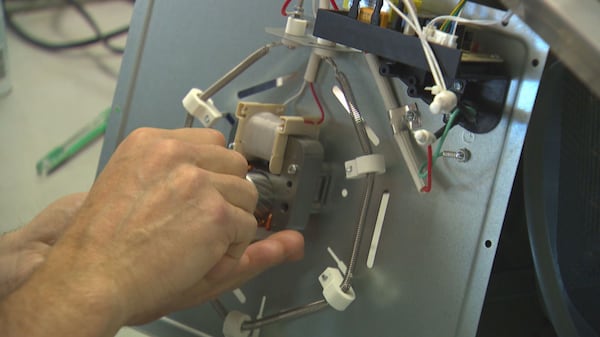
CAMPBELLVILLE, Ont. -- Inside the basement of a small church in the community of Campbellville, Ont., a large display of electronics is splayed out on several tables on Saturday. They’re all broken or defected in some way: a food processor with a faulty cable, a blender that makes a loud noise, a lamp that flickers even after the light bulb is replaced. All of these partially broken items are seen as a challenge for Mike Druiven, who takes pride in being able to fix most of the electronics and household items that get brought to him. “I enjoy working on things and giving some value back to people,” he told CTV News on Saturday. “It’s surprising sometimes when you have an old lamp; for people, it could be a family heirloom and they just love it when it works again.” Saturday’s event is what’s called a “repair cafe,” an idea brought forward in the Netherlands in 2009 and now held in thousands of communities around the world where volunteers offer to fix household items for free to save them from ending up in the landfill. Canada’s electrical and electronic waste more than tripled per person between 2000 and 2020, according to a University of Waterloo study published in 2023. Researchers estimated that annual waste generation climbed from 8.3 kilograms to 25.3 kilograms per person, reaching nearly one million tonnes nationwide in 2020. Statistics Canada found that 16 per cent of Canadian households had unwanted small appliances to dispose of in 2023. Easier to replace than repair Part of the reason why more household items, especially electronics, are being toss into the landfill is because it’s never been easier to order a new replacement, says tech analyst Carmi Levy. “It’s incredibly easy if your device fails and you can’t get it repaired... to just go online, order a new one and it shows up at your door the next morning, absolute zero friction,” he said. But Myra Hird, a professor at Queen’s University’s School of Environmental Studies who studies waste management, says companies are also now making it difficult to get products repaired. “Companies came to the conclusion that if if they made if they continued to make products that were very, very durable and lasted a long time, they would make less of a profit. You make more profit if you sell more,” she told CTV News via Zoom on Saturday. “Companies have designed products to either break down quickly, so that their parts are very difficult to get and they don’t provide the instruction manuals and they make the products themselves,” she added. “The products themselves become difficult or impossible to repair because you can’t really access them.” Levy says tech products have also changed in a way where they’re not easy to open up to tinker with, or the parts aren’t accessible. “Things aren’t designed to be repaired anymore. They’re not designed to be opened up by their owners, by users. They’re not designed to be accessible, manufactures don’t encourage that,” added Levy. A return to repair The European Union has introduced repairability requirements for certain appliances and electronics, including access to spare parts, and rules prohibiting manufacturers from unjustifiably blocking repairs through hardware, software or contracts. Canada passed two narrower laws in November 2024: Bill C-244 allows digital locks to be bypassed for diagnosis, maintenance and repair, while Bill C-294 expands exceptions allowing devices and components to work together. Neither requires all products to be repairable. A separate bill, C-267, proposing a national framework for durability and repairability, remains before a House of Commons committee. “We’re behind Europe in this, but we’re we’re certainly on that path,” said Hird. “Regulation is really critical here because the evidence is that companies don’t typically do this on their own. They need regulatory incitement to do these things.”A December 2025 report from Waste to Resource Ontario projects the province could exhaust its existing approved landfill capacity by 2037 if current waste exports to the United States continue. If those exports were stopped, that timeline could move up to 2034.