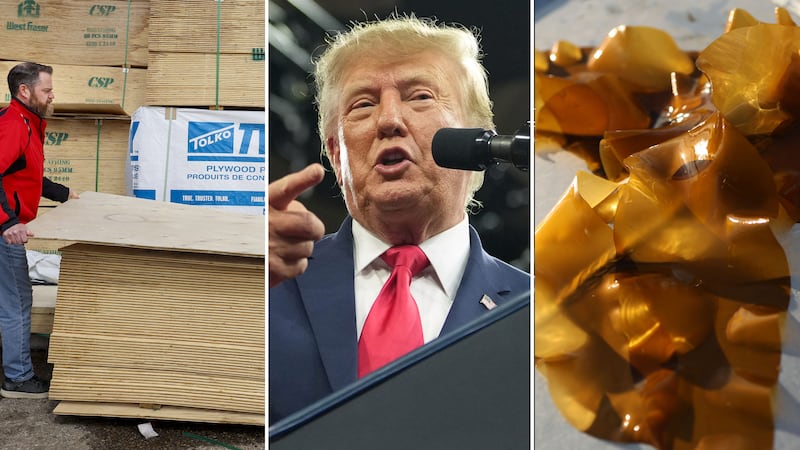
Quebec Finance Minister Eric Girard is admitting that the economic situation will likely be bleaker than the picture painted by last week’s pre-election report. The resurgence of trade tensions between Canada and the United States is casting another cloud over the economic outlook. “It’s certainly true that when you’re forecasting 0.7 per cent growth and there’s a new shock, the possibility of an economic slowdown is very real,” the minister said during a press conference on Thursday in Quebec City, ahead of the last cabinet meeting before the election campaign kicks off. Is Quebec heading toward a recession? “Not at all, because the recession scenario is based on a complete withdrawal by the United States from the Canada–United States–Mexico agreement,” said Girard. “So we’re not there yet.” Negotiations between Ottawa and Washington stalled a few days after the pre-election report was released. For the major political parties, this document provides useful information for establishing their fiscal frameworks. In its baseline scenario, the ministry projected economic growth of 0.7 per cent in 2026 and 1.4 per cent in 2027. Its pessimistic scenario forecasts a decline in real GDP of 0.2 per cent and two per cent in 2026 and 2027, respectively. The minister believes the current context would place the forecast somewhere between the baseline and pessimistic scenarios. “We’re in a slowdown, somewhere in between,” he said. Conversely, he said that there is “enormous potential” for the Quebec economy to pick up speed if relations between Canada and the United States improve. Sébastien McMahon, economist and chief strategist at iA Financial Group, also mentioned a scenario of very low growth during an interview this week. “What we’re seeing is a kind of stagnation with an economy that’s transforming—an economy that will continue to transform for a little while longer,” he said. An even tighter fiscal framework The uncertainty comes as public finances leave little room for political parties to make costly promises while complying with the Balanced Budget Act. Even before the trade war called the Department of Finance’s baseline scenario into question, Auditor General Christine Roy said nearly 70 per cent of the fiscal efforts needed would fall to the next government, during a press conference on the pre-election report earlier this month. Budgetary efforts totalling $2 billion will be needed as early as next year. The following year, the fiscal framework calls for a $3 billion restriction, in addition to a $1.85 billion shortfall that has not yet been identified. Roy also warned that upcoming decisions could impact public services and investments in aging infrastructure. Luc Godbout, director of the Chair in Taxation and Public Finance at the University of Sherbrooke, warned in a recent interview that political parties will have to take Quebec’s budget situation into account in their election platforms. “(The most recent overview of public finances) leaves no room for maneuver to make costly financial commitments,” he said. “If political parties want to adhere to the plan to return to a balanced budget, every financial commitment that results in a shortfall for the government should be accompanied by (measures to) finance that new commitment.” Girard didn’t answer directly when asked whether he would need to review the financial framework that the Coalition Avenir Québec (CAQ) will present to voters during the campaign. “We must be cautious and responsible,” he said. “It’s clear that we need to take the right steps, and the premier and I are in constant discussion, and things are going very well.” This report by The Canadian Press was first published in French on Aug. 27, 2026.