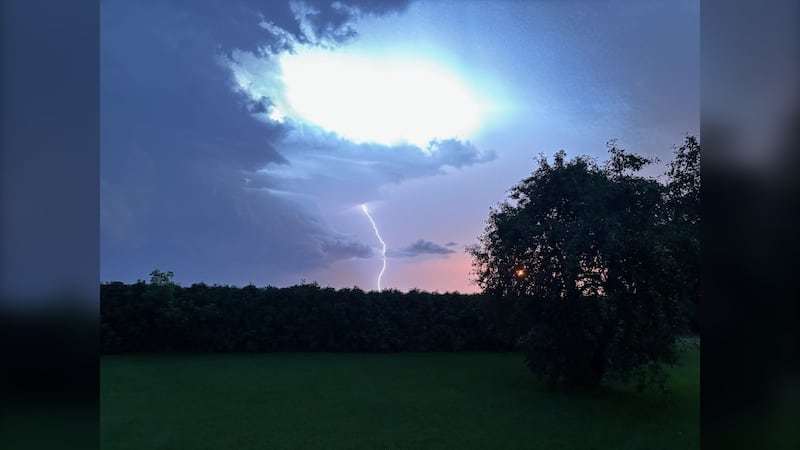
A meteorite flew over Montreal Wednesday night before landing in the Eastern Townships, Space for Life confirmed to Noovo Info. The group explains that cameras from three DOMe (Detection and Observation of Meteors) stations captured the meteorite as it blasted through the sky. According to Space for Life, the piece most likely weighed several hundred grams and probably fell in or near the Lac Brome area – depending on the accuracy of the scientists’ calculations and analysis. Last June, a meteorite was spotted soaring over much of the province before crashing in the Saint-Wenceslas area of Quebec’s Mauricie region. Last March, another object was seen flying above the Centre-du-Québec area. “There is no increase in meteorite falls at this time,” said Chantal Côté, communications officer with Space for Life. “Approximately 200 to 400 meteorites weighing 10 g or more fall to Earth each year, along with more than 15,000 micro-meteorites.” The last meteorite fall that was found and recorded in Quebec was in June 1994, remembered as the Saint-Robert meteorite. It plunged into the Earth’s atmosphere, causing quite a stir as it flew past the Montreal and Montérégie areas, according to Space for Life. What is a meteorite? According to Space for Life, meteorites are fragments of asteroids, the moon, or even Mars, “that were blasted off the surface during an impact.” “What we observe when we see this kind of phenomenon is the re-entry into the atmosphere of a fragment of an asteroid or a piece of rock that is more or less metallic,” explained Auriane Egal, a specialist in the observation and modelling of meteor showers. When a meteoroid (which becomes a meteorite when it lands on Earth) enters the planet’s atmosphere, its high-speed friction with the air causes its surface to heat up — sometimes to over 2,000 degrees Celsius. “This intense heat causes the meteoroid to burn, vaporize and create a bright streak of light in the sky known as a meteor,” Space for Life explains. A meteorite can be identified by looking at its fusion crust (usually smooth and shiny with a glassy appearance) and observing the presence of iron, nickel and chondrules, as well as the absence of internal cavities (or bubbles). “You can see that there is a really smooth black layer around the rock with an interior that will be different from the exterior shape,” Egal said.