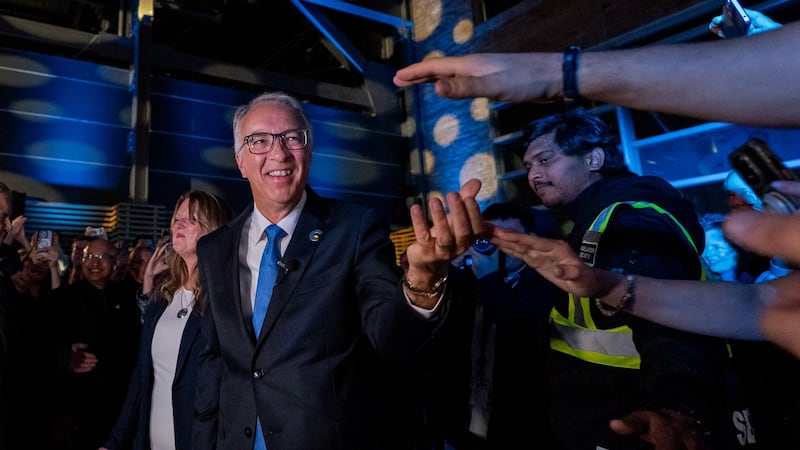
Former Quebec premier François Legault is trying clarify the reasoning behind the risks his government took in investing in the battery sector, in response to a scathing report by the Auditor General of Quebec. In a long message posted to social media, the former premier insisted that Quebecers should “carefully read certain comments” from Investissement Québec and the Ministry of Economy on the subject. This comes after a report by the Auditor General accused the provincial government of showing poor planning when it came to $2.2 billion worth of investments in various battery companies — many of which are now experiencing financial troubles. The report released Wednesday by Quebec’s Auditor General Christine Roy found that the investments by the Coalition Avenir Québec (CAQ) government lacked clear objectives and timelines. “This initiative is based on a poorly planned approach,” Roy wrote. “Indeed, certain essential elements, such as objectives and timelines, which would have helped to achieve results, were omitted.” Roy’s office analyzed 29 files related to 11 companies in the battery sector, representing approximately $2.2 billion in authorized financial assistance as of Sept. 30, 2025. About $1.9 billion of that money had been disbursed as of that time. The risks associated with the different projects were “not adequately analyzed or documented,” Roy wrote. “However, in most cases, these were significant risks.” In its 2025-2026 report, the Auditor General noted that “The development of the battery industry in Quebec took place within a context of international competition aimed at attracting companies in this sector.” It went on to say that this type of innovation often requires “certain risks.” “Effective risk management is necessary, particularly to ensure sound management of the public funds used — and thus limit losses — but also to ensure that the financial assistance granted helps achieve the government’s goal of making Quebec a world leader in the electrification of transportation,” it stated. However, the auditor noted that four of the 11 companies that received funding have filed for creditor protection, while two others have suspended or abandoned their projects. Three more have had their costs increase significantly. The companies analyzed include electric vehicle-maker Lion Electric and battery manufacturer Northvolt, whose parent company in Sweden went bankrupt in March 2025. In his response, Legault insisted that his government shared the risks with “other investors.” “Losses resulting from these same investments total $375.2 million, or approximately 14.6 per cent of the amount authorized to date, and 95 per cent of these losses are related to two specific cases [Lion Electric and Northvolt],” he quoted, adding that the main risk to the projects was “external.” He pointed to comments by Investissement Québec and the Ministry of Economy regarding volatile global geopolitics and economics that created “a climate of global uncertainty that hindered investment,” including the inauguration of Donald Trump as president of the United States in 2025, which “led to the rapid withdrawal of both support for electric vehicle demand (purchase rebates) and support for the production of electric vehicles and batteries.” He argued that according to the International Energy Agency, the global lithium-ion battery market grew by 600 per cent between 2020 and 2025. “The government never acts alone in an economic project and always strives to maintain a minority stake,” he insisted. “This constitutes the most significant risk mitigation measure in any investment case.” Roy has estimated that losses could continue to rise, depending on “how the situation evolves for each of these companies.” With files from The Canadian Press.