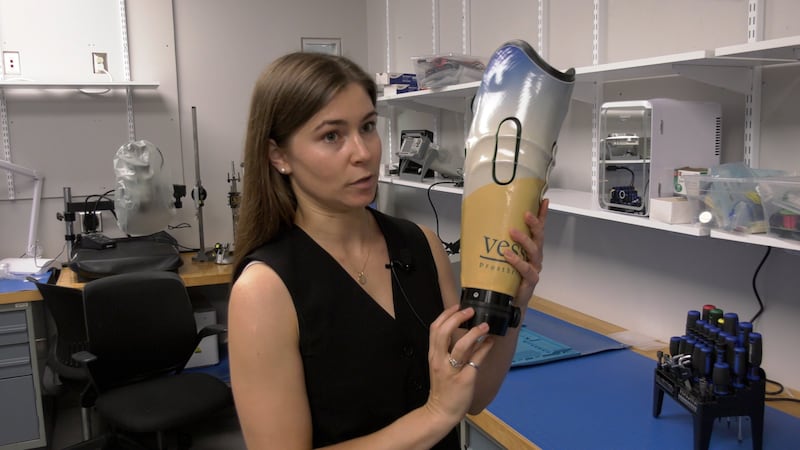
A London-based medtech startup, Vessl Prosthetics, is poised to significantly improve the lives of amputees worldwide with its groundbreaking Kinn Automatic Volume Management System. Having recently secured registration as a Class 1 medical device with the U.S. Food and Drug Administration (FDA), the company is set to expand its innovative prosthetic socket technology across North America and beyond. Vessl leadership said the need for such an advancement is stark, noting that every 30 seconds, a leg is amputated worldwide. Despite decades of innovation in prosthetics, amputees continue to grapple with a fundamental challenge: The ever-changing volume of their residual limb. This fluctuation, which can range up to 13 per cent throughout a single day due to factors like activity, temperature, and fluid changes, leads to poor socket fit. Traditional methods, often relying on prosthetic socks or manual adjustments, can leave users in discomfort, risking painful blisters, infections, and even further complications. “The rubbing from the misfit can lead to blisters that get infected, lead to hospitalization, and sometimes even another amputation,” explained Sydney Robinson, CEO and Co-Founder of Vessl Prosthetics. Vessl Prosthetics, founded four years ago by Western University graduates Sydney Robinson and Oleksiy Zaika through the Western Medical Innovation Fellowship, has developed a solution embedded directly into the prosthetic socket. The Kinn System automatically adapts to limb volume changes in real-time. Robinson describes how the Kinn System uses walking to modify the fit saying the device, “Absorbs shock from that walking motion, which automatically turns this dial and pulls on the cable to tighten the panels against the leg.” This seamless adaptation ensures a more consistent, comfortable, and secure fit, reducing the need for frequent manual adjustments and mitigating the risks associated with ill-fitting sockets. The recent FDA registration marks a pivotal moment for Vessl, officially classifying the Kinn System as a low-risk medical device and paving the way for broader distribution in the U.S. The company anticipates similar registration from Health Canada soon and plans to apply for European registration within the next year. The journey has not been without its complexities. CTO Oleksiy Zaika admitted. “It’s definitely a difficult process. Doing hardware and doing medical hardware is incredibly complex.” However, the team, which has grown from three to nine members with substantial expansion planned, has leveraged the expertise available at Western University, where they are headquartered at the Discovery Park. This facility allows for small-scale production, with plans now underway to secure a larger space in London to scale manufacturing. The growing need for improved prosthetic solutions is significant, with an estimated 185,000 new amputations occurring annually in North America. Diabetes remains a leading cause of leg amputation, compounded by an increase in traumatic amputations globally. “Getting the regulatory approvals takes us into those markets. It really is that one barrier standing between us and sales, us and helping the patients that we intended to help,” Robinson emphasized. An article on the London Economic Development Corporation (LEDC) website heralded the continued growth of Vessl Prosthetics. Larry MacKinnon, Director of Business Development at London Economic Development Corporation (LEDC), is quoted saying, “Vessl’s emergence and growth confirm London’s life sciences ecosystem can support medical innovations and talented entrepreneurs.” Robinson said the Vessl team continues to collaborate closely with patients, prosthetists, and physical therapists to further refine the Kinn System.